
Driveway Paving in Bedford, MA
If you’re looking at a Bedford driveway that’s heaved, alligatored, or gone soft at the edges, you already know patching isn’t going to fix it. The same is true if you’re standing on bare ground at a new build, trying to figure out who to call before anything gets poured. Either way, the decision comes down to who actually looks at the ground before they talk price.
When you call, we come look at the site before we say much of anything. On a Bedford lot that usually means a flat or gently sloped frontage, a wide approach, and enough room to stage a paver and a roller without a complicated turn. That’s good news for access, but it doesn’t tell us anything about what’s under the surface, which is the part that actually determines whether the new driveway lasts or fails the same way the old one did.
What we measure and why it changes the scope
We measure square footage, obviously, but we’re also checking grade – which way water wants to run, and whether the existing surface is helping it along or fighting it. We dig a test spot or two to see what’s actually there: gravel base, old pavement built on top of older pavement, or just soil. Mid-century capes and colonials in Bedford often have driveways that were built up in layers over decades rather than excavated and based properly once. That history matters more than the square footage does.
The base is what decides everything else. Asphalt is a surface, not a structure. It flexes with what’s underneath it. If there’s compacted gravel that drains, the surface can take New England’s freeze-thaw cycles for a long time. If the base is thin, contaminated with loam, or sitting over soil that holds water, the pavement will crack and heave no matter how well it’s laid on top. This is where a resurfacing outfit and a real paving contractor part ways – one looks at the top inch, the other looks at what’s six or eight inches down.
Drainage gets its own look, separate from grade. Bedford’s mix of older subdivisions and newer construction means some lots were graded well from the start and others have been fighting runoff for years, with water pooling at the garage apron or cutting a channel along one edge of the pavement every spring. A driveway that ignores where that water goes will fail at the low point first, no matter how thick the asphalt is. So part of the site visit is figuring out whether we need a swale, a trench drain, or simply a different pitch across the pad before any base goes in.


What Our Clients Say
Full Replacement or Overlay
Not every failed-looking driveway in Bedford needs full excavation. If the base underneath is sound – compacted, well-drained, no major cracking through to the subgrade – an overlay can work and costs less than tearing everything out. But an overlay on a failed base just hides the problem for a season or two before the same cracks telegraph straight back through the new surface, often faster than before.
What Drives the Price
Square footage is the starting point, not the answer. Depth of excavation and how much old material has to be hauled out matter more on a driveway that's been built up over the years, which is common on Bedford's older lots. Access for trucks and equipment plays a role too — a tight approach or a steep grade can add time that a wide-open lot never needs. Drainage is another factor: where water needs to go, whether a swale or catch basin has to be tied in, and how the grade sheds runoff away from the garage and foundation. The condition of the apron where it meets the road, and whether the town requires work there, also affects the scope. Base material and thickness matter as much as surface material once you're past the quote stage.
Scheduling Around New England Weather
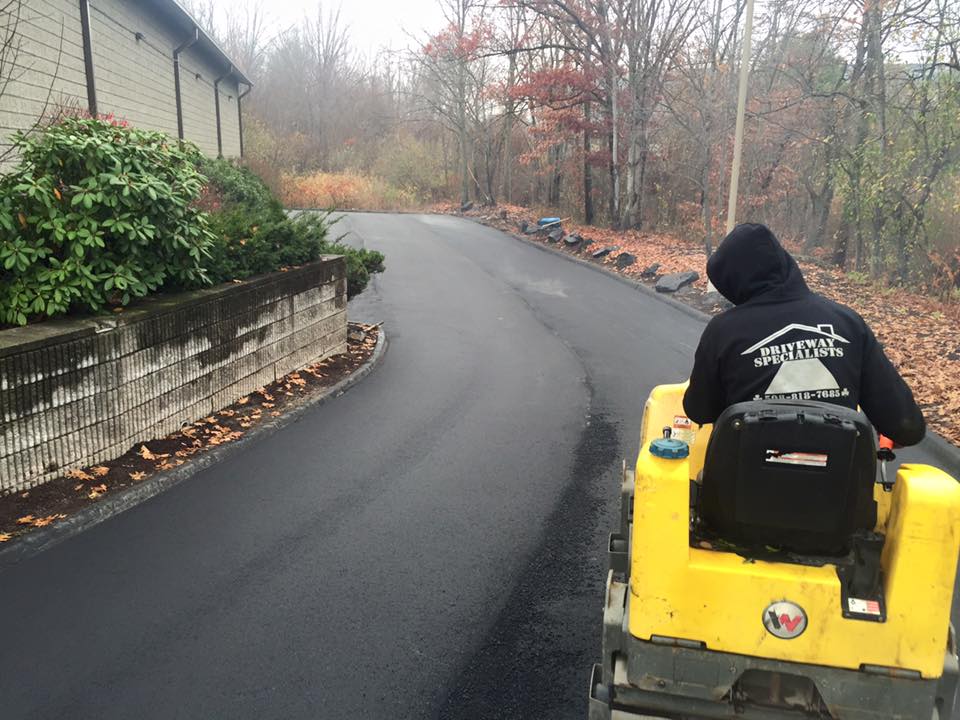
Paving is seasonal here. Asphalt needs warm ground, dry conditions, and enough sustained temperature for the material to compact and cure properly, which narrows the workable calendar in Bedford to roughly spring through fall. Spring jobs often wait on ground conditions after frost, while early fall slots fill fast as homeowners rush to get driveways done before the window closes. That means booking ahead matters, especially if you’re aiming for a specific date before the weather turns. We’ll give you a realistic timeline once we’ve scoped the job and checked the forecast, rather than a date that just sounds good on the phone.
What drives the price
Several things set the cost of a driveway, and each one is visible only on site.
- Square footage : The area to be paved, plus any widening, turnaround or parking pad you want added.
- Depth of excavation : How far down the old material has to come out, and how much of the base has to be rebuilt.
- Material removed : The old asphalt has to be hauled away, and the amount depends on what is there.
- Access: A paver, a roller and delivery trucks all need to get in and turn around. Tight Bedford frontages can limit what equipment fits, which changes how the work is staged.
- Grade: A steep drive is harder to prepare, harder to compact and harder to drain correctly.
- Drainage: If water needs to be moved off the drive and away from the house, that work is part of the job.
- The apron: On many Bedford lots the apron meets the sidewalk with very little room between the street and the house. How that transition is built affects both the drive and the walk, and we look at it closely.
Anyone who gives you a firm figure without having stood on your driveway is guessing. When the guess is wrong, the extra cost shows up later as shortcuts in the base.
A new driveway is a structural job before it’s a cosmetic one. The surface is the part you see; the base is the part that decides whether you’re doing this again in a few years or not.
We’ve been doing this work across Middlesex and Norfolk counties since 1988, family-run the whole way, which means we’ve seen how Bedford lots behave through enough winters to know what holds up and what doesn’t.
Next Step
If your Bedford driveway is cracking, heaving, or just not there yet, the next step is a site visit, not a phone quote. Call Driveway Specialists at (413) 337-3772 and we’ll come look at the ground before we talk numbers.
FAQs
Can my Bedford driveway be repaved without full excavation?
Sometimes. If the existing base is compacted and drains well, with no major structural cracking, an overlay can work. We check this on site rather than assuming either way.
Why won't you give a price over the phone?
Because depth of excavation, access, grade, drainage and apron condition all change the cost, and none of those are visible without walking the site.
How soon can paving happen in Bedford?
It depends on the season and how far out we're booked. Asphalt needs workable ground and proper curing conditions, so scheduling ahead is worth doing.
What should I do after the new driveway is installed?
Keep vehicles off it for the period we specify, move cars to an alternate spot during the work, and expect the surface to firm up fully over its first season.
Call us
If your Bedford driveway has reached the end of its life, or you are putting one in for the first time, call (413) 337-3772. We will arrange a time to see the site, measure it, and tell you what it needs.