
Asphalt Repair in Wellesley, MA
You’re standing at the top of the drive looking at it again: a pothole that’s gone from annoying to deep, a patch of cracks spreading like a spiderweb near the apron, or a dip by the garage door that fills with water every time it rains. On a property like most in Wellesley, where the drive is as much a part of the first impression as the landscaping, that kind of damage doesn’t sit well. The question isn’t whether it looks bad. It’s whether it can be fixed, or whether you’re looking at the start of something bigger.
That’s what this page is for. Not a pitch for a new driveway, but a straight answer on what’s actually happening under that crack or that sunken spot, and what it takes to put it right.
Reading the damage correctly
Different failures mean different things, and knowing which one you’re looking at changes the whole conversation about repair. Hairline cracking across a wide area usually means the surface is aging and drying out, but the base underneath is still doing its job. A sealcoat and crack fill at this stage can buy real time. Alligator cracking, the patch that looks like reptile skin, means the base has already failed in that spot and flexed under load until the asphalt gave up; surface patching over this just hides the problem for a season. Edge failure, where the border of the drive is crumbling or breaking away, is almost always a drainage and support issue at the perimeter, often made worse by plow trucks or heavy mowers riding the edge. Sinking or heaving, especially near a garage apron, points to something going on underneath, whether that’s water movement, settlement, or a root working its way through.
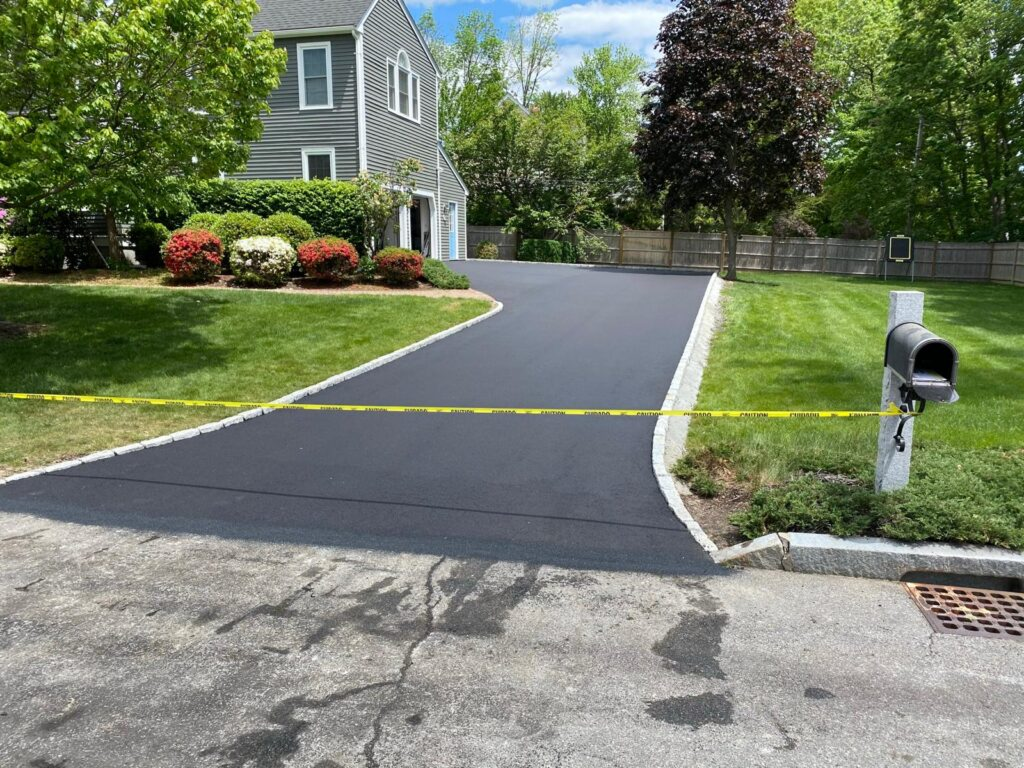
On the large, well-kept lots common in Wellesley, these problems often show up around ornamental features, like a curved section near a stone border or a planting bed, where roots have had room to grow and drainage has been altered by landscaping over the years. Long driveways with mature trees lining the approach are especially prone to root heave a few years after planting, and older homes with original asphalt laid decades ago often show base failure that newer surface treatments can’t fully mask. Winter is usually the forcing event: water gets into a crack, freezes, expands, and turns a cosmetic issue into a structural one almost overnight.


What Our Clients Say

How to read the damage
Asphalt rarely fails for the reason it appears to. The surface shows a symptom, and the cause is usually underneath.
Infrared patching
Infrared patching reheats the existing asphalt in place and fuses it with new material, leaving a seamless, well-bonded repair without cold joints.
Saw-cut and replace
For damage that goes deeper than the surface, we saw-cut a clean rectangle around the failed area, remove it, and rebuild the base before repaving.
Crack filling
Crack filling seals hairline and surface cracks before water gets underneath and freezes, a real risk through Wellesley winters.
Edge rebuilding
Edges crumble where there's no support behind them, often along planting beds or stone borders common on Wellesley lots.
Regrading sunken sections
A sunken spot by a garage or walkway in Wellesley usually means the gravel base settled or washed out below.
Why it failed in the first place
Wellesley’s larger, established lots often combine a few things that work against pavement over time. Mature trees along the drive mean roots pushing up from underneath, plus a shaded surface that stays damp longer after rain or snowmelt. Ornamental curves and borders mean more edges, and every edge is a place where water can get in if it isn’t backed by a solid base.
Then there’s the freeze-thaw cycle every New England driveway deals with. Water that gets into a crack or under an edge in the fall sits there through the winter. When it freezes, it expands, turning a hairline crack into a wide one, or an edge that was holding into one that’s crumbling by March. It’s the single biggest driver of repair calls we get every spring, and it’s rarely about the asphalt failing on its own. It’s about what’s getting underneath it.
On lots where the house has gone through a teardown-rebuild, heavy equipment traffic during construction can also stress a drive that wasn’t built to carry that load, showing up as cracking or sinking well after the project wrapped.

What the repairs are
Timing matters more than people think
A crack you fill this fall costs far less than the saw-cut repair it becomes after one more Wellesley winter of water getting underneath it.
What a winter left unattended looks like
Left alone, water in a crack freezes, expands, and widens it. By spring a hairline has become a structural crack, and what was once a small patch job has become a saw-cut repair across your Wellesley driveway.
Matching repair to the surface
Infrared patching blends into existing asphalt almost invisibly, which matters on Wellesley drives with high finish expectations. Saw-cut repairs are more visible but necessary where the base has failed, giving a durable fix that outlasts a simple surface patch.
What we look at first
Before recommending anything, we check the base condition, not just the surface crack. A sound base under a cracked surface means a very different repair than a failed base underneath—common with Wellesley’s older driveways and seasonal freeze-thaw cycles.
Getting it looked at
Standing over a pothole or a spidered patch in your Wellesley driveway? The quickest way to know what's really going on is to have it looked at directly.
Why drives fail in Wellesley
Wellesley's ground is unforgiving in a few specific ways.
Steep hillside lots mean water arrives with speed. A sloped drive carries runoff downhill, and where that water meets a low corner, a garage door or the seam of an old patch, it goes down instead of away. Over years that washes out fine material from under the asphalt and leaves the hollows that later sink. On a hillside, drainage decides how long the work lasts.
Shared drives on two-family properties take more traffic than a single-family drive was built for. More vehicles, more turning, more weight on the same few feet. That is exactly where alligator cracking appears first, and where edges break down from vehicles clipping the sides.
Tight frontages put the apron directly against the sidewalk. Plows and shoveling push snow and meltwater straight onto that strip, and the edge there takes constant punishment. It is also the part of the drive most likely to involve the town, so if the damage reaches the apron or the sidewalk line, we will tell you before work begins what is yours to fix and what isn't.
And in every case, frost is the engine behind it. Water enters a small crack, freezes, expands and pries the crack wider. It thaws and drains into the opening, and the cycle repeats all winter. A hairline crack in October can be a pothole by March.

Why timing matters
A crack that is filled this fall is a small job. The same crack left through a winter lets water into the base, and the cost of the repair rises with every freeze. A pothole gets larger as vehicles break its edges away. An edge failure keeps retreating.
Spring is when the damage that has been hiding becomes obvious, and when everyone calls at once. The cheapest repairs happen before that, while the problem is still the size of a hand.
Asphalt repair questions in Wellesley
Can a cracked driveway in Wellesley be repaired instead of replaced?
Often, yes. If the base underneath is still sound, cracks and small failed sections can usually be patched or rebuilt without tearing out the whole driveway. We check the base first before recommending either approach.
What's the difference between alligator cracking and hairline cracking?
Hairline cracks are surface-level and usually mean the asphalt is aging while the base is still intact. Alligator cracking, which looks like reptile skin, means the base underneath has already failed in that area and needs to be rebuilt, not just patched.
Why does the edge of my driveway keep crumbling?
Edges fail when there's no compacted base supporting them, which is common along planting beds and ornamental borders. Water gets in, freezes over winter, and breaks the edge apart further each year until it's rebuilt properly.
How soon should I deal with a small crack or pothole?
Before winter if possible. Water that sits in a small crack and freezes will widen it, turning a simple crack-fill job into a larger saw-cut repair by spring.
Will tree roots keep damaging the repair after it's fixed?
If a root caused the heaving, it's worth addressing the root or adjusting the repair area to account for it, otherwise the same section can shift again. We'll flag this during the assessment if it looks like a factor.
Next step
Call us at (413) 337-3772. Tell us what you are looking at and where on the drive it is. We will come out, look at the damage and the ground around it, and tell you honestly whether it can be repaired and what that involves.