
Cobblestone Aprons and Edging in Hudson, MA
Hudson has two different kinds of driveway problem to solve, often a few streets apart. Near the old mill blocks, lots are narrow and the drive sits close to the house, so the apron has to do its job in a small footprint without making the entry feel cramped. Out toward the newer subdivisions, frontages are wider and the apron has more room to make a real visual statement where it meets the street. Either way, the question is the same: how do you finish the transition between road and drive so it looks intentional and survives a Massachusetts winter.
Cobblestone aprons and edging are not a repair. They are a property improvement, usually done alongside a driveway replacement or on their own to upgrade an asphalt drive that is otherwise sound. The work is as much about how the stone ages and how it ties into the rest of the property as it is about cost, so it is worth understanding what actually happens below the surface before comparing materials.
What’s really under the stone
A cobblestone apron that stays flat for years and one that heaves and gaps within a couple of winters are built the same way on top and differently underneath. The visible stone is the last four inches of a system that starts with excavation deep enough to get below the organic topsoil, a compacted aggregate base, a bedding layer the individual stones sit in, and an edge restraint that keeps the whole assembly from creeping outward. Skip or shortcut any one of those layers and the stone itself does not matter.
Frost is the reason the base matters so much here. Massachusetts ground freezes and thaws repeatedly over a winter, and water trapped under a hardscape surface expands every time it freezes. An open-graded base lets that water drain through instead of lifting the stone above it. A shallow base over clay, or one that was never compacted properly, holds water, and that’s what you see as individual stones working loose or whole sections rising unevenly by spring.
Edge restraint is the other half of the equation, and it’s the part that fails first if it’s cut. Without a buried concrete or aggregate edge holding the perimeter, the outer row of cobbles has nothing to push against. Plow blades catching an unprotected edge in winter will walk stones out of line within a season or two. Edging that’s properly set below grade survives plow contact because the blade rides over it rather than catching it.


What Our Clients Say

What the work involves below the surface
The stone is the last and smallest part of the job. A cobblestone apron stays flat or goes wavy depending on what is underneath it.
Granite cobbles hold their edge and color for decades but cost the most up front. Reclaimed cobbles bring real age and character immediately, at a price reflecting their history.
Concrete pavers shaped like cobblestone cost less and install faster, but color fades with UV exposure over the years in a way natural stone does not.
Repairability separates these materials more than looks do. A granite cobble can be lifted, reset, and reused indefinitely, which matters through Hudson's freeze-thaw winters.
Grade decides where water goes the moment you add a hard apron. Pitch that carries runoff away from the garage and foundation has to be built in, not assumed.
Matching an existing entry matters in Hudson's older neighborhoods.
Materials and the trade-offs
Materials and real trade-offs
Natural granite cobblestone is the most durable option and the one that ages best, developing a worn, settled look rather than a deteriorated one. It costs more than manufactured alternatives and takes longer to install because each stone is set and leveled individually, but a granite apron laid correctly outlasts the asphalt it borders.
Reclaimed cobblestone, where available, brings genuine age to a property immediately rather than over decades. It suits older Hudson homes near the center particularly well, since the stone often predates the house it’s being installed at. Supply is inconsistent and sizing is less uniform, which affects install time.
Concrete cobble pavers are the budget option and the fastest to install, with far more uniform sizing that speeds up bedding and setting. The trade-off shows up over time: the surface color fades with sun exposure in a way natural stone doesn’t, and once a batch is discontinued, replacing a damaged section can mean a visible mismatch.


Grade, drainage, and tying into what's there
Any hard surface change is a drainage change. An apron that doesn’t pitch away from the garage door or the house foundation collects runoff right where you don’t want it, and cobblestone, being a jointed surface rather than a sealed one, actually needs the grade to do more of that work than asphalt does, since water passes between units as well as across them. A proper base and edge restraint keep that water moving instead of pooling and undermining joints over a few freeze-thaw cycles.
Tying the new work into the existing drive, entry walk, and any retaining walls or planting beds already on the property is where the real design decisions live. Stone that doesn’t match the house’s era or the drive’s existing finish looks bolted on rather than built in. On older Hudson properties near the mill district, that usually means choosing a stone, joint width, and pattern that reads as original rather than modern. On newer subdivision lots, there’s more freedom to set a style that simply looks deliberate and well-proportioned against a wider frontage, while still respecting existing grades and drainage paths.
Where this suits Hudson properties
Cobblestone aprons and edging suit a wide range of Hudson properties, from historic homes near the town center to newer builds along quieter residential streets. An apron at the base of your driveway creates a defined transition where asphalt or concrete meets the street, adding a finished look while helping to contain loose material and control water runoff during Hudson’s wetter months. Edging along the sides of a driveway serves a similar purpose, holding gravel or pavers in place and keeping lawns and garden beds from encroaching over time.
Many Hudson homeowners choose cobblestone for its durability and classic appearance, which pairs well with brick facades, stone walkways, and traditional landscaping common throughout the area. It also holds up well through freeze-thaw cycles typical of the region’s seasonal changes.
This service works particularly well for:
- Driveways with plain asphalt that needs visual definition
- Properties with curved or sloped driveways prone to erosion
- Homes aiming for added curb appeal before a sale or renovation
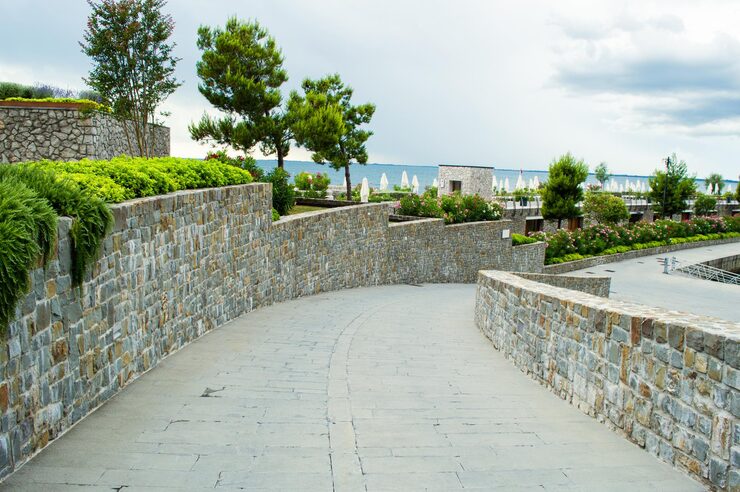
Where this suits Hudson properties
Mill-era narrow drives
Compact lots near the old mill neighborhoods often have a single narrow drive with no real margin for error. A tight cobble apron defines the edge cleanly without eating into usable width.
Wider subdivision frontage
Newer Hudson subdivisions outside the center give more room to work with. A fuller apron and edging treatment can carry across a longer frontage without looking like an afterthought.
Older homes near the center
Houses built close to the street benefit from stone that reads as established rather than new. Edging ties a plain asphalt drive into a property that already has real age and character.
So tar and chip suits a longer, gentler Hudson drive with some room around it. It is a poor match for a short, steep or shared one, or one that opens straight onto the walk.
Questions we hear
Does cobblestone edging work with an existing asphalt driveway?
Yes. Most of this work is done alongside a sound asphalt drive, using the cobblestone to frame the apron and edge rather than replacing the drive surface itself.
How is a cobblestone apron different from a concrete one?
A cobblestone apron is a jointed surface built from individual units over a compacted base, which lets water pass through rather than sit on top. Concrete is a single poured slab, which handles differently in freeze-thaw and cracks rather than shifting.
Can damaged cobblestone sections be repaired without redoing the whole apron?
Natural granite cobbles can usually be lifted and reset individually, which is one of the material's real advantages. Concrete paver sections are harder to patch invisibly once the original color has faded or the product line has changed.
Does Hudson's older housing stock limit what stone will look right?
It shapes the choice more than it limits it. Reclaimed or natural granite cobble tends to suit homes near the mill-era neighborhoods, while newer subdivision lots have more room for a cleaner, more uniform stone pattern.
Next step
Call us at (413) 337-3772. Tell us about the lot, the slope and what you want the frontage to look like. We have been working in this area since 1988, and we will tell you plainly what suits your property.