
Walkway Installation in Northborough, MA
Northborough has two kinds of front yard. There are the older homes along and off the main road network, where the walk was often an afterthought poured decades ago and has been patched, re-set, or simply tolerated ever since. And there are the newer subdivisions on larger lots, where a long straight driveway leads to a front door with no proper walk at all, just a gap in the lawn where people cut across. Both situations end with the same question: what do you actually put in, and will it still look right and sit flat in five years.
A walkway is not a driveway. Nobody is parking two tons of car on it every day. But it carries its own kind of stress in Massachusetts, because it sits exposed to the same frost that heaves driveways and foundations, often on a narrower, shallower base that was never built to resist it. A four-foot-wide path has less mass holding it down and less margin for error in the base beneath it.
The part anyone looking at a finished walkway can’t see is the part that decides whether it stays flat. That means excavating below the frost-affected zone, laying a compacted gravel base that lets water drain through rather than pool under the surface, bedding the material correctly, and setting a solid edge restraint so the sides don’t creep outward over time. Skip any one of these steps and the walkway will tell you within a couple of winters, usually as a dip, a lifted paver, or a crack running straight across a poured section.
Frost is the real author of most walkway failures here. Water gets into the base, freezes, expands, and pushes the surface up unevenly. Because the ground under a path rarely freezes and thaws uniformly, different sections move by different amounts. That is why an old concrete walk ends up with a stair-step where two slabs no longer meet, and why unit pavers on a poorly built base go wavy while the border stays put. The fix isn’t a thicker slab. It’s a base that drains instead of holding water where it will freeze.
On an older Northborough property, the walkway also has to work with what’s already there: a brick or stone front step, an established foundation planting bed, maybe a low wall that’s been part of the yard for longer than the current owners. On a newer subdivision lot, the problem is usually the opposite: nothing to tie into yet, just a driveway and a door, and a path that needs to look like it belongs rather than like it was added after the fact.
Material choice matters as much as the base. Poured concrete gives a clean, uniform line that suits a more formal entry, but it shows every crack as one continuous flaw. Unit pavers flex slightly as a system, so minor settling in one spot doesn’t necessarily crack the whole run, and a damaged paver can be lifted and replaced without redoing the path. Natural stone or bluestone treads read as more established and pair well with older homes, but they cost more and demand tighter, more careful setting work to keep joints even.


What Our Clients Say
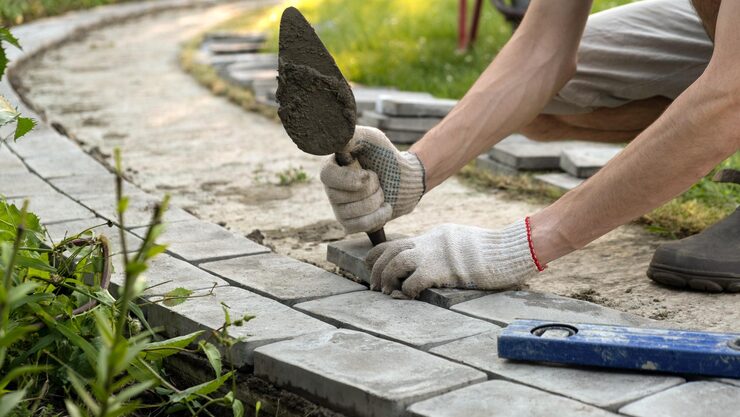
Materials: the real trade-offs
Concrete, poured as a slab or scored into sections, is the lowest-maintenance option for Northborough walkways, ageing into a plain, consistent surface. It’s the least forgiving to repair: once it cracks, patching shows, and the section usually needs full replacement.
Natural stone, laid as irregular flagging or cut pavers, suits an older Northborough colonial or farmhouse. It costs more upfront, but individual stones can be reset by hand if one shifts, no need to redo the whole path.
Concrete pavers sit in between: more consistent than stone, more repairable than poured concrete, because a single damaged unit lifts out and gets replaced without disturbing its neighbors.
Brick reads as traditional and suits Northborough’s older colonial-style homes well, but individual units are more prone to cracking under New England freeze-thaw cycles than concrete pavers, and matching aged, weathered brick later can prove surprisingly difficult.
None of these options is simply better. Each one trades upfront cost against how it ages, how easily it’s repaired, and how well it tolerates frost heave and the ground moving under it each Northborough winter.
Where the water goes
A hard, impermeable surface sheds water instead of soaking it in.
Choosing a material
The materials are not equal. Each suits some properties and not others.
On the larger subdivision lots common in newer Northborough developments, a walkway often crosses a gentle slope. Grading has to account for that cross-slope so water tracks off the path rather than running down its length.
Permeable paver systems are worth considering where drainage is tight to a house or a neighboring low spot. They let water pass through the surface into the base rather than sheeting off to one side.
Tying into what's already there
A walkway rarely stands alone. It meets the driveway at one end, the front step at the other, and often passes planting beds or a low retaining wall. Material and scale should read as deliberate, not improvised.
Matching an older Northborough house means picking a material and joint pattern that doesn’t fight the age of the building. A crisp, modern paver pattern can look out of place next to a hundred-year-old foundation.
Where the walk meets the driveway apron in a Northborough front yard, the transition needs a clean edge and matched or complementary material so the two surfaces look designed together, not patched in at different times by different crews.


Where this fits Northborough properties
Northborough’s older homes near the main roads tend to have narrower front yards and short, direct walks from sidewalk or driveway to the door. These suit natural stone or brick, where the smaller footprint keeps material cost manageable and the traditional look fits the house. Existing hardscape on these lots, a stone wall, brick step, or old granite curb, is usually worth working around rather than replacing.
The newer subdivisions, with larger lots and longer driveways, often call for a different approach. A path from driveway to front door tends to run longer and sometimes curves around landscaping or a mailbox post. Concrete pavers hold up well here, since the extra length multiplies the value of repairing a single unit rather than an entire slab. A wider, more generous path also suits the scale of these lots better than a narrow strip that looks undersized against a long drive and lawn.
What drives the price
A new walk has to meet several existing things cleanly.
- The entry : The walk must arrive at the door at a sensible height. The threshold sets the finished level, so the work starts at the door and runs outward.
- The drive : Where a walk meets a drive, the levels and the drainage have to agree. A mismatch becomes a trip edge or a puddle.
- Walls and planting : Existing stone walls, foundation beds and mature trees constrain the route. Roots under a path are worked around, not cut through without thought.
- An older house : Scale, colour and pattern should follow the architecture. A narrow, dark stone walk suits an old house differently than a broad paver field does.

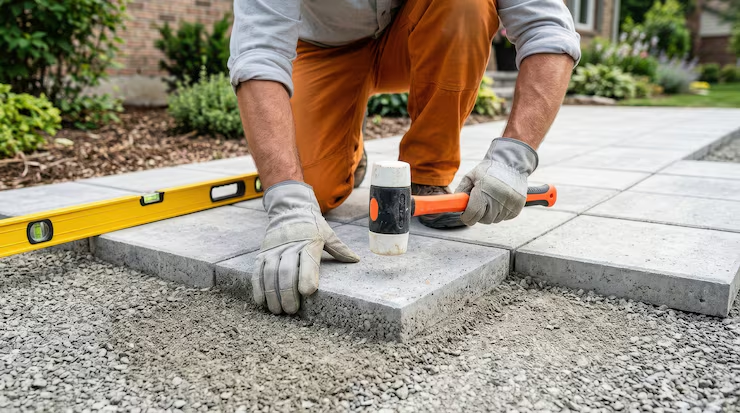
Next step
A walkway is a smaller job than a driveway, but it’s not a smaller decision; it sits at the front of the house, greets every visitor, and gets walked on every day for years regardless of weather. If you’re planning a new path from the driveway to the front door, replacing one that’s heaving or cracking from years of freeze-thaw cycles, or tying a walkway into a larger driveway project already underway, Driveway Specialists has worked on hardscape across Worcester, Middlesex, and Norfolk counties since 1988, including plenty of properties right in Northborough with the same mix of clay-heavy soil and mature tree roots that cause so many local walkways to shift.
Getting the next step right means thinking beyond the surface material. Proper base preparation, grading that moves water away from the foundation rather than toward it, and control joints placed where the path will actually crack matter more than whether you choose concrete, pavers, or natural stone.
- A site visit to assess existing drainage and soil conditions
- A clear recommendation on materials suited to your home’s style and budget
- A written plan before any work begins
Before you call
It helps to know:
- Where the walk starts and where it needs to end
- Whether the route crosses a slope or a shared area
- Which material you lean towards, and whether the house is older
- Where water currently runs on the property
Questions people ask
How is a walkway different from a driveway when it comes to installation?
A walkway carries foot traffic instead of vehicle weight, so the base doesn't need the same depth or compaction a driveway does. But it's narrower and shallower by design, which gives frost less mass to work against before it shows as movement, so the base still has to be built correctly rather than scaled down carelessly.
Can an existing walkway be widened or extended instead of replaced?
Sometimes, if the existing base is sound and drains properly. If the original walk was built on a poor base or has already heaved, extending it usually just extends the problem. It's worth having the existing section checked before deciding to build onto it.
What causes a paver walkway to go uneven after a few winters?
Almost always the base underneath, not the pavers themselves. If the gravel base wasn't compacted properly or doesn't drain, water sits in it, freezes, and pushes sections up unevenly as the ground thaws and refreezes through the season.
Does a walkway need the same drainage planning as a driveway?
Yes, in principle, even though the surface is smaller. Water that doesn't drain away from a walkway can pool near the foundation or saturate the base, which is the main driver of frost heave. Grading the path to shed water matters regardless of its size.
Next step
Call Driveway Specialists on (413) 337-3772. We are a family-run company in business since 1988, and we will walk the route with you and talk through material, grade and drainage before anything is priced.