
Driveway Paving in Brookline, MA
A Brookline driveway rarely fails quietly. In a neighborhood of Victorian and prewar houses on tight lots, the apron is often the first thing that cracks, because it is the shortest run and takes the hardest daily use – two tires, every day, turning in the same few feet. If yours has reached the point of frost heave at the edges, standing water by the garage, or a surface that has gone soft and crumbly, you are not alone in Brookline this time of year, and the fix depends on what is happening underneath, not just what you can see on top.
When we come out for a site visit, we are not just looking at the asphalt. We measure the drive, check the slope toward the street or the house, and dig a small test area to see what the existing base actually is. In a lot of Brookline’s older housing stock, that base was never built to modern depth – it was whatever sat under a driveway poured decades ago, sometimes with little more than compacted soil beneath a thin asphalt layer. That matters more here than almost anywhere else we work, because space to fix it properly is tight and the margin for error is small.
Why the base decides everything
The surface you drive on is the easy part. What holds it up is a layer of compacted stone underneath, and that layer has to drain. Brookline’s older lots often combine clay-heavy soil with flat or barely-sloped grading between the house and the street, so water that should move through the base instead sits in it. Through a Massachusetts winter, that trapped water freezes, expands, and pushes the surface apart from below. You see the result as alligator cracking or a sunken strip near the garage. A new layer of asphalt over that same base just repeats the failure on a faster timeline.
That is the real dividing line between a full replacement and an overlay. An overlay makes sense when the base underneath is sound – dry, well-compacted, draining the way it should – and the existing asphalt is worn or cosmetically cracked but structurally fine. If the base has failed, an overlay is a short-term patch over a problem that is still there. On many of the short, old-grading drives we see in Brookline, the base is the actual issue, which means the honest answer is to excavate, rebuild the base to handle the drainage, and pave on top of that.


What Our Clients Say
Scheduling around a New England season
Paving in Massachusetts runs on the weather, not the calendar. Asphalt needs the ground workable and the material able to compact properly, so the working season is shorter than homeowners expect, and it fills up fast once spring arrives. If your drive is already failing, it is worth calling before you are choosing from whatever dates are left. We will talk through timing honestly rather than promise a slot we cannot hold.
Once a date is set, the ask on your side is simple: keep vehicles off the drive and off the street frontage where the crew needs to stage material, since Brookline’s street parking is often tight enough that this takes some planning ahead of time.
What to expect the first season
A new driveway firms up gradually rather than overnight. For the first several weeks, avoid sharp turning in one spot, keep heavy delivery trucks and dumpsters off the surface, and don’t be alarmed by faint tonal variation as the asphalt or concrete continues to cure. Keep an eye on the edges through the first freeze-thaw cycles, since that is when any weak point in the base work would show itself. On a well-built base, Brookline’s winters are manageable; on a shortcut base, they are the test that exposes it.

A short drive is still a real project
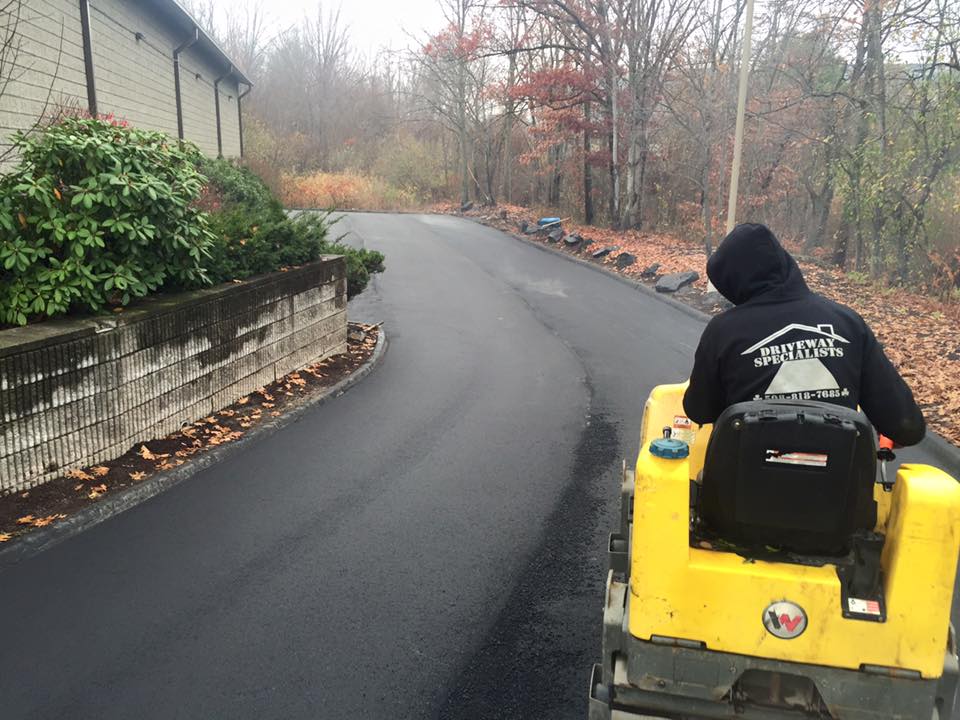
It is tempting to treat a small apron as a small job. In Brookline, a short drive often means a tighter radius, less room to stage equipment, and a closer relationship to the sidewalk and street than a suburban lot with open frontage. None of that changes what the base needs to do its job – it just changes how carefully the crew has to work to get there.
What drives the price
Several things set the cost of a driveway, and each one is visible only on site.
- Square footage : The area to be paved, plus any widening, turnaround or parking pad you want added.
- Depth of excavation : How far down the old material has to come out, and how much of the base has to be rebuilt.
- Material removed : The old asphalt has to be hauled away, and the amount depends on what is there.
- Access: A paver, a roller and delivery trucks all need to get in and turn around. Tight Brookline frontages can limit what equipment fits, which changes how the work is staged.
- Grade: A steep drive is harder to prepare, harder to compact and harder to drain correctly.
- Drainage: If water needs to be moved off the drive and away from the house, that work is part of the job.
- The apron: On many Brookline lots the apron meets the sidewalk with very little room between the street and the house. How that transition is built affects both the drive and the walk, and we look at it closely.
Anyone who gives you a firm figure without having stood on your driveway is guessing. When the guess is wrong, the extra cost shows up later as shortcuts in the base.
What drives the cost
Square footage is only one part of a quote. Depth of excavation, how much old material has to be hauled out, how the finished grade will shed water, and what it takes to cut in a new apron against the sidewalk or street all affect the number. Access matters too – a drive squeezed between two houses with street parking on both sides takes longer to work than one with open frontage, because equipment has to be sized and staged differently. Anyone willing to quote a firm price over the phone, without seeing the lot, is guessing at numbers that change the job.
FAQs
Does a short Brookline driveway cost less to pave than a longer one?
Square footage is part of the price, but on short urban drives the base work, apron tie-in, and access constraints often matter more than the size. A tight lot with limited staging room can take as much care as a longer drive with open access.
Can you just resurface over my existing driveway?
Sometimes, if the base underneath is sound. We check this during the site visit by examining the existing structure, not by guessing. If the base has already failed, resurfacing only covers the problem for a short time.
Will street parking affect the work?
In much of Brookline, yes. Equipment and material delivery need room to stage, and tight street parking around the house often means coordinating timing in advance so the crew can access the drive without delay.
How far ahead should I book paving work?
Massachusetts paving is seasonal, and schedules fill as the weather turns workable. If your driveway is already showing signs of failure, it is worth calling early rather than waiting until the drive is unusable.
Does Brookline's historic district affect driveway work?
In parts of Brookline it can affect what the apron and curb area look like where the drive meets the street. We confirm the specifics for your property during the site visit.
Call us
If your Brookline driveway has reached the end of its life, or you are putting one in for the first time, call (413) 337-3772. We will arrange a time to see the site, measure it, and tell you what it needs.