
Asphalt Repair in Wayland, MA
You’re standing over a pothole by the garage, or a patch of asphalt that’s gone spidery and soft underfoot, or an edge along the lawn that’s crumbled into gravel. The question isn’t whether it looks bad. It’s whether it’s a problem you can fix now for a reasonable amount, or the first sign of something bigger coming.
That answer depends on what’s actually happening under the surface, and in Wayland that’s harder to judge than it looks from the driveway. A lot of these drives run a few hundred feet from the road, through mature oak and maple cover, often with a grade change somewhere along the run and conservation or wetland setbacks that limited how the drive was built in the first place. Shade keeps asphalt damp longer after rain than it would be out in the open, which slows curing after any patch work and gives water more time to work into existing cracks. Roots push up from underneath in ways that mimic other kinds of failure — a heave near a tree line can look like a base problem when it’s really a root, and the fix is completely different. A driveway that drops toward a garage or a low point is carrying water somewhere, whether anyone designed it to or not, and that water has to go somewhere when it freezes.
We’ve been doing this work across Middlesex County since 1988, and the honest answer on most repair calls is that only part of the driveway needs attention. The rest is sound. Our job on a repair visit is to tell you which is which, not to talk you into more than the driveway needs.
That starts with reading the damage correctly. A hairline crack and an alligatored section look similar from the kitchen window but mean completely different things about what’s going on underneath, and they call for different fixes:
- Hairline and edge cracking — usually a surface issue, sealed or filled before winter so water can’t get under the pavement and freeze.
- Alligatoring (a web of interconnected cracks) — almost always a base failure underneath, which means the patch has to go deeper than the surface or it fails again within a season.
- Potholes and soft spots — point to saturated base material, often from drainage that’s never quite worked, and need the wet material cut out before new asphalt goes in.
- Heaving near trees — a root issue first, an asphalt issue second; patching over it without addressing the root just buys a year.
Get the diagnosis wrong and you either waste money patching something that needed to be rebuilt, or you rebuild something that only needed a patch. For Wayland driveways specifically, that diagnosis has to account for the tree cover, the drainage path, and whatever grade change is sending water toward the trouble spot — not just the crack pattern on the surface.
If you’re looking at damage right now and want a straight answer on what it needs and what it’s likely to cost to fix properly, call (413) 337-3772. We’ll tell you plainly if it’s a patch job or something more.


What Our Clients Say

How to read the damage
Asphalt rarely fails for the reason it appears to. The surface shows a symptom, and the cause is usually underneath.
Hairline cracks
Fine surface cracks, often forming a loose, spider-web network, usually mean the asphalt itself has aged and lost flexibility from years of Wayland's freeze-thaw cycles.
Alligator cracking
Tight, interlocking cracks that resemble reptile skin point to a failing base, not just worn surface. Common on older Wayland driveways exposed to freeze-thaw cycles, this damage spreads fast.
Edge failure
Crumbling along the driveway's border is common in Wayland where there's no curb or hard edge to confine the asphalt.
Sinking and heaving
A section that's dropped usually means water washed out the base material below it, often near a downspout or low spot. A section that's lifted is often a root from a nearby Wayland oak or maple pushing upward.
Repair or replace
Patching makes sense when failure is localized and the base nearby is sound. When cracking, potholes, and sinking spread across most of a Wayland driveway, repeated patching just becomes money spent twice—full replacement delivers better long-term value.
What the repairs actually involve
Each type of damage calls for a different fix, and using the wrong one is how a driveway ends up patched three times in five years.
Infrared patching reheats the existing asphalt in place, blends in new material, and fuses the seam, which works well for surface-level cracking and small areas without base failure.
Saw-cut and replace removes a defined section down to the base and rebuilds it, which is the right call for alligatored areas or sunken spots where the base itself has failed.
Crack filling seals hairline and linear cracks before water gets underneath, and is most useful as early intervention rather than after a crack has already widened and spread.
Edge rebuilding re-establishes a firm border where asphalt has crumbled away, often tying in compacted base material that was never adequately supported in the first place.
Regrading a sunken area addresses the drainage problem that caused the dip, not just the dip itself, which matters most on the graded, tree-covered drives common around Wayland.

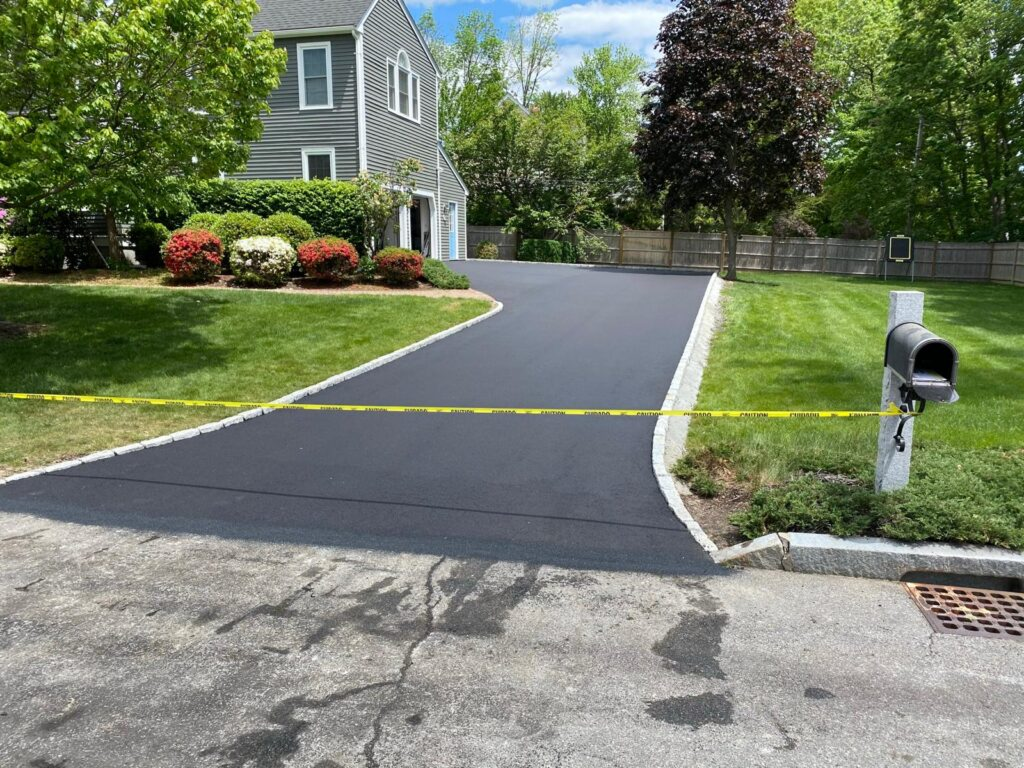
What the repairs are
Why it's failing in Wayland specifically
Root heave from mature trees, water running down a sloped drive toward a garage, and shaded asphalt that never fully dries after rain are the three patterns we see most often on these wooded, long-run properties.
Water finds the weak point
A driveway with any fall to it moves water somewhere. On a long Wayland drive, that’s often toward the garage slab, a low bend, or the street edge — exactly where base erosion, sinking, and cracking show up first.
Frost does the rest
Water that gets under asphalt and freezes expands, widening cracks and loosening the base beneath. Each freeze-thaw cycle through a Wayland winter makes existing damage worse, not better, turning hairline cracks into potholes by spring.
Small problems don't stay small
A crack left unsealed lets water into the base every time it rains. In Wayland’s freeze-thaw winters, that water expands as ice, and by spring that same crack is often wider, deeper, and surrounded by new ones nearby.
Acting before winter
Repairing a crack or small patch before the ground freezes costs far less than rebuilding the same section after a winter of freeze-thaw cycles has finished the job water started.
Why drives fail in Wayland
Wayland's ground is unforgiving in a few specific ways.
Steep hillside lots mean water arrives with speed. A sloped drive carries runoff downhill, and where that water meets a low corner, a garage door or the seam of an old patch, it goes down instead of away. Over years that washes out fine material from under the asphalt and leaves the hollows that later sink. On a hillside, drainage decides how long the work lasts.
Shared drives on two-family properties take more traffic than a single-family drive was built for. More vehicles, more turning, more weight on the same few feet. That is exactly where alligator cracking appears first, and where edges break down from vehicles clipping the sides.
Tight frontages put the apron directly against the sidewalk. Plows and shoveling push snow and meltwater straight onto that strip, and the edge there takes constant punishment. It is also the part of the drive most likely to involve the town, so if the damage reaches the apron or the sidewalk line, we will tell you before work begins what is yours to fix and what isn't.
And in every case, frost is the engine behind it. Water enters a small crack, freezes, expands and pries the crack wider. It thaws and drains into the opening, and the cycle repeats all winter. A hairline crack in October can be a pothole by March.

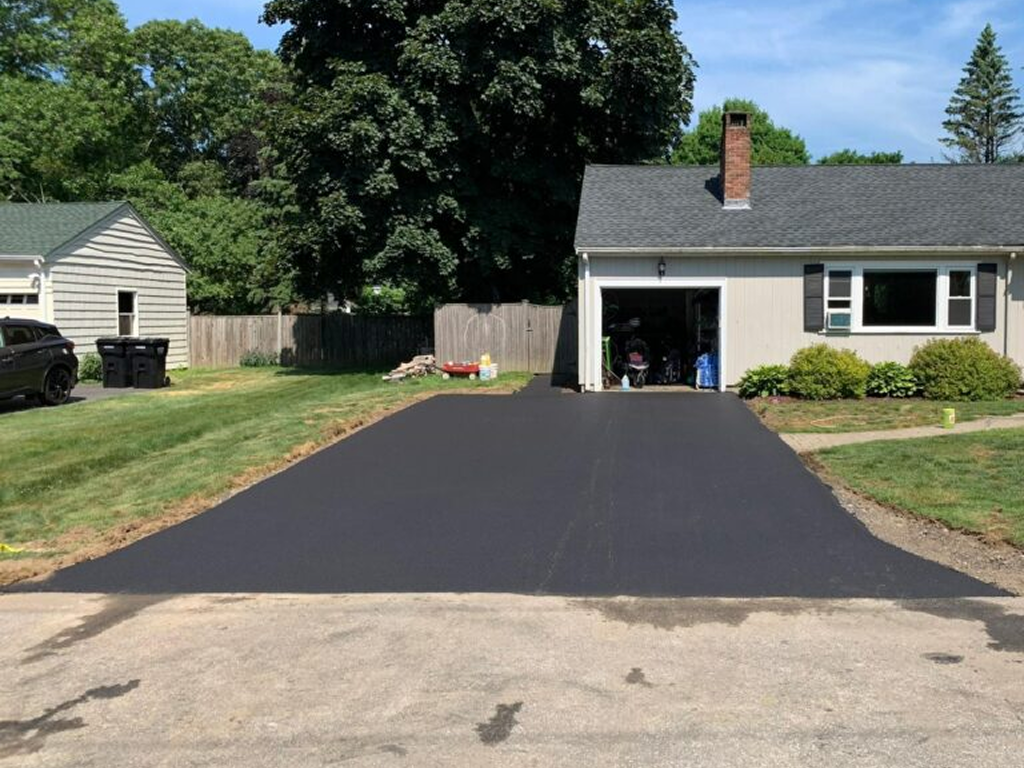
Why timing matters
A crack that is filled this fall is a small job. The same crack left through a winter lets water into the base, and the cost of the repair rises with every freeze. A pothole gets larger as vehicles break its edges away. An edge failure keeps retreating.
Spring is when the damage that has been hiding becomes obvious, and when everyone calls at once. The cheapest repairs happen before that, while the problem is still the size of a hand.
Asphalt repair questions in Wayland
Can a sunken section of asphalt be repaired without replacing the whole driveway?
Usually yes, if the sinking is localized. The area is saw-cut out, the base underneath is rebuilt and properly compacted, and new asphalt is laid in to match. Replacement only makes sense when sinking shows up in multiple spots across the drive.
How do I know if a crack is just cosmetic or a sign of base failure?
A single hairline crack running in a fairly straight line is usually surface aging. A cluster of interlocking cracks in a tight pattern, often called alligator cracking, means the base underneath is compromised and needs more than surface filling.
Will tree roots keep causing problems after a repair?
If the root that caused the heave is still growing under the repaired section, it can raise the surface again over time. In some cases the root needs addressing, in others the repair simply outlasts the issue for long enough to be worthwhile.
Is it worth repairing asphalt in the fall before winter?
Yes. Water sitting in a crack or under a sunken patch freezes and expands during a Massachusetts winter, which widens existing damage. Sealing or patching before the ground freezes stops that cycle from starting.
What if the driveway has damage in several different spots?
We'll look at each one and tell you honestly whether it adds up to a repair job or whether the base has failed broadly enough that patching would just be a short-term fix. Not every driveway with multiple problem spots needs full replacement.
Next step
Call us at (413) 337-3772. Tell us what you are looking at and where on the drive it is. We will come out, look at the damage and the ground around it, and tell you honestly whether it can be repaired and what that involves.