
Private Driveway Paving in Wrentham, MA
A lot of Wrentham properties sit well back from the road, reached by a drive that runs two hundred feet or more through trees before the house ever comes into view. Some of those drives serve one home. Others are a private way shared by two or three houses that have never formally agreed who pays for what. Either way, a drive that long is closer to a small private road than a driveway, and it fails for different reasons than a suburban one does. If yours has gone soft at the low end, rutted under tree cover, or was never built with real drainage in the first place, that is the starting point, not an afterthought.
Length changes the engineering
At driveway length, a bit of standing water at the edge is a nuisance. At a quarter mile, the same water has somewhere to go, and if nobody planned for that, it goes wherever the ground happens to slope. A long private drive needs a crown or cross-pitch that moves water off the surface consistently along its whole run, not just near the road, plus culverts or cross-drains at the low points and at any stream crossing. Turnarounds matter too, since a drive this long usually needs one, and where it goes has to work with the grading, not fight it.
Shared drives and private ways
Where a drive serves more than one house, the surface itself, the base under it, and the drainage all belong to whoever owns that stretch of private way, which is usually the abutters jointly rather than the town. Before any work starts it is worth getting that in writing between neighbours: who is paying what share, what happens at the boundary between one owner’s section and the next, and what the plan is if one abutter won’t contribute. We’ve seen jobs stall or get built in a patchwork because that conversation never happened. It is worth more than any amount of extra asphalt.
Access for everyone who needs to reach the house
A long wooded drive has to carry more than your own car. Fire apparatus, oil delivery trucks, and moving vans all need real width and a turning radius that works, and low branches that clear a sedan will not clear a fire engine. On a shared or narrow private way this is a safety question before it is a convenience one, and it’s one of the first things worth checking before any resurfacing plan is drawn up.


What Our Clients Say
Why a long or steep drive is a different job
Length and slope turn drainage from a detail into the main design problem. Water on a short, flat apron sits and soaks in. Water on a hillside drive picks up speed, carries fines out of the surface, and cuts channels along the edges. By the bottom it has gathered into a stream.
That is why the work starts with where the water goes, not with the surface:
- Crown and pitch : Crown and pitch. The drive needs a shape that sheds water sideways before it can build up speed down the length of it.
- Where water is sent : Moving it off the drive is not enough. It has to land somewhere that will not wash out a neighbour's lawn, undercut a retaining wall, or run across the public sidewalk at the bottom.
- Culverts and crossings: Where the drive crosses a low spot or a drainage path, water needs a way under it. A drive without one acts as a dam and fails at that point first.
- Turnarounds: A drive with no place to turn means vehicles reversing the whole length, which wears the surface and is a real hazard on a slope.
Frost makes every one of these worse. Water left in the base freezes, lifts the surface, and opens cracks, and the next thaw sends more water in. On a steep drive, ice is also a safety question. Where water sheets across the surface in winter, it freezes in the same place every time.
Shared drives and private ways
If you share a drive in Wrentham, the paving is the easy part. The hard part is agreeing on it. Most failed shared drives are not neglected out of carelessness. They are neglected because nobody is sure who is responsible.
Before anyone prices anything, settle these:
- Who owns the surface: Ownership can differ from use. Your deed, and your neighbour's, usually says whether the drive is owned jointly, owned by one lot with an easement for the others, or split down the middle. It is worth reading before you collect a cheque from anyone.
- How the cost is split: Equal shares is the simplest. Splitting by use or frontage can feel fairer when one household drives it daily and another rarely does. There is no single right answer, but there must be one answer, agreed before the work starts.
- Agreement in writing: A short note signed by everyone, covering scope, share of cost and who pays when, prevents most disputes. It does not need to be formal. It needs to exist.
- When one neighbour will not pay: This is the common sticking point. If the drive crosses their land or they have a right to use it, you cannot simply leave them out, because the surface is continuous. Sometimes the people who want the work pay for it and accept the cost. If it comes to more than that, a lawyer is the right next call, not the contractor. We will tell you plainly which side of that line you are on.
We can write up the scope in a way that makes it easy to share and discuss with neighbours, with the work broken into parts so people can see what each portion covers. Where a drive meets the public sidewalk, on the tight frontages common in Wrentham, the last stretch is a separate question. The apron at that point may not be yours to alter on your own. Check before work starts.
Access for everyone who has to reach the house
A steep, narrow, wooded drive is a safety issue as well as a paving one. The vehicles that matter most are the ones you hope you never need:
- Fire apparatus
- Ambulances
- Oil and propane delivery
- Moving and construction trucks
Each needs width to pass, room to turn, and clear space overhead. On a hillside drive, branches that were fine for a car are a problem for a truck. Tight bends that a car takes without thought can stop a larger vehicle. So we look at the drive the way a delivery driver would, and flag anything that would stop a truck. Sometimes the answer is widening a bend or cutting back growth. Sometimes it is a turnout, so a vehicle can pull aside.
Choosing a surface for a long drive
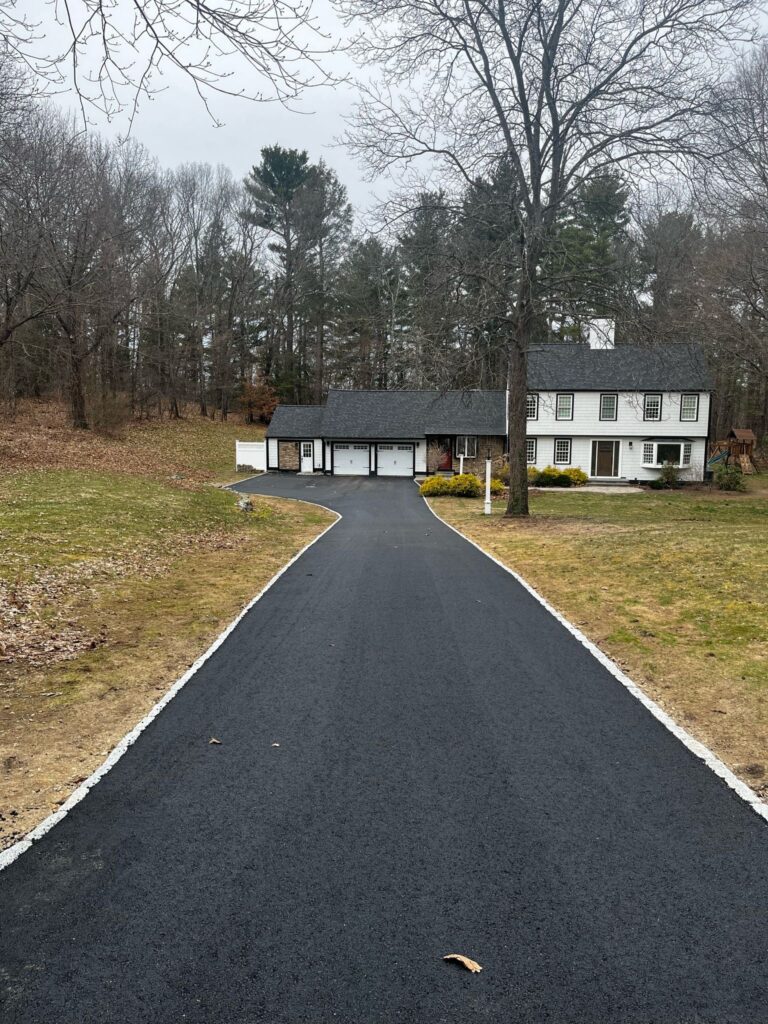
Full-depth asphalt is not automatically the right answer. It is a good surface where the ground is stable and the water is under control. It is a poor one where neither is true.
Asphalt
Full-depth asphalt holds up well on a long drive only where the subgrade is stable and water is already under control through grading and culverts. On wet or shifting ground it cracks and heaves regardless of thickness.
Tar and chip
A lower-cost surface that flexes with frost movement and roots better than solid asphalt, which suits long wooded drives where some ground movement is unavoidable. It needs periodic top-ups rather than one permanent surface.
Stabilised gravel
Often the right call on the longest or most remote stretches of a private way, especially where heavy drainage work would be needed to support pavement. It drains on its own and is simpler to repair after a hard winter.
The right choice follows the ground. Hillside soil that holds a lot of water, a drive that takes traffic from two households, and a slope that sheds loose stone all point in different directions. We walk it with you and say which we would choose, and why.
Staging a long job
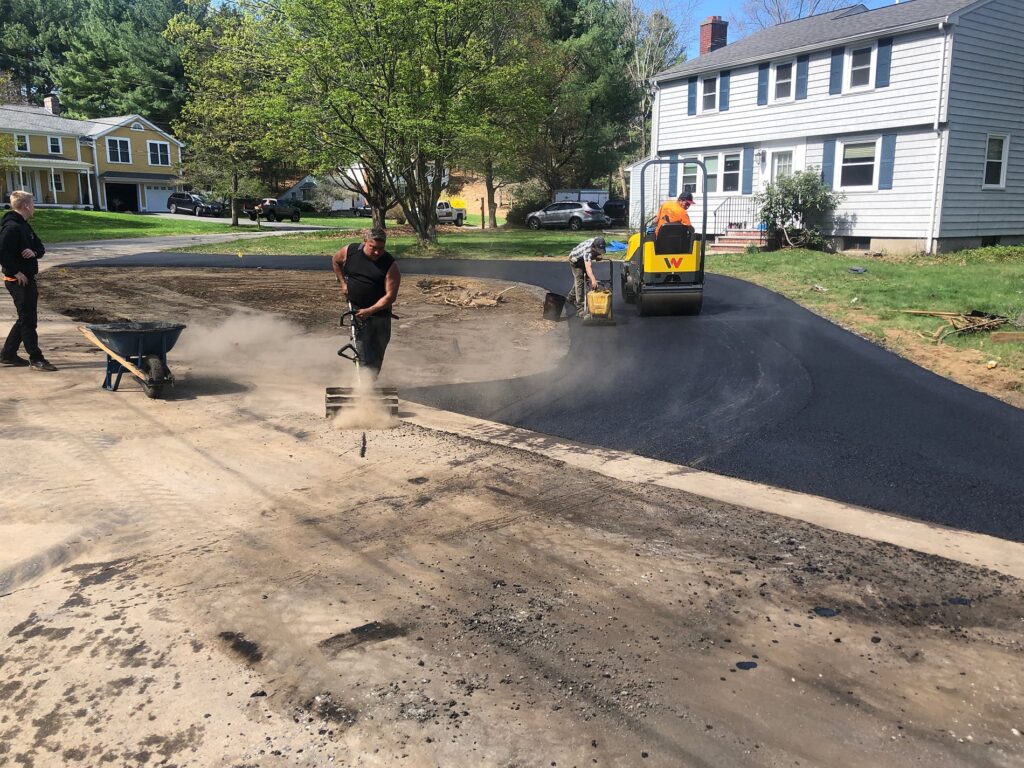
A drive that serves a household is hard to close. Getting the work done without trapping anyone is part of the plan.
- Material. On a narrow lot there may be nowhere to stage it, which affects how and when deliveries come.
- Access. On a shared drive, work is often done in sections so people can come and go. You will know in advance which section is closed and when.
- Disruption. A long job means a few days of machinery, noise and limited parking. We say that at the start and plan around it, instead of promising it will be painless.
Anyone with a medical need, a delivery schedule or a vehicle that has to leave at a set time should tell us early. It changes the order of work.
Frequently Asked Questions
Who is responsible for paving a shared private way in Wrentham?
The abutters who use it, not the town. It is worth getting a written agreement among the owners on cost shares and maintenance before any paving work begins, so there is no dispute once the job is underway.
Does a long private drive need the same base as a standard driveway?
It needs the same principles applied over a much longer run, with more attention to crown, cross-pitch and drainage points along the way. A base that works for sixty feet can still fail at six hundred if water isn't managed the whole distance.
Is asphalt always the best surface for a long wooded drive?
No. Where roots, shade and uneven ground make settling likely, tar and chip or stabilised gravel often hold up better and cost less to maintain than a full asphalt surface.
Can emergency vehicles use a narrow private drive in Wrentham?
Only if the width, turning radius and overhead clearance are built for them. This is worth checking directly rather than assuming a drive that fits a car will also fit a fire engine or delivery truck.
Next step
Tell us where the drive is, who uses it, and what it does in a hard rain. We will look at it on site, before we say anything about surfaces, and talk it through with you and your neighbours if it is shared.