
Driveway Paving in Lincoln, MA
A driveway in Lincoln rarely looks like one anywhere else nearby. Most sit at the end of a long run through trees, on a large lot where the surface is meant to be seen as little as possible. When that surface starts to heave, pool water, or break up at the edges, the question isn’t just who can pave it – it’s who understands why it failed in the first place, given the woods, the grade, and the soil it’s sitting on.
What happens when you call
We start with a site visit, not a phone quote. On a Lincoln property that usually means walking the full length of the drive, not just the apron near the road. We’re looking at grade changes through the trees, where water is already cutting its own path, how close roots have gotten to the edges, and whether the existing surface is a repaveable base or a problem that needs to come out. On wooded lots the canopy also matters – shaded sections stay damp longer after rain and through spring thaw, which changes how the base and surface hold up over time compared with an open, sunny stretch of the same driveway.
We measure the full width and length, note where the drive narrows or curves through trees, and check what’s underneath wherever we can. On a lot with mixed soil – sandy in one stretch, denser and wetter where the drive dips – the plan often isn’t uniform from one end to the other. That’s a Lincoln condition more than a town-wide one: large lots mean more variation in a single driveway than you’d find on a short suburban one.
Why the base decides everything
The surface is the part you see. The base is the part that decides whether that surface is still flat in a few years. Where a long drive runs through wooded, lower-lying ground, water that isn’t carried away sits under the pavement and works at it through every freeze-thaw cycle. Where the base is built up correctly and water is given somewhere to go, the same winters don’t do nearly as much damage. This is the single biggest factor in how a Lincoln driveway performs, and it’s also the part that’s invisible once the job is finished – which is exactly why it matters who’s doing the work and not just what it looks like when they drive away.


What Our Clients Say
Full replacement or overlay
An overlay only makes sense over a base that’s still sound – no significant cracking through the full depth, no soft or shifting spots, no standing water sitting under the surface. On a long Lincoln driveway running through variable ground, that soundness often isn’t consistent from one end to the other, which is why a blanket overlay can hide a problem in one section while genuinely fixing another. Paving over a failed base just gives the same problems a fresh surface to crack through again, usually faster the second time round.
What drives the price
Square footage is only the starting point. A long wooded drive adds cost in ways a short flat one doesn't: more excavation if the base is compromised, more material to haul in and out, and often trickier access for equipment where trees narrow the route. Grade and drainage work change the number too – a drive that falls toward a garage or low point needs that water managed, not just paved over. The apron at the road is its own line item, and on a town-accepted road that detail has its own rules to work within. Lincoln's mix of older, narrower rights-of-way and newer subdivision lots means two driveways of the same length can price out very differently once equipment access and base condition are factored in. Existing pavement or gravel also matters – tear-out and disposal add real labor before a single new layer goes down.

Scheduling and the first season
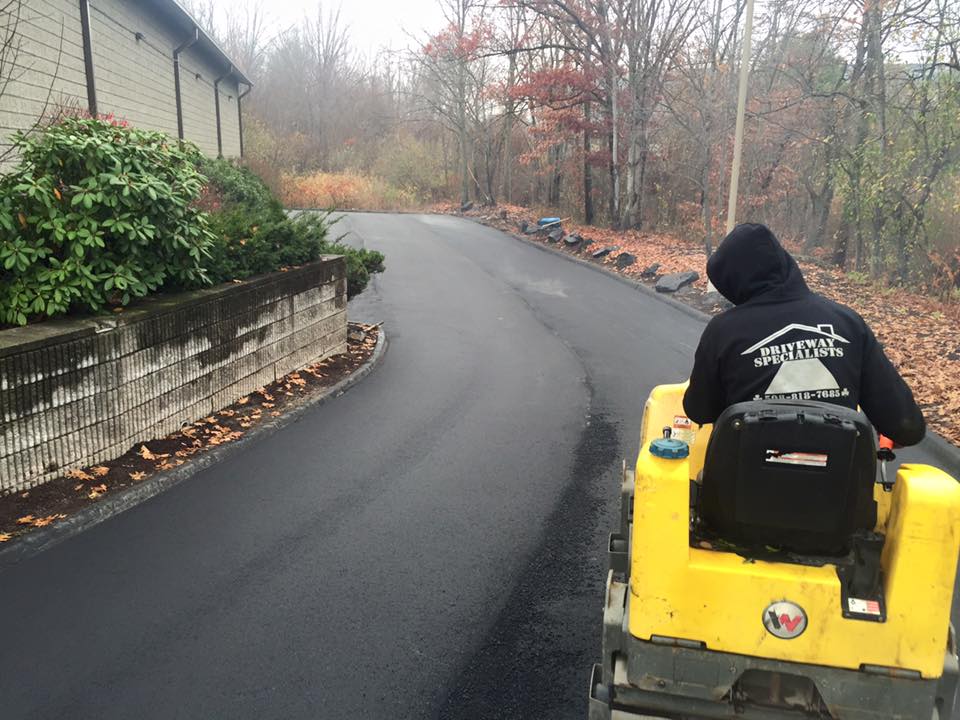
Paving in Massachusetts is seasonal work, and a long private drive through trees can be slower to prep than an open one, so booking ahead matters more here than on a short suburban job. Lincoln's wooded lots and winding, tree-lined drives often mean tighter access and more hand work around roots and low branches, which affects how we schedule the crew and equipment. Once we're on site, you'll need vehicles clear of the full length of the drive, not just the garage end, since trucks and pavers need room to move and turn through the wooded sections. Keep the new surface free of traffic for the period we specify after paving – it's still curing and vulnerable to damage, ruts, and scuffing early on.
What drives the price
Several things set the cost of a driveway, and each one is visible only on site.
- Square footage : The area to be paved, plus any widening, turnaround or parking pad you want added.
- Depth of excavation : How far down the old material has to come out, and how much of the base has to be rebuilt.
- Material removed : The old asphalt has to be hauled away, and the amount depends on what is there.
- Access: A paver, a roller and delivery trucks all need to get in and turn around. Tight Lincoln frontages can limit what equipment fits, which changes how the work is staged.
- Grade: A steep drive is harder to prepare, harder to compact and harder to drain correctly.
- Drainage: If water needs to be moved off the drive and away from the house, that work is part of the job.
- The apron: On many Lincoln lots the apron meets the sidewalk with very little room between the street and the house. How that transition is built affects both the drive and the walk, and we look at it closely.
Anyone who gives you a firm figure without having stood on your driveway is guessing. When the guess is wrong, the extra cost shows up later as shortcuts in the base.
Getting equipment onto a wooded lot
Access on a Lincoln lot is a planning problem before it’s a paving one. Pavers, rollers, and delivery trucks need a clear path in and enough room to turn around, which isn’t guaranteed on a drive built for cars, not machinery. We work out the access plan during the site visit, including whether low branches or narrow bends need temporary clearing to get equipment through without damage to the property.
Keeping the surface unobtrusive
Many Lincoln properties sit near or within conservation land, and part of the brief is often a driveway that does its job without standing out against the woods. That’s a finish and edge decision as much as a material one. We talk through surface options and edge treatment at the site visit so the result works with the lot instead of announcing itself against it – functional first, visually quiet by design.
Next step
If your Lincoln driveway has reached the point of heaving, pooling, or breaking up through the base, or you’re building new and need the surface planned from the ground up, the next step is a site visit, not a guess over the phone. Driveway Specialists has been doing this work across Middlesex County since 1988. Call (413) 337-3772 to get a time scheduled and start with an honest look at what your driveway actually needs.
FAQs
How long does driveway paving take on a long Lincoln driveway?
It depends on the length, how much of the base needs rebuilding, and access through the trees. A short flat section moves faster than a long run requiring excavation and drainage work. We give a realistic timeframe after the site visit, not before.
Can you pave a driveway that runs through conservation land setbacks?
We work within whatever boundaries and setbacks apply to the property, which we review as part of the site visit. The scope and finish are planned around those limits rather than guessed at in advance.
Will tree roots near my driveway cause problems after paving?
Roots close to the edge can cause heaving over time regardless of how the surface is paved. We flag any root pressure we see during the site visit so you know what to expect and what, if anything, should be addressed before paving.
Does a wooded, shaded driveway wear differently than one in the open?
Yes. Shaded sections stay damp longer after rain and through spring thaw, which affects how the base and surface hold up compared with a sunny stretch. We account for this when planning the base rather than treating the whole driveway the same.
Do you handle the apron where my driveway meets the road?
Yes, as part of the overall scope. Where the drive meets a town-accepted road, that section is subject to the town's requirements; where it meets a private way, it's the owner's decision. We'll tell you which applies to your property.
Call us
If your Lincoln driveway has reached the end of its life, or you are putting one in for the first time, call (413) 337-3772. We will arrange a time to see the site, measure it, and tell you what it needs.