
Driveway Paving in Hudson, MA
If you’re looking at a driveway in Hudson that’s cracked through, heaving at the edges, or just gone soft underfoot, you’re trying to figure out who to call before it gets worse. Same thing if you’ve got a new build or an addition and no driveway in yet. Either way, the decision comes down to who actually looks at your ground before they tell you what it needs.
Hudson isn’t one kind of lot. Close to the old mill streets the drives tend to be narrow and tight to the house, laid out for an era before most households had two cars. Head out toward the newer subdivisions and you get wider frontage, longer runs, and more room to work. We treat those as two different jobs because they are – different equipment access, different drainage paths, and often a different base to start from.
What happens when you call
We come out and look at the actual driveway – not a satellite photo of it. That means measuring the area, checking the grade and where water is already moving across the surface, and digging down enough to see what’s under the existing asphalt or gravel. In a narrow mill-area lot, we’re also checking how a paver and roller actually get in and turn around without tearing up a lawn or a neighbor’s fence line. On a subdivision lot with more frontage, that’s rarely the constraint – grade and drainage usually are, especially where a driveway slopes toward a garage or a walkout basement.
What we find changes the scope. A driveway that looks rough on top but has a solid, well-drained base underneath is a different job – and a different price – than one where the base itself has failed. You can’t tell which one you have by looking at the surface, which is exactly why a firm quote over the phone, before anyone has opened up the ground, is a guess dressed up as a number. We’d rather spend twenty minutes on site than hand you a figure we’ll have to walk back later.
Soil in and around Hudson varies block to block. Some lots sit on sandy, well-draining glacial material that holds a compacted base for years. Others sit on heavier, wetter ground that moves with the seasons and pushes a thin base apart from underneath. We won’t know which one your lot is until we’re standing on it.
That site visit also tells us what the job actually needs, not just what it costs:
- How much of the existing base can stay versus needs to come out
- Where water needs to be redirected so it doesn’t pool against the garage or foundation
- Whether the edges need reinforcement given how close some Hudson lots sit to sidewalks or property lines
- What thickness and compaction the ground under your specific driveway calls for


What Our Clients Say
Why the base is the job
The asphalt on top is the part you see, but the base underneath is what decides whether your driveway lasts. Hudson's clay-heavy soils and freeze-thaw winters are hard on driveways that skip this step. A proper base starts with excavating down past the topsoil, then building up with compacted aggregate graded to shed water away from the surface rather than letting it pool and soak in. That compaction has to happen in layers, not all at once, or the base settles unevenly later. A base laid over soft or wet ground, or never properly compacted in the first place, moves every freeze-thaw cycle – and once it starts moving, no amount of surface patching or sealcoating holds it together for long.
Full replacement or overlay
An overlay puts new asphalt over the old. It’s cheaper, faster, and it works only when the base underneath is still sound – no major cracking through to the subgrade, no soft or sunken spots, decent drainage already in place. Lay an overlay over a failed base and you’ve paid for a surface that mirrors every flaw underneath within a season or two, which is a common letdown we see on older Hudson driveways that were patched instead of properly assessed.

What drives the price
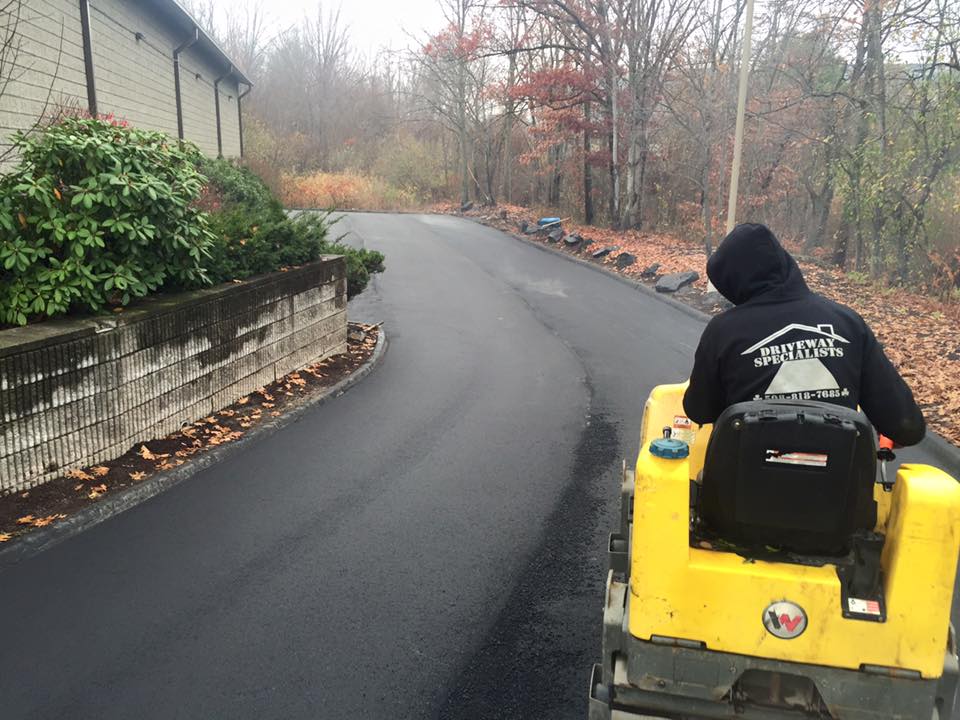
Square footage is the starting point, but it’s not the whole number. Depth of excavation matters – a failed base in Hudson’s heavier clay pockets needs to come out further than a thin skim over sound sand and gravel. Material hauled off site costs to remove and dispose of. Access matters too: a tight mill-era driveway that needs hand work and smaller equipment costs differently than a wide-open subdivision lot a paver can drive straight onto.
Grade and drainage factor in as well – a driveway that slopes toward the garage needs grading and drainage work built into the base, not bolted on after. And if your drive meets a town-accepted road, the apron and curb cut are handled as the town’s business, which can add a step to the job that a private-way driveway doesn’t have.
What drives the price
Several things set the cost of a driveway, and each one is visible only on site.
- Square footage : The area to be paved, plus any widening, turnaround or parking pad you want added.
- Depth of excavation : How far down the old material has to come out, and how much of the base has to be rebuilt.
- Material removed : The old asphalt has to be hauled away, and the amount depends on what is there.
- Access: A paver, a roller and delivery trucks all need to get in and turn around. Tight Hudson frontages can limit what equipment fits, which changes how the work is staged.
- Grade: A steep drive is harder to prepare, harder to compact and harder to drain correctly.
- Drainage: If water needs to be moved off the drive and away from the house, that work is part of the job.
- The apron: On many Hudson lots the apron meets the sidewalk with very little room between the street and the house. How that transition is built affects both the drive and the walk, and we look at it closely.
Anyone who gives you a firm figure without having stood on your driveway is guessing. When the guess is wrong, the extra cost shows up later as shortcuts in the base.
Scheduling around New England weather
Paving is seasonal work in Massachusetts. Asphalt needs the right conditions to compact and bond properly, and that narrows the calendar to the warmer months. In practice that means booking ahead rather than calling the week you want it done – Hudson jobs fill up the same way they do everywhere else in the region once the weather turns reliable.
Once a date’s set, your part is straightforward: clear vehicles off the area, keep foot and tire traffic off the new surface for as long as we tell you, and go easy on it through its first season while it fully sets up. Driveways that get babied a little early tend to hold their edges and surface a lot better long-term than ones that get driven on hard right away.
Get the ground checked first
Before anything gets quoted, we need to see your driveway – the narrow mill-street kind or the wide subdivision kind, it doesn’t matter which. Call Driveway Specialists at (413) 337-3772 and we’ll set up a site visit, figure out what your base is actually doing, and tell you straight whether you need a full replacement or an overlay.
If your situation is a long shared driveway with abutters splitting costs, that’s handled on our private driveway paving in Hudson page. If it’s a pothole or a crack that needs patching rather than a full job, that’s our asphalt repair in Hudson page. Otherwise, give us a call and let’s look at the ground.
FAQs
How long does a driveway paving job in Hudson take?
It depends on whether the job is a full replacement or an overlay, and on what the excavation turns up once the old surface comes out. We give a realistic window after the site visit rather than a number before we've seen the ground.
Can you match the scope of my neighborhood - older mill-area lot or newer subdivision?
Yes. A narrow drive near the old mill streets and a wide frontage drive in a newer Hudson subdivision call for different equipment access and grading, and we plan each one on its own site visit.
Do I need a full replacement or can the existing driveway be overlaid?
That's answered by what's under the surface, not by how the top looks. If the base is sound, an overlay can work. If the base has failed, an overlay just hides the problem for a season or two.
What time of year do you pave in Hudson?
Paving is seasonal in Massachusetts, so scheduling fills up through the warmer months. Call ahead and we'll give you a realistic place in the schedule rather than a guess.
Will I be able to use my driveway right after it's done?
You'll need to keep vehicles off the new surface for a stretch while it sets, and go easier on it than normal through its first season. We'll walk you through exactly what that means for your household when the job is booked.
Call us
If your Hudson driveway has reached the end of its life, or you are putting one in for the first time, call (413) 337-3772. We will arrange a time to see the site, measure it, and tell you what it needs.