
Retaining Walls in Watertown, MA
Watertown lots don’t leave much room to work with. Two-families sharing a single drive, a few feet of setback between the house and the property line, a grade that drops off faster than the lot is wide. When you need to hold that grade back, whether it’s a slope eating into a shared driveway or a side yard that sheds soil onto a neighbor’s parking pad, a retaining wall is doing real structural work, not just marking an edge. It has to hold, and it has to look like it belongs next to a hundred-year-old triple-decker or a postwar bungalow.
Most of what decides whether that wall is still straight in twenty years happens before a single block goes down.
What’s Under the Wall Matters More Than What’s On It
A retaining wall fails from the bottom up. Excavation has to go deep enough to get below the frost line and onto stable ground, not just scraped flat. Compacted crushed stone underneath spreads the load and lets water pass through rather than pool against the back of the wall. Skip that step, or skimp on compaction because the lot is tight and there’s nowhere to stage material, and the wall will lean within a few winters as frost works behind it.
Bedding courses need the same attention as the base. Each course has to sit level and tied back into the soil behind it, usually with geogrid on anything over a couple of feet, so the wall and the slope move as one mass instead of the wall taking the full load alone. Edge restraint at the top course keeps the cap from walking during freeze-thaw cycles, which in this part of Massachusetts means every winter, not just a bad one.
Drainage behind the wall deserves its own attention, separate from the base. A perforated pipe set in stone at the bottom of the backfill, wrapped in filter fabric to keep soil from clogging it over time, gives water somewhere to go besides pushing against the back face of the wall. Without it, hydrostatic pressure builds every time it rains hard, and that pressure is what eventually bows a wall outward or cracks a cap, even when the base was built correctly.
On a shared drive, the retaining wall often doubles as the only thing keeping the paved surface itself from slumping toward one side. That raises the stakes on getting the base right, because a repair later means tearing into a surface your tenant or neighbor is also driving on every day. Material choice matters here too: segmental block systems handle tight, awkward Watertown lots well because they can be cut and stepped around utility lines, trees, and property corners without the forming work a poured concrete wall requires.


What Our Clients Say
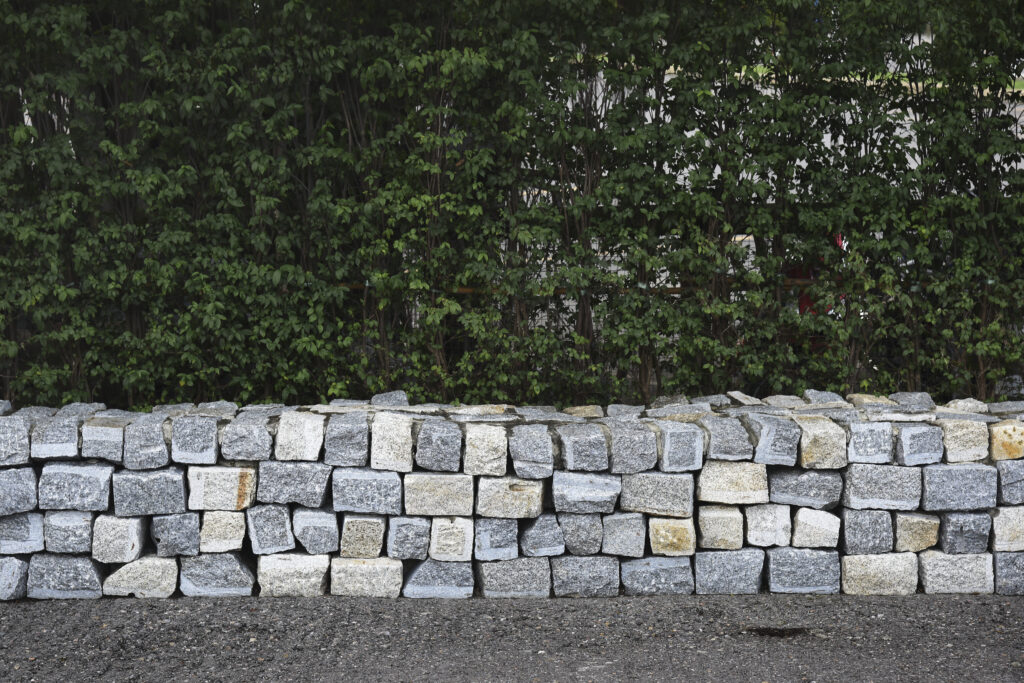
What holds a wall up is underground
The part you see is the smaller part of the job. Below it, the work runs in a fixed order.
Segmental concrete block handles Watertown's freeze-thaw cycles well and keeps its line on a tight, uneven lot where a wall has to turn corners around a drive.
Natural stone costs more and takes longer to lay, but it ages the way an older Watertown house expects a stone wall to age, and it's the easiest material to patch years later when frost heave or tree roots shift a section.
Poured concrete retaining walls go in fast on a tight Watertown site and hold a hard, uniform line against sloped yards. But a crack shows clearly, and repairing one usually means refinishing the whole face, not just a patched section.
Timber is the cheapest option up front and simplest on a small job in Watertown, but wood rots against wet soil faster than masonry fails, and replacement means digging out and starting over, not patching.
Whatever material carries the face, drainage behind it decides the lifespan. Watertown's clay-heavy soil and freeze-thaw winters push hard against any wall.
Drainage behind the wall
Where the Water Goes
Every retaining wall changes how water moves across a lot, and on a small Watertown property that water usually has nowhere to go but toward a foundation, a neighbor’s yard, or the shared driveway. A wall built without drainage behind it just becomes a dam. Water pools in the backfill, freezes, and pushes the wall forward a little more each winter until it leans or the face spalls off. A drain line at the base, gravel backfill, and a slight pitch that carries runoff to a safe outlet are not optional add-ons. On lots this tight, where the next property might sit a few feet from the base of the wall, getting that water routed correctly is often the difference between a wall that holds for decades and one that needs rebuilding within ten years.
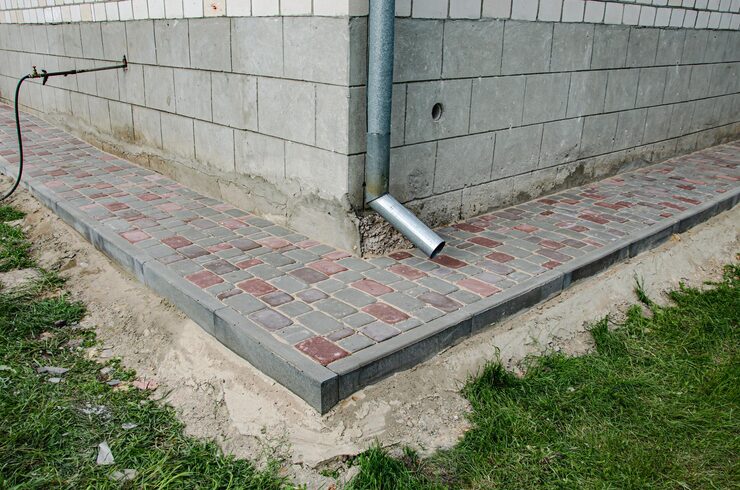

Choosing the material
A retaining wall rarely stands alone on a Watertown lot. It usually meets the edge of a driveway apron, steps up to a front walk, or runs along a foundation planting bed that’s been there since the house was built. Tying the new wall into that existing grade means matching cap height to a step, aligning a wall line with an existing drive edge, and choosing a material that doesn’t look dropped in next to an older stone foundation or a brick stoop. On a shared two-family drive, the wall also has to account for where cars turn and where snow gets pushed, so the base course sits clear of tire paths and plow blades.
Why Watertown Lots Call for This Work
Dense lotting and minimal setbacks mean that grade changes on one property often affect the one next door, which is exactly the situation a retaining wall is built to solve. A slope that sheds water or soil onto a shared driveway, a side yard that’s a few feet higher than the neighbor’s, or a small backyard that needs a level patio cut into a hillside; these are common lot shapes in Watertown, and they’re the reason a well-built wall does more for the property than almost any other hardscape project. It holds the usable flat ground you actually have, instead of losing another few feet of yard to an unretained slope every time it rains hard.


Planning a Wall on a Tight Lot
Access is the first practical question on most Watertown jobs, before material or design. A crew needs room to stage block or stone, run a small excavator, and get fill in and spoil out, and on a lot with minimal setbacks and a shared drive, that often means careful sequencing rather than simply parking a truck and starting. Property lines close to the work also mean confirming exactly where the wall sits before excavation, since a wall built even slightly over a line becomes a problem for both owners later, not just one. None of this is a reason to avoid the work; it’s a reason to plan it properly before the first shovel goes in, with someone who has actually built on lots this size and knows what sequencing keeps a project moving instead of stalled halfway through.
Questions we get asked
Does a retaining wall in Watertown need an engineer?
It depends on height and what's above or below it. Taller walls, walls near a shared driveway, or walls close to a neighbor's foundation often call for an engineered design, especially on the small, tightly packed lots common in Watertown. Shorter walls holding back a simple slope usually don't.
What material holds up best to New England winters?
Segmental concrete block and natural stone both handle freeze-thaw well when the base and drainage behind them are done correctly. Timber is the weakest option against repeated freezing and wet soil, and poured concrete can crack visibly even when it's structurally sound.
Can a retaining wall be built on a shared two-family driveway?
Yes, and on Watertown's lots it's one of the more common requests. The wall has to account for where vehicles turn and where snow gets pushed, so the base and cap sit clear of tire paths and plow blades.
Why does a new wall need drainage if the ground already seems dry?
A wall changes how water moves across the lot even when the soil looks fine on the surface. Without a drain line and gravel backfill, water collects behind the wall, freezes in winter, and pushes the face forward over several seasons until it leans or fails.
How close can a retaining wall sit to a property line?
On Watertown's minimal setbacks, this needs to be confirmed before excavation starts, since a wall built over a line affects both properties. It's one of the first things worth sorting out when planning the job.
Next step
Call us and we will come look at the slope, the access and the water. We will tell you what the wall needs and what it will cost to do properly.