
Asphalt Repair in Brookline, MA
You’re standing over a pothole by the front steps, or a patch of asphalt near the garage that’s gone spidery and soft underfoot. Maybe it’s the edge of the apron, crumbled away where the plow caught it last winter. Before you call anyone, you want to know one thing: can this actually be fixed, or is someone about to tell you it needs a whole new driveway.
In Brookline, that question comes with its own wrinkles. The housing stock is dense and mostly prewar – Victorians, triple-deckers, early-1900s colonials – and the drives that go with them are short, often narrow, and squeezed between a foundation, a fence, or a neighbor’s property line. Some aprons sit in a historic district where even small exterior changes get a second look. And on plenty of streets, the driveway itself is the only place to park, which means any repair has to work around a car that has nowhere else to go, and the work has to be scheduled so you’re not stranded for a week.
Asphalt repair in a town like this is rarely a simple patch-and-go. It’s reading the damage correctly, figuring out why it happened on this specific lot, and then choosing a fix that matches the size of the problem – not the size of the quote. A hairline crack and a sunken slab are not the same job, and they don’t deserve the same price tag or the same panic.
Most of what we see in Brookline falls into a few recurring categories:
- Frost-heaved edges where a short drive meets an old granite curb, the asphalt lifting and cracking as the ground moves beneath it each winter.
- Alligatored sections near a downspout or low corner with nowhere good to drain, so water sits and softens the base until the surface fractures into that telltale web pattern.
- Localized sinking where an old utility trench or sewer tie-in was never compacted properly before the asphalt went back down, leaving a dip that gets worse every freeze-thaw cycle.
Each one has a specific cause, and each one has a specific repair that fits it – not a blanket recommendation to tear it all out. A frost-heaved edge might just need the broken section cut out, the base rebuilt, and fresh asphalt tied in cleanly. A sunken trench often means excavating down to find out what actually failed underneath before anything gets repoured. Guessing at it, or papering over it with a thin overlay, just means the same problem resurfaces by next spring.
If you’re trying to decide whether to call someone, the short version is this: if you can point to a clear boundary around the damage – a crack pattern that stops, an edge that’s broken but the rest holds firm underfoot – there’s a decent chance a targeted repair buys you real years, and it’s worth getting a second opinion before anyone quotes a full replacement. If the whole surface flexes, ripples, or shows the same failure in multiple spots, that’s a different conversation, and an honest assessment of what’s going on underneath is worth more than a quick patch that won’t hold through another Brookline winter.

What Our Clients Say
How to read the damage
Asphalt rarely fails for the reason it appears to. The surface shows a symptom, and the cause is usually underneath.
Reading the Damage
A single hairline crack is just the surface drying and shrinking – cosmetic, not urgent. Alligator cracking, where the surface looks like reptile skin, means the base has failed. Brookline’s freeze-thaw winters widen these fast, so early assessment saves driveways.
Edge Failure
Crumbling at the edges, common where a short Brookline drive meets an old curb, walkway, or plow line, usually means the asphalt there was never confined properly.
Sinking and Heaving
A section that’s dropped usually sits over a soft spot or old trench. A section that’s lifted is frost pushing water-logged soil upward. Both point to what’s under the surface, not the surface itself.
Repair or Replace
Patching makes sense when damage is contained and the base nearby is sound.
Infrared Patching
Infrared repair reheats and blends existing asphalt into the patch, avoiding a hard seam that traps water and refreezes each winter.
Saw-Cut and Replace
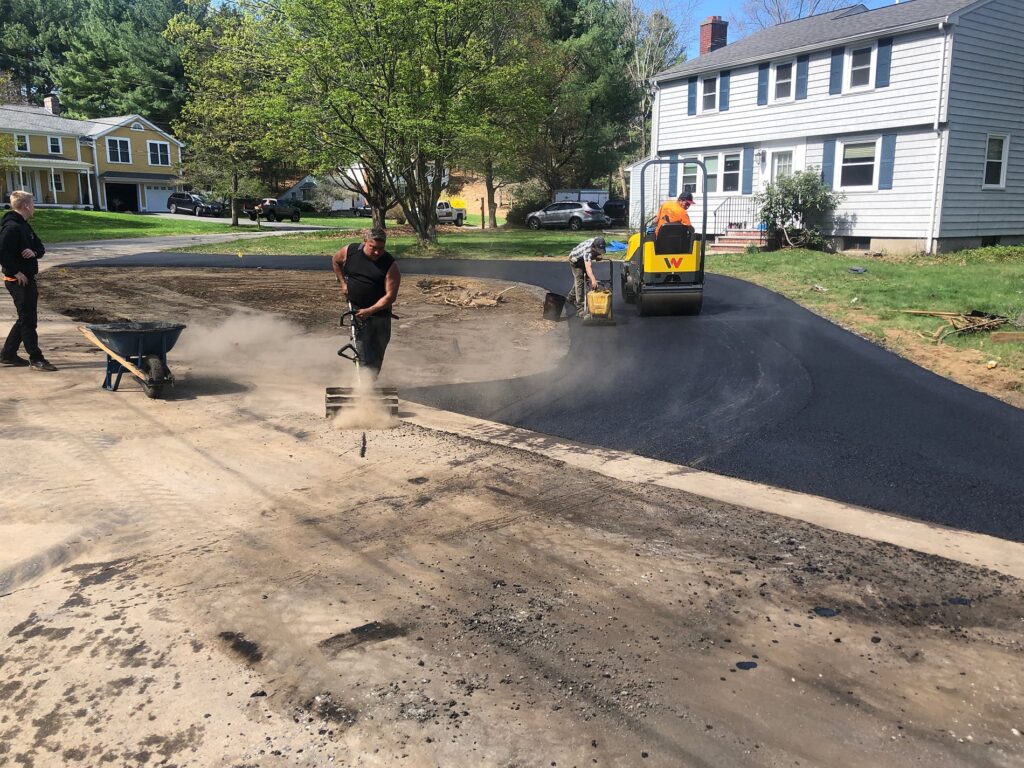
Some asphalt damage in Brookline goes deeper than a surface patch can fix—base failure under heavy clay soils, long cracking from freeze-thaw cycles, or alligatored areas near tree roots and old utility cuts common throughout the town’s older driveways and side streets. When that’s the case, we saw-cut a clean, straight-edged rectangle around the full extent of the damage rather than guessing at a rough boundary. The failed asphalt is removed completely down to the base material, and we inspect what’s underneath before rebuilding. If the base has washed out, shifted, or never compacted correctly, we correct it first, since paving over a weak base only brings the problem back within a season or two.
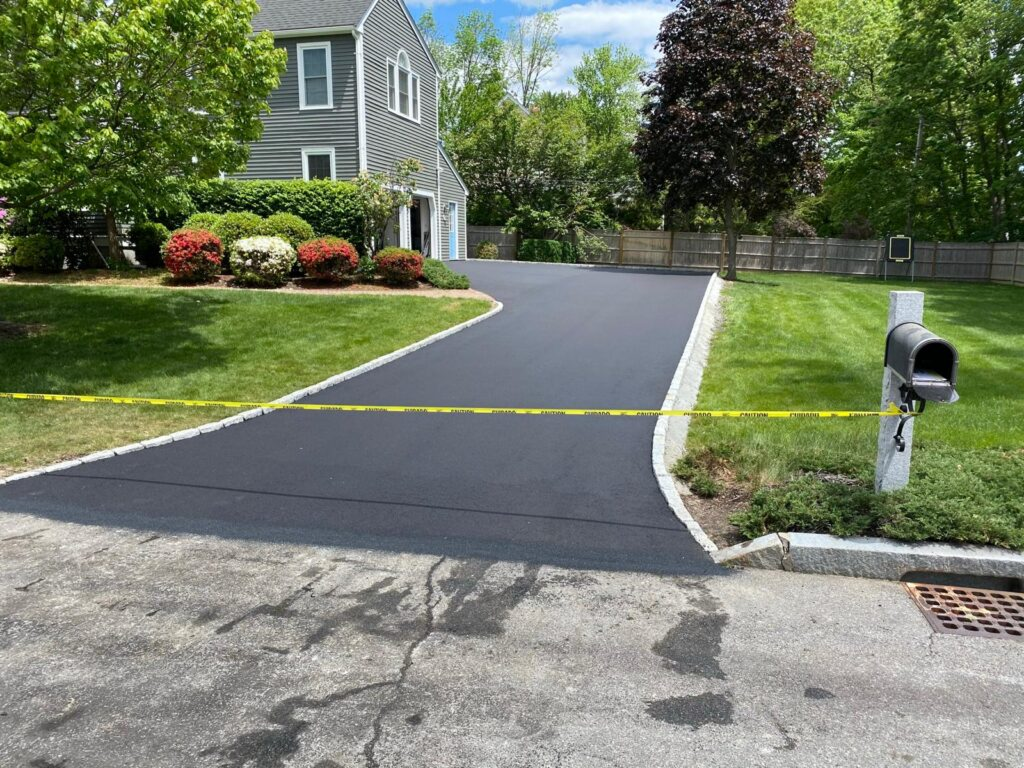
Once the base is sound, we compact fresh aggregate as needed and install new asphalt to match the depth and slope of the surrounding driveway, then seal the perimeter joint so water can’t work its way in from the edges. This is the right approach when infrared patching won’t reach the real problem—it costs more than a surface repair, but it’s a permanent fix rather than a temporary one.
What the repairs are
Crack Filling and Edge Rebuilding
Crack filling seals hairline and shrinkage cracks before freeze-thaw cycles and water intrusion widen them into potholes.
Why It Failed Here
Brookline's tight lots push downspouts and old trenching to drain across asphalt, not away, and freeze-thaw widens every seam from below. Street-tree roots cause heave; repeated truck loading on short drives stresses weak spots.
Timing Matters
A small crack filled in fall costs little. Left through a Massachusetts winter, water gets in, freezes, expands, and turns that same crack into a pothole by spring – a bigger, costlier repair from the same starting point.
Working Around Parking and Access
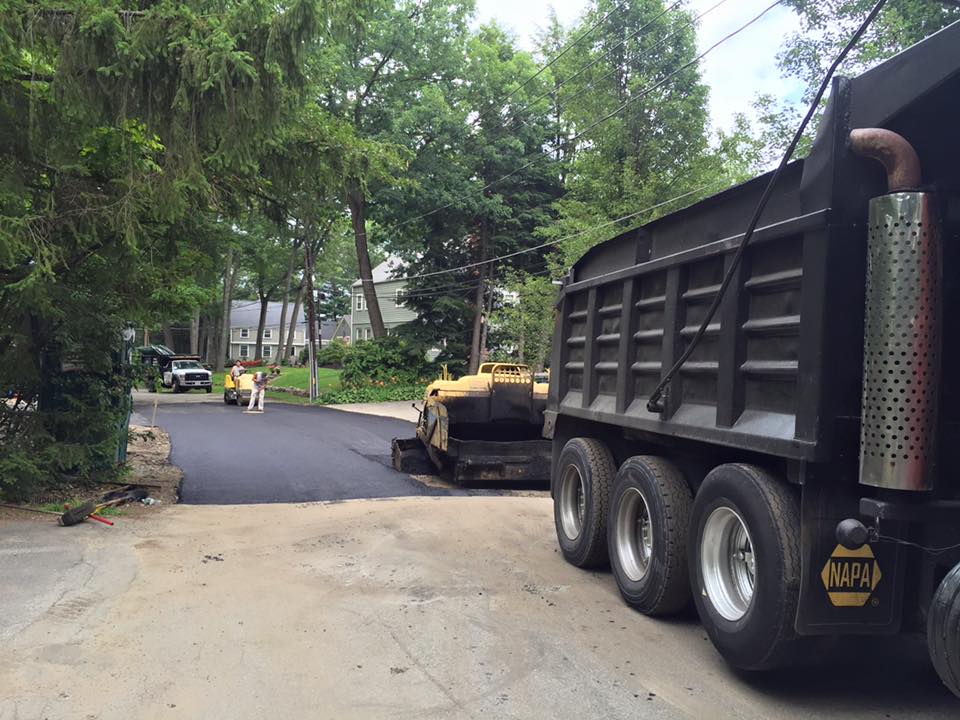
On a Brookline street where the driveway is the only parking, we plan repairs around your schedule – working in sections where possible so the drive isn’t fully blocked longer than it needs to be.
Historic District Considerations
If your property sits in one of Brookline’s historic districts, apron and edge work facing the street may need a lighter touch. We keep repairs consistent with the existing look rather than introducing an obvious mismatch.
Why drives fail in Brookline
Brookline's ground is unforgiving in a few specific ways.
Steep hillside lots mean water arrives with speed. A sloped drive carries runoff downhill, and where that water meets a low corner, a garage door or the seam of an old patch, it goes down instead of away. Over years that washes out fine material from under the asphalt and leaves the hollows that later sink. On a hillside, drainage decides how long the work lasts.
Shared drives on two-family properties take more traffic than a single-family drive was built for. More vehicles, more turning, more weight on the same few feet. That is exactly where alligator cracking appears first, and where edges break down from vehicles clipping the sides.
Tight frontages put the apron directly against the sidewalk. Plows and shoveling push snow and meltwater straight onto that strip, and the edge there takes constant punishment. It is also the part of the drive most likely to involve the town, so if the damage reaches the apron or the sidewalk line, we will tell you before work begins what is yours to fix and what isn't.
And in every case, frost is the engine behind it. Water enters a small crack, freezes, expands and pries the crack wider. It thaws and drains into the opening, and the cycle repeats all winter. A hairline crack in October can be a pothole by March.
Why timing matters
A crack that is filled this fall is a small job. The same crack left through a winter lets water into the base, and the cost of the repair rises with every freeze. A pothole gets larger as vehicles break its edges away. An edge failure keeps retreating.
Spring is when the damage that has been hiding becomes obvious, and when everyone calls at once. The cheapest repairs happen before that, while the problem is still the size of a hand.
Asphalt repair questions in Brookline
Can a cracked asphalt driveway in Brookline be repaired instead of replaced?
Often, yes. If the cracking or sinking is contained to one area and the base nearby is still solid, a targeted repair like saw-cut patching or infrared repair can add years to the drive without a full replacement.
Why does asphalt in Brookline crack along the edges so often?
Many Brookline drives are short and butt directly against old curbs or walkways with no confined edge. Plow blades and winter frost both work on that unprotected edge, which is why it tends to fail before the main surface does.
How quickly should a pothole or alligator crack be fixed?
Sooner rather than later. Water that gets into a small crack or pothole before winter will freeze, expand, and turn a minor repair into a much larger one by spring.
Does a historic district affect asphalt repair work in Brookline?
It can affect how visible edge and apron repairs are finished along the street-facing side, but it doesn't generally prevent the repair itself. We match the existing appearance where that matters.
What if my driveway is too narrow for equipment to access?
Most Brookline drives are tight, and we plan the work around that – sequencing repairs so the equipment fits and your access isn't blocked for longer than necessary.
Next step
Call us at (413) 337-3772. Tell us what you are looking at and where on the drive it is. We will come out, look at the damage and the ground around it, and tell you honestly whether it can be repaired and what that involves.