
Walkway Installation in Natick, MA
A front walk in Natick has to do two jobs at once: get people from the driveway or street to the door without a trip hazard, and look like it belongs with the house. That second part is harder here than in a town full of identical new builds. Natick’s housing stock runs from dense older streets near the center, where walks sit close to the foundation and tie directly into a short front path, out to lakeside lots around Lake Cochituate and newer subdivisions in South Natick with longer, more open approaches. A walk that suits a tight in-town lot often looks wrong stretched across a half-acre lawn, and the reverse is just as true. Material choice follows from that: a narrow brick or concrete path reads naturally on an older in-town lot, while a wider paver or bluestone walk with a planting buffer on either side tends to suit the more open setbacks found elsewhere in town.
Whatever the lot, a walkway is judged on two things: does it stay flat, and does it still look right in ten years. Both come down to what happens below grade before a single paver or slab goes down.
What’s actually under a good walkway
The visible surface is the smallest part of the job. Underneath it there’s excavation to a consistent depth, a compacted base layer that can drain and carry load without shifting, a bedding layer that lets the surface units sit level and tight, and an edge restraint that keeps the whole assembly from creeping sideways over time. Skip or shortcut any one of those and the walk will eventually tell you, usually with a dip, a lean, or a gap that opens up along one edge.
Massachusetts frost is the reason this matters more here than in milder climates. Water in the soil beneath a walkway freezes and expands, then thaws and settles, every winter, for as long as the walk exists. A base built to drain handles that cycle without much drama. A base that holds water, or one that was never compacted properly in the first place, moves a little more each year until the surface is visibly uneven. That’s why a walkway that was installed cheaply often looks fine for a year or two and then starts to fail all at once – the movement was happening underneath the whole time.
A few details tend to separate a walkway that lasts from one that doesn’t:
- Base depth and compaction suited to Natick’s clay-heavy soil pockets, not a one-size-fits-all spec
- Positive slope away from the foundation and toward a spot where runoff actually has somewhere to go
- A width that comfortably fits two people, or matches how the house is actually used – deliveries, trash bins, winter shoveling
- Edge restraint tied in properly at transitions, like where the walk meets a driveway apron or porch step


What Our Clients Say
Material choice shapes the outcome
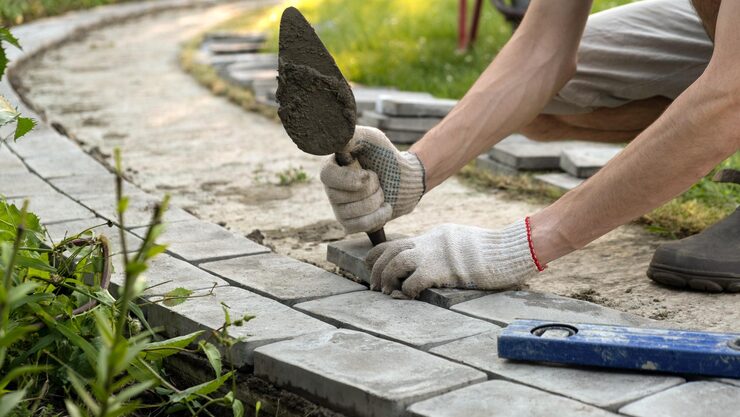
Concrete, brushed concrete pavers, natural stone, and clay brick all handle Natick's freeze-thaw cycles differently, age differently, and cost differently to repair later.
Poured concrete gives Natick walkways a clean, low-maintenance surface at a lower upfront cost, but once one section cracks from winter freeze-thaw, patching that slab leaves a visible repair that never quite blends in again.
Concrete pavers cost more to install but fail in pieces, not as a whole.
Natural stone – bluestone, fieldstone – suits older Natick homes near the center especially well, but irregular stone needs a skilled hand to set tightly and stays costlier to repair.
Clay brick ages with character and pairs naturally with Natick's colonial and cape-style homes, though it's more sensitive to frost heave than concrete or stone unless the base beneath it is properly excavated, compacted, and drained for our New England winters.
Drainage decides whether any material lasts
A walkway is a hard surface laid across ground that used to absorb water.
Choosing a material
The materials are not equal. Each suits some properties and not others.
Pitching the walk away from the foundation, even slightly, is the single most important grading decision on the job. It’s invisible once finished but it’s the difference between a dry foundation and a wet one.
On the lakeside lots around Cochituate, ground is often already closer to saturated for parts of the year, which makes correct pitch and a well-draining base even more important than on higher, drier ground.
Longer walks on the newer South Natick subdivision lots sometimes cross more than one grade change, which means the base has to be built in sections, each properly compacted, rather than as one flat run, so the finished surface stays level and sheds water correctly.
Tying the new walk into what's already there
A walkway rarely stands alone. It meets the driveway at one end, the entry steps at the other, and often runs past a retaining wall or planting beds.
Matching material, color, joint pattern, and edging to an existing Natick driveway or patio keeps the property looking planned rather than patched together, while proper base prep and pitch guard against the heaving and puddling common after New England winters.


Older Natick homes near the center often have mature plantings and established grade right up to the foundation, so a new walkway has to work around roots and existing drainage patterns, not just a blank lawn. We survey the route before any digging starts, noting where silver maples, old shrub beds, and hardscaping have shifted the soil over the decades, so the new path settles correctly rather than heaving or pooling water after the first hard freeze.
That same care carries through to material choice and layout. A walkway from the driveway to the front door, or a side path connecting to a patio, should match the pitch of the yard and tie into existing steps or retaining walls without awkward transitions. We lay a proper compacted base and account for tree roots so pavers or concrete stay stable instead of cracking within a season or two.
- Base prep suited to Natick’s clay-heavy, root-threaded soil
- Grading that directs water away from the foundation
- Material and joint choices that resist frost heave
The result is a walkway that looks intentional and holds up through freeze-thaw cycles for years to come.
What drives the price
A new walk has to meet several existing things cleanly.
- The entry : The walk must arrive at the door at a sensible height. The threshold sets the finished level, so the work starts at the door and runs outward.
- The drive : Where a walk meets a drive, the levels and the drainage have to agree. A mismatch becomes a trip edge or a puddle.
- Walls and planting : Existing stone walls, foundation beds and mature trees constrain the route. Roots under a path are worked around, not cut through without thought.
- An older house : Scale, colour and pattern should follow the architecture. A narrow, dark stone walk suits an old house differently than a broad paver field does.

Where this fits different Natick properties
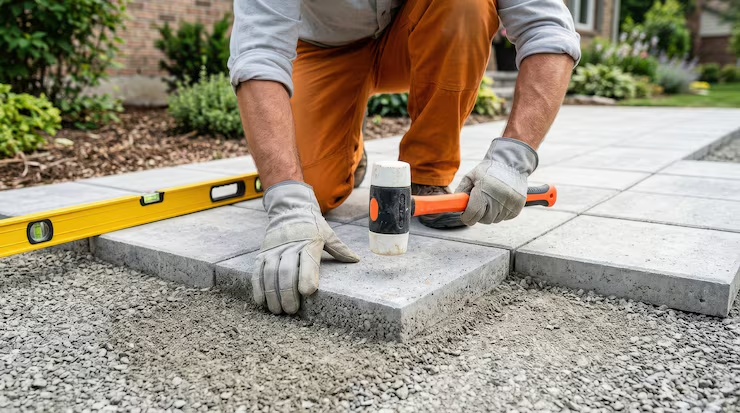
The right approach really does change block by block in this town. A dense street near the center usually means a shorter, narrower walk set close to the house, built to match an older facade and worked in around existing foundation plantings and whatever grade is already established – there’s rarely room, or reason, to change much about the layout.
Out toward the lake, lots tend to be more open and the ground wetter for more of the year, so the base and drainage work carries more weight in the plan than the material choice does. A walk here needs to shed water reliably before it needs to look a particular way.
In the newer South Natick subdivisions, lots are often larger with more distance between the driveway and the front door, sometimes crossing a grade change or curving around existing landscaping. These walks tend to be longer runs, which means the base has to be consistent across the whole length, not just at the ends.
Before you call
It helps to know:
- Where the walk starts and where it needs to end
- Whether the route crosses a slope or a shared area
- Which material you lean towards, and whether the house is older
- Where water currently runs on the property
Questions people ask
How is a walkway installation different from driveway paving?
A walkway carries foot traffic, not vehicle loads, so the base doesn't need to be built to the same depth or compaction standard as a driveway. That opens up material choices – natural stone, brick, decorative pavers – that wouldn't hold up under a car but work well underfoot and offer more design options to match the house.
Can an existing walkway be widened or extended instead of replaced?
Sometimes, if the existing base is sound and the material is still available or can be reasonably matched. More often the original base wasn't built to handle an extension, or the material has aged enough that a visible seam would show, so a full replacement gives a more consistent result.
Why does a walkway need to pitch away from the house?
Without a slight grade away from the foundation, rain running off the walkway surface heads toward the house instead of away from it, which over time can lead to water sitting against the foundation. Correct pitch is built in during grading and is one of the most important parts of the job, even though it's invisible once finished.
What causes a paver or brick walkway to become uneven over time?
Almost always it's what's happening below the surface, not the surface itself. Freeze-thaw cycles move soil beneath the base each winter, and if the base wasn't compacted properly or doesn't drain well, that movement eventually shows up as dips, lifted edges, or an uneven walking surface.
Does the style of an older Natick home limit material choices for a new walk?
It narrows the range more than it limits it. Natural stone and clay brick tend to suit older colonial and cape-style homes near the center of town, while concrete or paver options can work on newer construction without looking out of place. The goal is a walk that reads as part of the property, not an addition to it.
Next step
Call Driveway Specialists on (413) 337-3772. We are a family-run company in business since 1988, and we will walk the route with you and talk through material, grade and drainage before anything is priced.