
Walkway Installation in Hudson, MA
A walkway in Hudson has a different job depending on which part of town it sits in. Close to the old mill streets, lots are tight and the walk from the sidewalk to the front door is often the single most visible piece of hardscape on the property, squeezed between a narrow drive and a foundation planting bed that has been there for decades. Out in the newer subdivisions, frontage is wider, the walk may run from a driveway apron across open lawn to an entry porch, and it has room to be a real design feature rather than just a strip of pavers getting you to the door. Both situations call for the same underlying work, but the decisions about width, material and layout are different.
What you are improving here is not a failed surface, the way a cracked driveway is a failed surface. You are adding something that was either never built properly or was poured as a plain concrete slab decades ago and now looks tired next to a renovated entry. The goal is a walk that reads as part of the house, sits flat through winter after winter, and does not fight with the drainage that is already happening around the foundation.
Everything that matters on a walkway is invisible once the job is done. Excavation depth, base material, compaction, bedding layer, edge restraint. Skip or shortchange any one of those and the surface above it will eventually show it, usually as a dip, a heave, or a joint that has opened up. Frost in Massachusetts does not politely sit still under a path. Water in the soil beneath an improperly prepared walk freezes and expands, lifts the surface unevenly, then lets it back down in spring. Repeat that every winter and a walkway without a proper base and drainage path will wander out of level within a few seasons, while one built on a compacted, free-draining base stays put because there is nothing underneath it to move.
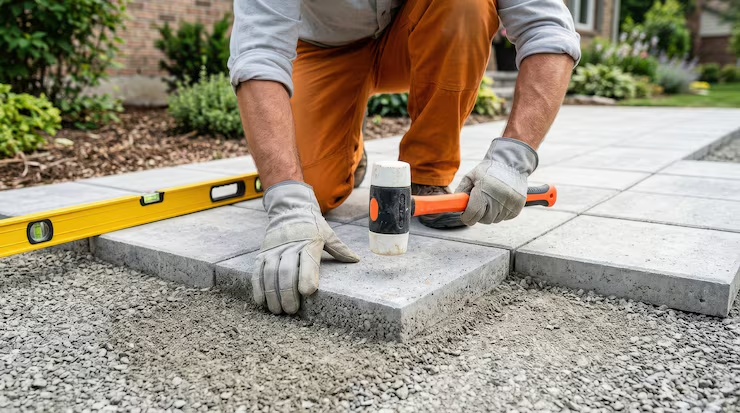
Edge restraint matters more on a walkway than people expect, because a path is narrow and every paver or slab is close to an edge. Without something holding the sides, the whole assembly can spread sideways over time, especially where it is adjacent to a mower strip or planting bed that gets worked every year. Restraint set below grade and backed properly is what keeps a two- or three-foot-wide walk from slowly widening into the lawn on either side.
Material choice is worth thinking through for a Hudson property specifically. A paver walk handles the freeze-thaw cycle well because the joints give it a little flexibility that a monolithic slab does not have, and individual pavers can be lifted and reset if a tree root or settling spot ever calls for it. Natural stone or stamped concrete can match an older home’s character near the mill district streets, while a cleaner paver or poured pattern often suits the newer subdivisions where the entry itself is more contemporary. Width matters too: a walk that only needs to fit one person comfortably is a different project than one meant to handle two people walking side by side or a stroller alongside a visitor.


What Our Clients Say
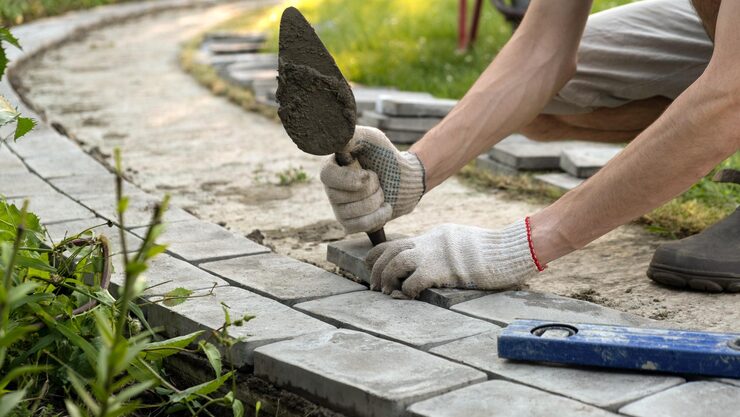
Bluestone fits the older, formal entries found near the Hudson mill district, where a quarried-stone look suits the house.
Concrete pavers cost less than natural stone and come in enough shapes to suit either a tight mill-area lot or a wide subdivision frontage without looking out of place.
Poured concrete is the cheapest option for Hudson walkways, but also the hardest to repair in pieces. A frost crack in one slab usually means replacing the whole section, not just a stone, come spring thaw.
Brick reads as traditional against older Hudson homes but spalls faster in freeze-thaw than dense concrete pavers, and matching aged brick later gets harder every year.
Gravel or stepping-stone paths suit side yards and secondary routes around Hudson properties, not the main entry walk.
A hard surface sheds water instead of absorbing it. In Hudson, we pitch each walkway away from the house and toward a safe outlet, not toward the foundation, a crawlspace, or your neighbor’s yard.
Choosing a material
The materials are not equal. Each suits some properties and not others.
On a sloped Hudson lot, a walkway running downhill toward an entry needs a grade plan that carries water off to the side before it reaches the steps or door, with a stable base and textured pavers to keep footing sure through icy winters.
Where a Hudson walkway crosses a low spot in the yard, a drain or gravel-filled channel beneath the base keeps water from pooling there, protecting pavers and joints from heaving and cracking through freeze-thaw cycles each spring.
A new Hudson walkway has to meet the driveway apron, entry step, and any existing wall or planting bed at a height, slope, and line that looks planned, not patched in.
Matching an older Hudson house usually means a simpler material and a straighter line rather than an elaborate pattern that competes with the architecture.
Where a driveway meets the walk, the two surfaces should share a sensible transition, not an abrupt material change that becomes a tripping edge once settled.


Where this suits Hudson properties
Hudson’s mix of neighborhoods is why this work looks different from one street to the next. Near the mill district, lots are compact and setbacks tight, so the walk from sidewalk to door is often the only visible hardscape, running close beside a narrow drive and established foundation plantings. Crew access is tighter too, with material staged and moved by hand more than wheeled in, and the finished walk needs a scale that suits an older house rather than overwhelm it.
Out toward the newer subdivisions, wider frontage gives a walkway more room to work, curving across a lawn from a driveway apron to a porch, with space for a border planting or a small entry landing. These lots typically drain better and offer easier access for equipment, which keeps the job simpler. Either way, the fundamentals stay the same: a compacted base that won’t hold water, edge restraint to keep the sides from spreading, and a material chosen to hold up through Massachusetts winters, not just look good on day one.
What drives the price
A new walk has to meet several existing things cleanly.
- The entry : The walk must arrive at the door at a sensible height. The threshold sets the finished level, so the work starts at the door and runs outward.
- The drive : Where a walk meets a drive, the levels and the drainage have to agree. A mismatch becomes a trip edge or a puddle.
- Walls and planting : Existing stone walls, foundation beds and mature trees constrain the route. Roots under a path are worked around, not cut through without thought.
- An older house : Scale, colour and pattern should follow the architecture. A narrow, dark stone walk suits an old house differently than a broad paver field does.

Next step
If you are weighing materials for a Hudson walkway, or trying to figure out how a new path should tie into an existing drive and entry, that is a conversation worth having before anything is dug. Grade matters as much as looks: a walkway that pitches water toward a foundation or pools at the first step becomes a maintenance headache fast, and Hudson’s mix of older, tree-lined lots near the center and newer, more open frontage further out each present their own drainage and soil quirks. Driveway Specialists has worked on hardscape across Middlesex County since 1988, so a crew arriving at your property has likely already handled a similar grade, a similar tie-in, or a similar material pairing nearby.
- Matching a new walkway’s material and joint lines to an existing driveway or patio
- Planning base depth and drainage so the path holds up through freeze-thaw seasons
- Routing the layout around trees, utilities, and entry points without awkward angles
Call (413) 337-3772 to talk through the layout, the material options, and what the ground on your property actually calls for before any plans are finalized.
Before you call
It helps to know:
- Where the walk starts and where it needs to end
- Whether the route crosses a slope or a shared area
- Which material you lean towards, and whether the house is older
- Where water currently runs on the property
Questions people ask
What is the best walkway material for an older Hudson home?
It depends on the house. Bluestone or a traditional-pattern concrete paver generally suits homes near the mill district better than poured concrete, because the texture and joint lines read as intentional rather than utilitarian. Newer subdivision homes have more flexibility since there is no established streetscape to match.
Why does a concrete walkway crack in winter even when the driveway next to it is fine?
A walkway is narrower and often has less base depth than a driveway, so it is more sensitive to frost movement underneath. If the base wasn't compacted properly or water sits under the slab, freeze-thaw cycles will crack a thin walk before they affect a thicker driveway.
Can a new walkway be installed without disturbing existing landscaping?
In most cases, yes, especially on the narrower lots near Hudson's center where plantings are close to the path. Excavation can be kept tight to the footprint of the new walk, though mature root systems near the edges sometimes need to be worked around rather than cut through.
How does drainage around a walkway affect the foundation?
A hardscaped path sheds water instead of letting it soak in, so if it's pitched toward the house, that runoff ends up at the foundation. Grading the walk to carry water away, or installing a drain where the path crosses a low point, keeps that water from becoming a basement or crawlspace problem.
Next step
Call Driveway Specialists on (413) 337-3772. We are a family-run company in business since 1988, and we will walk the route with you and talk through material, grade and drainage before anything is priced.