
Patios in Littleton, MA
A lot of Littleton properties share the same layout: a long gravel or asphalt drive cutting back from the road, a house set well off the street, and a good amount of open or wooded ground around it that never got used for anything except mowing. If you’re looking at that space and thinking about a patio, you’re not fixing a problem the way a cracked driveway is a problem. You’re deciding how the back of the house, or the end of that long drive, actually gets lived in.
That decision is as much about drainage and base as it is about the stone you pick. Littleton’s sandy, well-drained glacial soil is actually a good starting point for hardscape – it’s one of the reasons gravel-to-asphalt conversions do well out here, and the same base logic applies to a patio. But sandy soil still needs to be excavated, compacted, and built up correctly, or the surface will settle unevenly within a few seasons regardless of how good the drainage is underneath it.
Strip the topsoil and organic layer first – that part can’t be skipped, sand included, because roots and loam compress and shift under a patio in a way that compacted aggregate base won’t. On a sandy base in Littleton, a properly compacted gravel sub-base drains fast and holds its shape through winter, which matters more here than in towns with heavier clay soils that hold water against the base. The bedding layer on top, usually a thin layer of coarse sand, is what lets individual pavers or flagstones settle evenly and stay level rather than rocking underfoot. Edge restraint – a hidden plastic or aluminum edge, or a mortared stone border – keeps the whole field from creeping outward as frost pushes and pulls at it every winter. Skip any one of these steps and the patio looks fine the first year and wavy by the third.
Layout matters too, especially on the wooded lots common around Littleton. A patio tucked near mature trees needs root-aware excavation so you’re not cutting through anything that keeps a tree healthy, and it needs a slight pitch away from the house regardless of how flat the surrounding ground looks. On open rural lots with no real shade, orientation relative to the house and the afternoon sun often matters more than the stone pattern itself – a patio planned without that in mind ends up used half as much as one that is.
Material choice follows from how the space gets used, not the other way around. Flagstone with wide joints reads informal and fits a wooded, rural setting well; tighter-cut pavers in a running bond look more finished near a newer build. Either way, the pattern and joint width should be decided after the base plan, not before it – a beautiful material laid on a rushed base still fails the same way a cheap one does.


What Our Clients Say
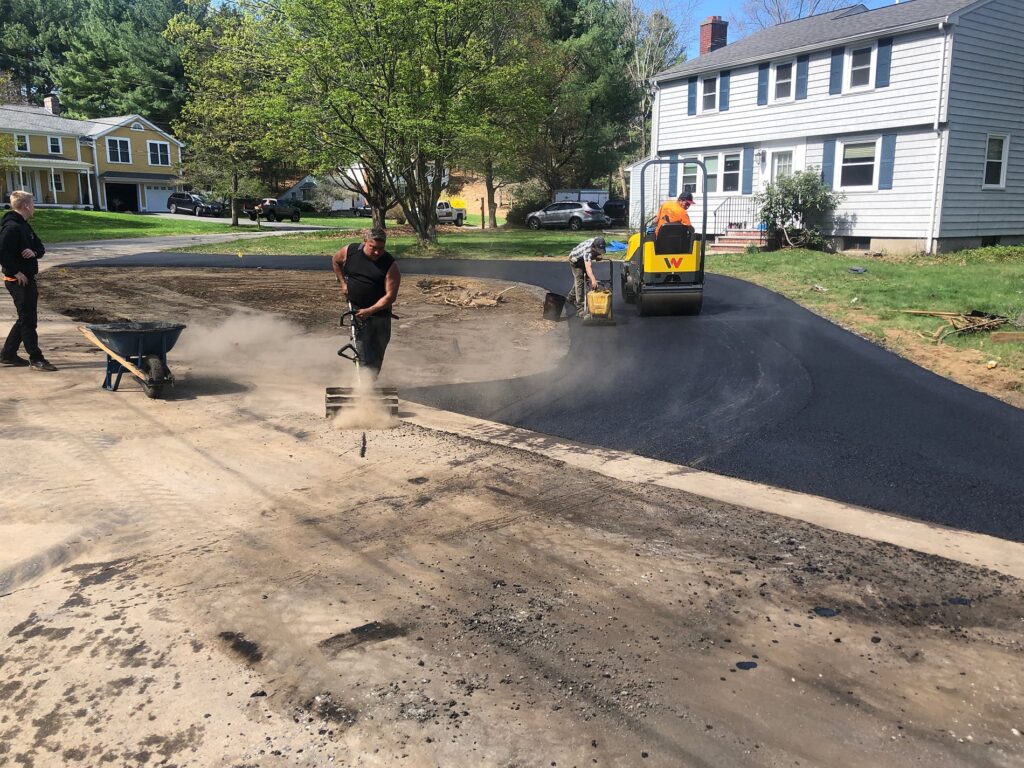
What happens below the surface
A patio is a thin finished layer sitting on a structure you never see. That structure decides whether the surface is flat in ten years or wavy in two.
Material choice sets the tone for the whole Littleton property.
Clay pavers hold color well and handle Littleton's freeze-thaw cycles cleanly, but a cracked one means special-ordering a match rather than lifting a spare from a leftover stack.
Natural flagstone looks right against an older Littleton farmhouse or a wooded lot, lending a patio timeless character.
Poured concrete is the cheapest patio option up front, but it cracks as one solid piece, and in Littleton’s freeze-thaw winters a hairline crack rarely stays small—it widens, heaves, and spreads until the whole slab needs replacing.
Mortared stone over a slab resists weeds and shifting best, but it’s unforgiving if the base below it was ever under-built or poorly drained.
Grade and drainage come first
Water has to go somewhere once a hard surface replaces lawn or gravel.
Materials and the trade-offs
On a sloped Littleton lot, a patio built level into a hillside often needs a low retaining wall or a drainage channel behind it to keep runoff from pooling against the house foundation, protecting both the patio base and your home's structure for years ahead.
Flat frontage lots have it easier – grading just needs to carry water out toward the yard or a existing swale, not toward the gravel drive.
Tying a new Littleton patio into an existing driveway, walkway or retaining wall means matching joint width, color, and laying pattern, not just material.
On older Littleton farmhouses, a patio that echoes the fieldstone foundation or an existing stone wall on the property reads as original rather than added on.
Mature trees near the build area mean working around root zones – cutting major roots to set a base can kill the tree slowly over several seasons.
Working around what's already there
Littleton’s rural and semi-rural lots often carry a lot of established landscaping – stone walls, mature trees, old plantings, sloped lawns that have settled into their own shape over decades. A patio here has to sit into that existing landscape, not compete with it, which usually means adjusting the layout rather than clearing ground to force in a standard rectangle.
That starts with a proper look at the site before any design is drawn up: where roots run close to the surface, how water moves across the lot after heavy rain, which stone walls or retaining features are structural and which are decorative, and where the ground has already settled versus where it’s likely to shift. Mature trees in particular shape the whole plan – root protection zones limit excavation and base depth in places, so the patio outline often curves or steps around them rather than cutting straight across.
What the work involves on a typical Littleton lot
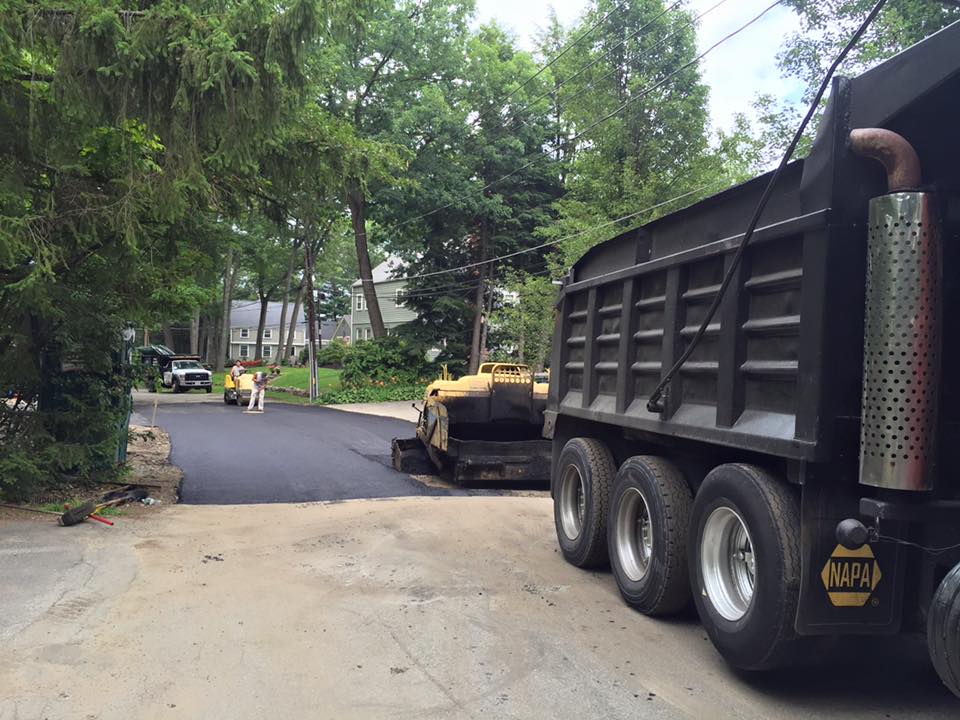
Most patio projects here start with a site walk to look at existing grade, tree root zones, and where the ground naturally wants to shed water. On a long rural drive, access for equipment is rarely the issue it would be on a tight suburban street – there’s usually room to bring in a mini excavator and a loaded dump trailer without disrupting the whole property.
From there it’s excavation to remove topsoil and set the sub-grade, a compacted gravel base sized to the soil underneath it, bedding sand, then the paver, flagstone, or mortared surface itself, finished with edge restraint and jointing sand or mortar. On sandy Littleton soil this base work moves faster than it would on heavy clay, since the material drains itself rather than fighting the compaction equipment. That’s a real advantage, but it still has to be done – sandy soil that’s merely graded and not compacted will settle just as unevenly as any other ground, just more slowly and less predictably.
Where this suits Littleton properties
Long rural drives
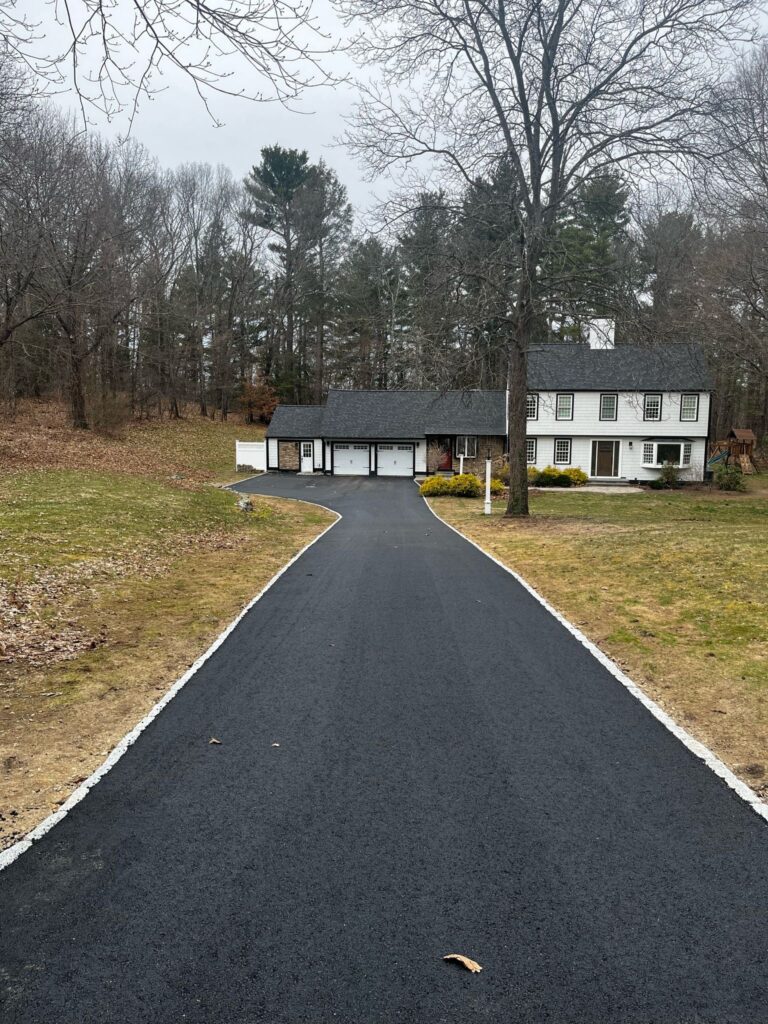
A patio set at the end or alongside a long gravel-to-asphalt drive gives the property a destination point, and the same base principles used on the drive carry over to the patio pad.
Wooded, sloped lots
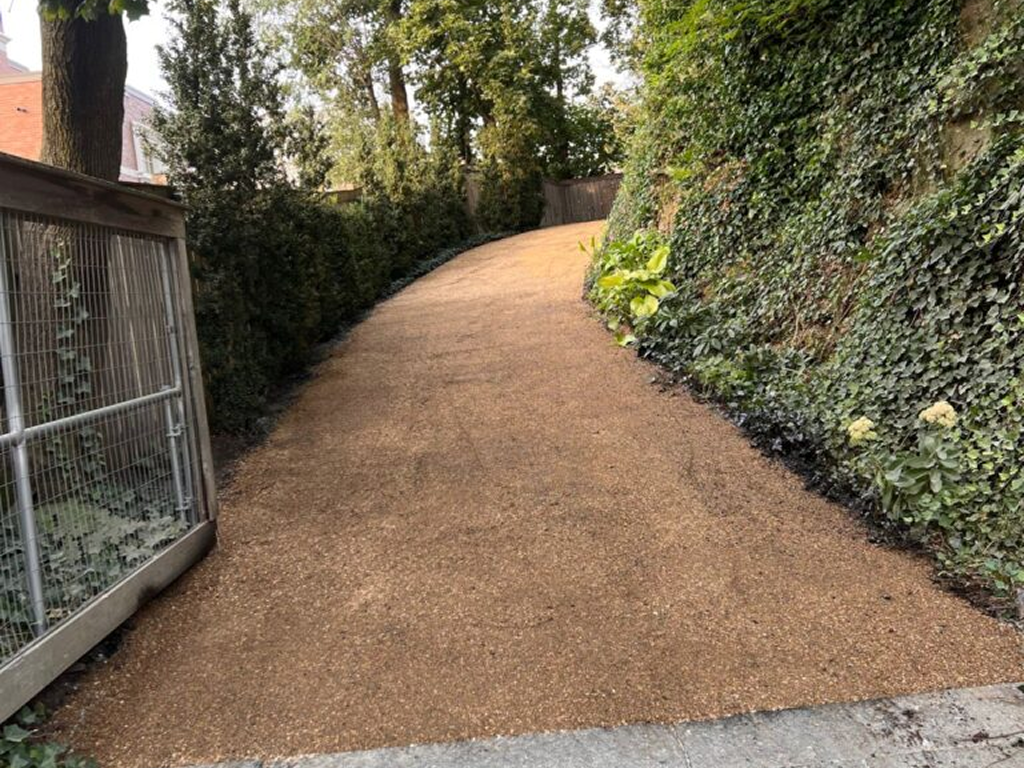
Littleton's mix of mature trees and uneven ground often calls for a patio built with a retaining edge or stepped grade rather than one flat slab, keeping runoff and root zones under control.
Older farmhouse properties
Fieldstone and flagstone patios tie naturally into older stone foundations and existing walls, reading as part of the original property rather than a modern addition.
Questions about patios in Littleton
Does Littleton's sandy soil make patio installation easier?
It helps with drainage and compaction speed, since sand drains and compacts more predictably than clay. But topsoil still has to be stripped and a proper gravel base still has to be built – sandy ground skips none of those steps, it just moves through them faster.
Can a patio be built around mature trees on my property?
Yes, but it means adjusting the layout and depth of excavation to avoid cutting major roots. Cutting through a tree's main root zone to level a base can slowly kill the tree over following seasons, so the design often works around the tree rather than through it.
What's the difference between a patio project and a driveway project here?
A driveway has to handle vehicle loads and is usually tied to the road or a curb cut. A patio is a living surface built for foot traffic and appearance, with more flexibility in material and layout, and the grading plan is built around the house rather than the street.
Will a concrete paver patio match my existing stone walls?
Not directly, but the laying pattern and jointing can be matched in tone and texture. For a closer match to existing fieldstone walls, natural flagstone or fieldstone paving is usually the better fit than manufactured concrete pavers.
Next step
Tell us what you have: the slope, the house, how the space gets used. We will look at the lot and talk through what will work on it. Call Driveway Specialists at (413) 337-3772. We are family-run and have been working in Massachusetts since 1988.