
Walkway Installation in Wellesley, MA
A lot of Wellesley properties were built with a drive and a front door, and not much thought given to how a person actually walks from one to the other. Add a mature landscape, an ornamental entry drive, and a house with real architectural presence, and a bare strip of lawn or a cracked old concrete path starts to look out of place. The brief here is usually not repair. It is building something that reads as intentional, holds its line through a New England winter, and matches a property where the finish expectations are already high.
That changes the decision-making. You are choosing a material for how it ages next to brick and fieldstone, not just for cost per square foot, and you are tying a new path into an existing drive, entry steps, and planting beds that were probably put in by someone else years ago. Getting the transitions right, where the walkway meets a granite step, wraps a tree well, or lines up with a front walk’s existing width, matters as much as the material itself. A path that’s six inches off-axis from the front door reads as a mistake forever, even if the surface itself is flawless.
What’s actually happening underground
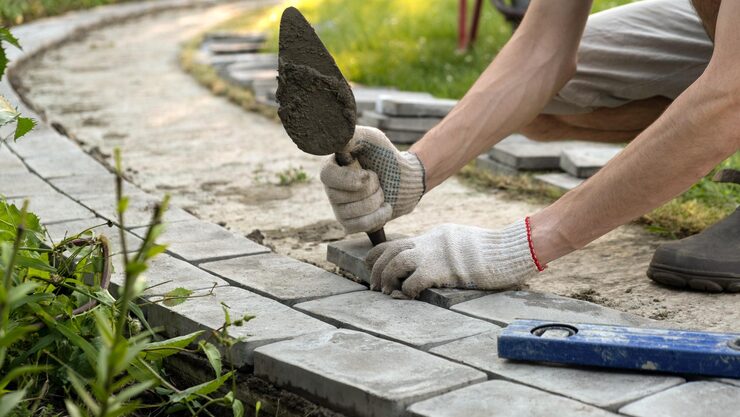
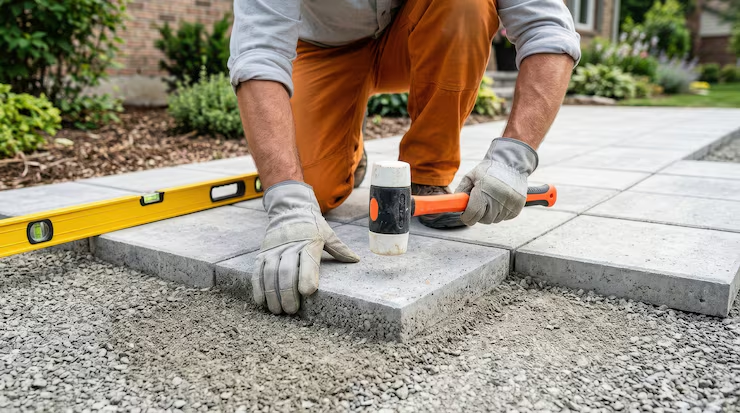
A walkway that stays flat and one that heaves and separates are built the same way on top. The difference is below grade. Proper installation means excavating past the topsoil and organic layer, laying a compacted aggregate base deep enough to manage water and resist frost movement, bedding the surface material correctly, and setting edge restraint that holds the line under pressure from lawn equipment, snow plows at the curb, and the freeze-thaw cycle that runs through a Massachusetts winter. Skip or shortcut any one of those steps and the surface will tell you within a season or two, no matter how good the material on top looks.
Frost is the part almost nobody explains properly. Water in the soil beneath a walkway freezes and expands, then thaws and settles, over and over, all winter. A base built to drain will move evenly, if at all. A base that traps water moves unevenly, and that is what produces the lifted pavers, the stepped joints, and the hollow sound underfoot that shows up a few years after a cheap installation. Grading matters just as much: a walkway needs enough pitch to shed water away from the house and off the surface itself, without being so steep it becomes a hazard in icy weather.
Materials carry real trade-offs, not just a style choice:


What Our Clients Say
Drainage and grade
A walkway must pitch water away from the foundation and entry steps, working with your lot's existing grade.
Tying into an existing drive
Most of this work ties into an existing Wellesley driveway rather than standing alone.
Matching an older house
Many Wellesley homes have real age and detail to them. A new walkway next to a decades-old foundation and mature plantings needs a material and pattern that looks considered, not like a visibly newer addition bolted on.
Entry steps and thresholds
Where a walkway meets the front steps is a common failure point in Wellesley. Unless base and steps move together, uneven settling creates a step or gap that worsens with each freeze-thaw cycle.
Working around mature landscaping
Established trees and planting beds mean roots, shade, and irrigation lines already in the ground. Excavation has to work around them, and a path running near mature roots needs a base that tolerates some movement.
Edge restraint and plow damage
An unrestrained edge is the first thing to fail, especially near a drive where a plow blade can catch it.
Choosing a material
The materials are not equal. Each suits some properties and not others.
Pattern and scale
A walkway on a sprawling Wellesley lot reads differently than one on a tight frontage. Width, pattern, and material scale should suit the house and approach, not simply fill the gap between drive and door.
Repairability over time
Ground moves eventually, everywhere in Massachusetts. A material and installation that allow a section to be lifted, reset, and matched later cost less to own over the years than one where any damage means replacing the whole run.
New builds and major renovations
Wellesley has steady teardown-rebuild activity, and a new or renovated home is the natural point to plan the walkway alongside the drive and entry, rather than adding it as an afterthought once landscaping is finished.
Working with other trades
On Wellesley renovations, walkway work often has to sequence around landscapers, masons setting entry steps, electricians running path lighting, and final grading. Getting that order right avoids redoing compacted base work that another trade disturbs later, saving time and cost.
Why Wellesley lots suit this kind of work
Established lots, ornamental drives, and high finish expectations are exactly where a well-built walkway earns its cost. It’s visible every day, it’s the first thing a visitor’s foot actually touches, and it’s worth building once, correctly.


Choosing a material for this property
The right material depends on what the house already is, not a general preference. Stone or high-end pavers suit a traditional colonial or stone-and-brick facade common around Wellesley, where a poured concrete path would look visibly cheaper than everything around it. A more contemporary rebuild can carry a cleaner concrete or large-format paver walk without looking out of place, provided the joints and edges are done with the same care as the rest of the property. Cost matters too, but on a property where the drive and entry were already a real investment, a walkway that looks like an afterthought undercuts that investment rather than completing it.
- Grade and drainage, so water sheds away from the foundation and steps instead of pooling on the walk
- Shade and root pattern from mature trees, which affects both material choice and how the base is built
- How the new walk ties into the existing drive, steps, and entry so materials and lines read as one property, not two projects
We walk the site and recommend a material and layout based on what actually suits that specific property, not a standard package.
What drives the price
A new walk has to meet several existing things cleanly.
- The entry : The walk must arrive at the door at a sensible height. The threshold sets the finished level, so the work starts at the door and runs outward.
- The drive : Where a walk meets a drive, the levels and the drainage have to agree. A mismatch becomes a trip edge or a puddle.
- Walls and planting : Existing stone walls, foundation beds and mature trees constrain the route. Roots under a path are worked around, not cut through without thought.
- An older house : Scale, colour and pattern should follow the architecture. A narrow, dark stone walk suits an old house differently than a broad paver field does.

Getting started
If you’re planning a new front walk, replacing a failing concrete path, or working out how a walkway should tie into a drive and entry as part of a larger renovation, we look at the site in person before recommending anything. Wellesley lots vary enough, from flat established frontages near the Village to sloped lots with mature trees, stone walls, and existing plantings further out, that a phone estimate isn’t worth much. Grade changes, tree roots, and tie-ins to existing stonework or steps all affect material choice and layout, and those details only show up on a walk-through.
Call Driveway Specialists at (413) 337-3772 to talk through what you’re trying to do and arrange a time to walk the property. On that visit we’ll talk through:
- Material options – bluestone, brick, pavers, or stamped concrete – and how each holds up through New England winters
- How the new walkway should relate to your driveway, entry, and any steps or retaining walls
- Drainage and grading, especially on sloped lots
Before you call
It helps to know:
- Where the walk starts and where it needs to end
- Whether the route crosses a slope or a shared area
- Which material you lean towards, and whether the house is older
- Where water currently runs on the property
Questions people ask
Can a walk be built on a steep Wellesley lot?
Yes. The route usually changes. It may zigzag, step up in stages or include landings. The base and drainage matter more on a slope, not less.
Do I need the walk pitched away from the house?
Yes. A walk that falls toward the foundation sends water to the wrong place. The pitch is gentle and almost invisible.
Pavers or poured concrete?
Pavers can be lifted and reset if the ground moves. Concrete cannot be repaired cleanly once it cracks. Concrete is simpler for a long straight run, and pavers allow more variety and easier repair.
Can you match a walk to an older house?
Usually. Material, colour, scale and pattern all matter, and we can talk through what suits the architecture before anything is ordered.
Why does the base matter more than the surface?
Frost lifts what sits above it. A deep, well-compacted, free-draining base gives frost nothing to work with, and that is why a well-built walk stays flat.
What does a walkway cost?
It depends on length, material, slope and access. We quote after seeing the site.
Next step
Call Driveway Specialists on (413) 337-3772. We are a family-run company in business since 1988, and we will walk the route with you and talk through material, grade and drainage before anything is priced.