
Cobblestone Aprons and Edging in Chestnut Hill, MA
Chestnut Hill houses tend to be older and larger, set back on short, formal drives that were built to be looked at as much as driven on. The apron where the drive meets the street, and the edge that holds the whole surface together, do more for the look of the property than almost anything else on the lot. A worn asphalt lip or a crumbling edge reads as neglect against a well-kept facade, even when the rest of the drive is sound. Cobblestone fixes that transition and gives the edge a line that stays straight, crisp, and in proportion with the house behind it.
None of that works unless what is under the stone is done properly. Cobblestone laid on a thin bed of sand over compacted soil looks fine for a season and then starts to rock, gap, and sink unevenly as the ground below it moves with the frost. The work that actually matters here is excavation to a stable depth, a crushed stone base compacted in layers, a bedding layer that lets individual stones be set true, and an edge restraint that keeps the whole assembly from creeping sideways under a snowplow blade or a turning wheel. Frost in a Massachusetts winter moves water in the soil up and down through the base, and an apron without a proper restrained edge will walk outward a little more each year until the pattern opens up and stones start to shift underfoot. The difference between an apron that still looks tight after ten winters and one that needs resetting after three almost always comes down to what was done before the first stone went in.
Chestnut Hill’s housing stock is older than most of the surrounding suburbs, and a lot of it has stone walls, brick walks, or granite curbing already in place. Cobblestone edging reads as continuous with that material palette in a way that poured concrete or a plain asphalt lip does not. Getting the color and jointing right so the new work sits next to existing stonework without looking like an obvious addition is as much of the job as the compaction underneath it. A granite-edged apron paired with a bluestone walk, or reclaimed cobble that echoes a fieldstone wall at the property line, tends to look like it belongs rather than looks installed.
Scale matters as much as material. A long, formal drive calls for an apron and edge detail sized to match, not a narrow strip that looks tacked on at the street. Options worth weighing before work starts include:
- Full cobblestone apron versus a cobblestone border framing asphalt or exposed aggregate
- Reclaimed granite cobble for a weathered match to existing stonework, versus new-cut stone for a cleaner, more formal line
- Soldier-course or radius edging where the drive curves or widens near the garage
Each of these decisions affects both the finished look and the long-term performance of the edge, which is why getting the base right and the layout right at the outset saves having to redo the visible work later.


What Our Clients Say

What the work involves below the surface
The stone is the last and smallest part of the job. A cobblestone apron stays flat or goes wavy depending on what is underneath it.
Granite vs. concrete cobbles
Reclaimed granite holds its edge and color for decades but costs more and needs careful sourcing to match. Concrete cobbles cost less and come in consistent batches, but they wear and fade faster and chip more visibly at the edge.
Repairing a damaged section
A well-built cobblestone edge can be lifted and reset section by section without disturbing the rest. That is one of its real advantages over a continuous poured strip, which usually has to be broken out entirely.
Pitch away from the house
A hard surface sheds water instead of absorbing it, so the apron and any edging has to be pitched away from the foundation. Get this wrong and water finds the basement instead of the street.
Tying into existing walls
Where a drive already runs past a stone wall or a brick walk, the new apron has to pick up the same joint lines and stone coloring, or it reads as a patch rather than a finished edge.
The street-side transition
Where the apron meets a Chestnut Hill road, the curb cut and the first few feet follow the town’s standard width and material. Past that line, stone choice, pattern, border edging and pitch are entirely the homeowner’s decision.
Materials and the trade-offs
Why the edge is the part that fails first
Most driveway failures that look like a surface problem actually start at the edge. Asphalt has no restraint of its own; it depends on the ground beside it to hold its shape. Once that edge loses support, from a mower, a plow blade, or ordinary frost heave in the adjacent soil, the asphalt ravels and the damage works its way inward. Cobblestone solves this directly: set into a compacted base with proper restraint behind it, it becomes the edge rather than something propped against one. It also gives a plow operator a hard line to find instead of guessing where pavement ends and lawn begins, which matters where stonework is costly to repair.


Drainage decisions that outlast the stone
Putting a hard surface where soil used to be changes where rainwater goes, and on an older lot with mature trees and established plantings, that water has somewhere specific it should not end up. The apron and edging need a pitch that carries water toward the street or a drainage swale, not toward the foundation or a neighboring lot. Jointing sand between cobbles allows some infiltration, which helps on tighter sites where a fully sealed surface would otherwise concentrate runoff into one narrow channel.
Tree roots are a factor too. Mature oaks and maples common to this part of Norfolk County can heave a base built too shallow or too close to a trunk, and a cobblestone edge that is disturbed by root growth is far easier to lift and reset than a continuous concrete curb would be. That repairability is one of the stronger practical arguments for cobblestone on an older, well-landscaped lot, separate from how it looks.
Suited to the way Chestnut Hill properties are built
Short, ornamental drives on older lots are exactly where cobblestone aprons and edging earn their keep. The scale is right: a long cobblestone treatment on a quarter-mile driveway starts to look like a different kind of project, but on a drive measured in tens of feet it reads as a deliberate, finished detail rather than an expense for its own sake. The finish expectations in this part of Norfolk County, close by the Brookline and Newton line, tend to be higher than average, and an apron is one of the few elements of a property that every visitor and every passerby sees up close.
It also suits sites where the drive has to coexist with existing stone walls, brick walkways or granite curbing, because the material vocabulary already matches. Where a property has none of that older stonework and the house itself is more modern, a simpler asphalt apron with a clean edge may be the more honest and economical choice. Cobblestone is a fit for the house it is going next to, not a default upgrade for every drive.
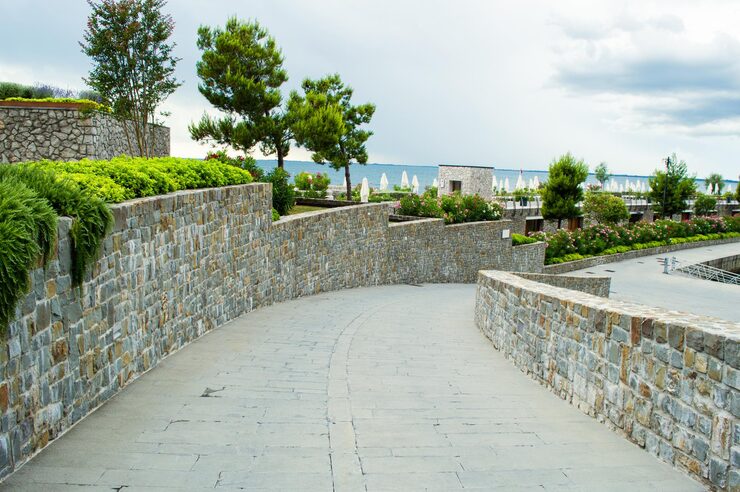
Where this suits Chestnut Hill properties
Older homes with existing stonework
Properties with stone walls, granite curbing or brick walks already in place give cobblestone a material match to carry through, so the apron reads as original rather than added on.
Short, formal drives
A drive measured in tens of feet rather than hundreds suits the slower, more detailed installation cobblestone requires, and keeps the cost in proportion to the visible result.
High-visibility entries
Where the apron and front walk are the first thing a visitor sees, the finish quality of the edge detail carries more weight than it would on a long, less visible driveway further from the house.
So tar and chip suits a longer, gentler Chestnut Hill drive with some room around it. It is a poor match for a short, steep or shared one, or one that opens straight onto the walk.
Questions we hear
Does cobblestone work on a short Chestnut Hill driveway, or is it only practical on larger estates?
Short drives are actually where it fits best. The cost and installation time scale with length, so a compact apron keeps the project proportionate while still giving the visible finish older homes in this area tend to call for.
How does a cobblestone edge hold up against snowplows?
Better than an unrestrained asphalt edge, because a plow blade has a solid line to follow instead of catching loose pavement. The stone itself can chip over many winters, but individual stones can be reset without redoing the whole run.
Can cobblestone be matched to an existing stone wall or walkway?
Usually, yes, though it depends on sourcing stone close in color and finish to what's already there. Reclaimed granite gives the best match to older existing stonework; new-cut or concrete cobbles are harder to blend in convincingly.
Who is responsible for the curb cut where the apron meets the street?
Where the drive meets a town-accepted road, the curb cut and the first section follow the town's standard. Everything behind that line, the stone choice, pattern and pitch, is the property owner's decision.
What happens underneath the stone that affects how long it lasts?
Excavation depth, compacted base and a proper edge restraint decide whether the stones stay flat through freeze-thaw cycles or gradually shift and gap. A thin bed over unprepared soil will fail regardless of how good the stone itself is.
Next step
Call us at (413) 337-3772. Tell us about the lot, the slope and what you want the frontage to look like. We have been working in this area since 1988, and we will tell you plainly what suits your property.