
Cobblestone Aprons and Edging in Sherborn; MA
A lot of Sherborn properties share the same shape: a long private drive running through trees before the house ever comes into view, a street frontage that’s more woods than lawn, and a wide piece of ground where conservation land or a stone wall marks the real edge of the property. On a lot like that, the first few feet where the drive meets the road often get less attention than the house itself, and it shows. A soft, unmarked transition at the street end wears down fast under plow blades and delivery trucks, and a drive with no edge definition slowly loses its shape into the surrounding lawn or woods.
A cobblestone apron and matching edging fix that without turning the entrance into something that looks out of place against an older house and mature trees. Done well, it reads as if it’s always been there, more like something original to the property than an add-on.
What’s happening below the stone
The visible cobblestone is the easy part to picture. What decides whether it stays flat or starts rocking within a few winters is everything underneath: excavation to a stable depth, a compacted base that can take the freeze-thaw cycle without shifting, and a setting bed that holds each stone firmly while still allowing a little movement instead of cracking. Massachusetts frost pushes up on anything set too shallow or bedded in soil that holds water. On a Sherborn lot with ledge close to the surface in places and clay pockets in others, the base has to be built to match what’s actually under that specific stretch of ground, not a single spec for the whole drive.
Edge restraint matters just as much as the base. Loose-set stone without a proper restrained edge will splay outward under the weight of a vehicle or a plow within a season or two. A well-built edge holds the line of the drive and keeps the asphalt or gravel field it borders from spreading, which is especially important on the long gravel and chip-seal drives common out here.
Layout decisions also matter more in Sherborn than in a tighter suburban setting. With long sightlines through trees and a slow approach to the house, an apron that’s too narrow or too straight-edged can look thin against the scale of the property. Widening the radius slightly at the street, or running the apron a bit further up the drive than the minimum, usually reads as more intentional and proportionate once the trees fill back in around it.
Stone selection is worth slowing down on too. Reclaimed granite cobbles pair naturally with the stone walls and older farmhouses scattered through town, while a cleaner-cut cobble suits a newer build without fighting the wooded setting. Either way, matching the joint pattern and coursing to what’s already on the property, rather than defaulting to a standard layout, is usually what makes the finished entrance look settled rather than inserted.


What Our Clients Say

What the work involves below the surface
The stone is the last and smallest part of the job. A cobblestone apron stays flat or goes wavy depending on what is underneath it.
Granite cobblestone is quarried for durability and ages without losing its edge, which matters on a long drive that sees plow blades every winter.
Cobblestone aprons and edging add timeless character to Sherborn's stone-wall lined properties, framing driveways with durable granite or Belgian block.
Belgian block sits between the two: a squared, more formal stone that reads well against a classic colonial or center-chimney house.
Reclaimed granite carries a weathered, irregular face that new-cut stone can't replicate, which matters when matching century-old fieldstone walls common throughout Sherborn.
Every material choice is a trade-off between upfront cost, how it weathers New England winters, and how easily a damaged section can be repaired later.
Materials and the trade-offs
Drainage and grade
Adding a hard edge and surface where there was none changes how water moves across a Sherborn property, and on a wooded lot that water needs somewhere specific to go. An apron set flat or pitched toward the house pushes runoff back at the foundation or across a garage floor during a hard rain. The fix is pitching the stone and base away from the house, toward a spot where water can disperse into the soil or an existing swale, not just toward the nearest low point by accident. On a long drive running through woods, this means reading the grade for the full length, since a low spot halfway down can hold water against the edging and accelerate frost heave there every winter.


Tying into what's already there
New cobblestone work rarely stands alone on an established Sherborn property. It usually has to meet an existing driveway surface, line up with a front walk or entry, and sit comfortably next to stone walls, plantings, or a fieldstone foundation that’s been there for decades. Matching stone color, joint width, and laying pattern to what already exists on the property keeps the new work from looking like an obvious add-on. On older houses, that often means choosing reclaimed or aged-face stone over a bright new-cut granite that would stand out for years before it weathers in. Where the apron meets the existing driveway surface, the transition needs a clean, level joint so the two materials don’t create a lip that catches a plow blade or a tire edge.
This kind of tie-in work benefits from seeing the whole property, not just the section being replaced, since decisions made at the street end affect how the rest of the drive and entry read once the stone is in.
Where this suits Sherborn properties
The large-acreage, wooded character common to Sherborn lots is exactly the setting where cobblestone aprons and edging earn their cost. A long private drive benefits from a clearly marked entrance that plow drivers and visitors can find in low light, ledge outcrops can be worked around rather than blasted through, and conservation-adjacent frontage holds its natural look while still getting a defined, maintainable edge. Many Sherborn properties also sit on well and septic systems rather than town water and sewer, so an apron laid with proper base and drainage considerations avoids pooling near the leach field or pulling runoff back toward the house. Stone edging along a gravel or asphalt drive also helps contain loam and mulch beds without introducing a hard suburban line that would look out of place against pasture, stone walls, or old-growth trees.
If you’re planning this kind of work on a Sherborn property, walk the site with us and we’ll talk through material options, how the grade and existing landscape affect the plan, and what the work actually involves before anything is excavated. Call Driveway Specialists at (413) 337-3772 to set that up.
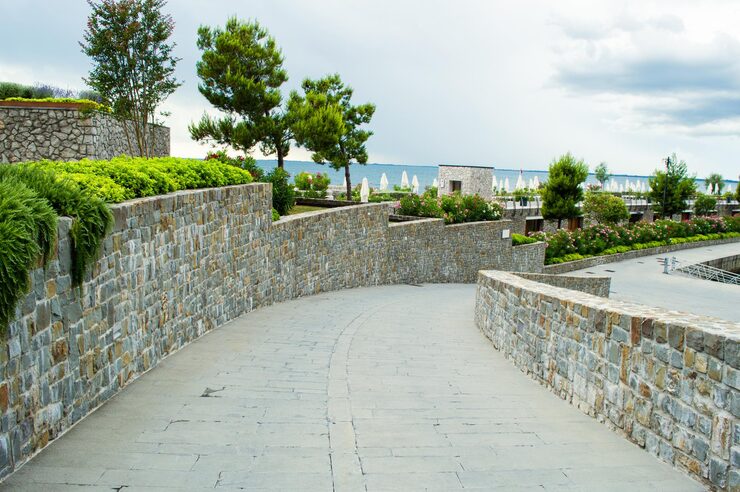
Where this suits Sherborn properties
Long woodland drives
A cobblestone apron at the street end of a long wooded drive marks the entrance clearly and gives plows and delivery trucks a stable edge to find in snow or fog.
Ledge and uneven grade
Where ledge sits close to the surface, cobblestone edging can follow the natural contour instead of forcing a straight cut, keeping excavation and cost down.
Conservation-abutting frontage
On lots bordering conservation land, a defined stone edge keeps gravel and asphalt from migrating into natural buffers while still reading as part of the landscape.
So tar and chip suits a longer, gentler Sherborn drive with some room around it. It is a poor match for a short, steep or shared one, or one that opens straight onto the walk.
Questions we hear
How is cobblestone edging different from asphalt or concrete edging?
Cobblestone is set as individual units in a bed of compacted base and setting material, not poured as one continuous surface. That means it can be lifted and reset if frost heave or root growth moves a section, rather than needing to be cut out and replaced.
Will cobblestone edging stop my asphalt driveway from spreading at the edges?
A properly set stone edge restrains the base and the asphalt mat so the edge doesn't crumble and splay under plow blades and wheel loads. It only works if it's set deep enough and backed with compacted base, not just bedded in loose soil or mulch.
Can you match reclaimed or antique cobblestone to an older Sherborn house?
Reclaimed granite cobblestone has an irregular, weathered face that new-cut stone doesn't have. It costs more and takes longer to source in quantity, but it's usually the right call on a property where the house and stone walls are already old.
Do you need to deal with the town for an apron on a private way?
If the drive connects to a private way rather than a town-accepted road, the apron and the cut into it are between the property owners involved, not the town. We'll ask about the road status before we plan the work.
How long does a cobblestone apron and edging project take?
It depends on the length of edging, the amount of excavation needed for ledge or roots, and whether we're matching existing stonework. We'll give you a realistic schedule once we've walked the site.
Next step
Call us at (413) 337-3772. Tell us about the lot, the slope and what you want the frontage to look like. We have been working in this area since 1988, and we will tell you plainly what suits your property.