
Walkway Installation in Sherborn, MA
Most Sherborn properties don’t have a short front path from the street. They have a long run from a parking court or the end of a gravel drive, through trees, over uneven ground, to a front door that might sit well above or below the surrounding grade. The walkway is doing real work: carrying people across a woodland lot, tying a new entry into an old farmhouse or a newer build set back off the road, and holding its line through a Massachusetts winter without heaving apart. On acreage like this, a walkway is also one of the few hardscape elements visible up close, so the material and the joint lines get noticed in a way a long driveway doesn’t.
What holds a walkway flat for years and what makes it wavy by the second winter comes down to what’s under it, not what’s on top. Excavation depth, the base material, how well that base is compacted, the bedding layer under the pavers or stone, and the edge restraint that keeps the whole assembly from creeping outward – that’s the work that doesn’t show. Skip or skimp on any of it and frost will find it. Water gets under the surface, freezes, expands, and pushes stone or paver out of plane. On Sherborn’s mixed soils, with ledge outcrops in places and heavier ground in others, the base has to be built for what’s actually there, not a standard spec applied blind.
Matching materials to the property
Bluestone, granite, brick, and concrete pavers all handle freeze-thaw differently and age differently. Natural stone like bluestone or granite reads right against an older Sherborn farmhouse and holds up well, but it costs more up front and repair means re-matching stone. Pavers are more repairable – lift one, reset it, done – and often cost less, but they look more manufactured. Poured concrete is the cheapest option initially but cracks don’t photograph well and patch repairs always show. None of these is the right answer for every lot; it depends on the house, the budget, and how much the owner will tolerate age showing in the surface.
Drainage has to be decided before any material gets ordered. Water has to leave the walkway and move away from the house foundation, not pool against it or sheet across the path in a thaw. On a wooded lot with tree cover and limited sun, surfaces stay damp longer, so pitch and a permeable base matter even more than on an open lot. Call to talk through what fits your property before anything gets dug.


What Our Clients Say
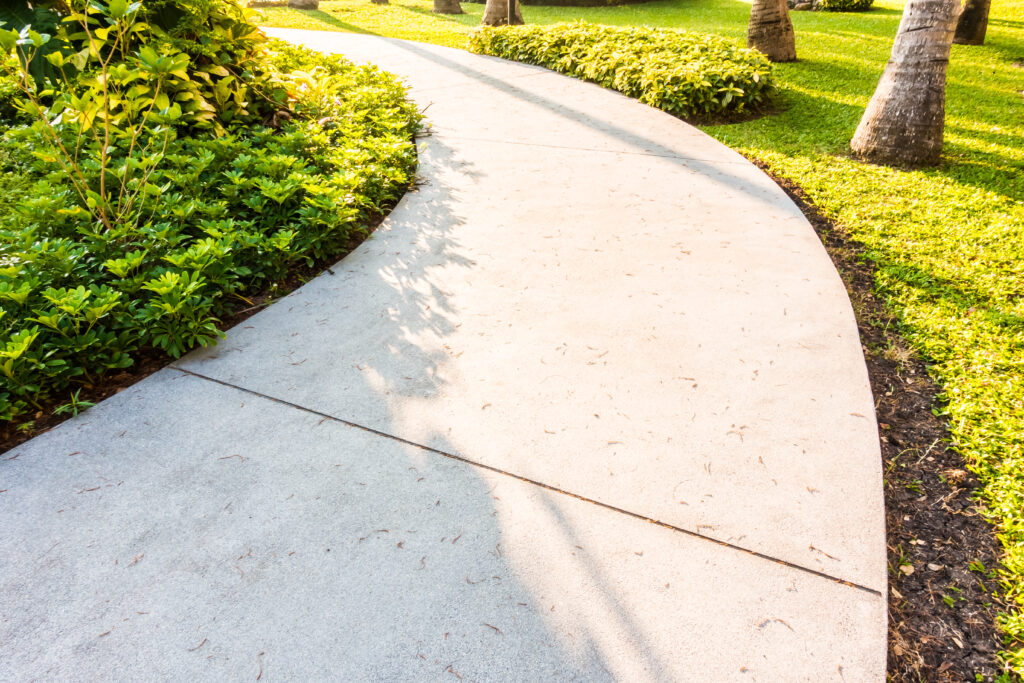
A wooded Sherborn lot holds moisture under tree cover long after an open yard dries out. That damp ground is exactly why base depth and drainage planning carry more weight here than the surface material itself.
Long private drives through trees often need a connecting path from the parking area to the door. That transition point is where grade changes and tree roots are most likely to cause future movement.
Granite and bluestone read as permanent against an older Sherborn farmhouse or fieldstone wall. Concrete pavers cost less and repair easier, but the two don’t blend well side by side, so choose one material before mixing driveway and walkway styles.
Excavation on ledge-prone Sherborn ground sometimes means working around rock rather than through it. That shapes a walkway’s route as much as the homeowner’s original layout does, so we assess grading, drainage, and stone depth on-site before finalizing any plan.
Edge restraint keeps loose material like gravel or small pavers from creeping outward each winter. Without it, a crisp path edge softens into the lawn within a few freeze-thaw cycles common to Sherborn’s clay-heavy soil and wooded, root-crossed lots.
Mature oaks and maples mean root heave under a path laid too shallow.
Choosing a material
The materials are not equal. Each suits some properties and not others.
Sherborn's conservation frontage often limits how close new hardscape can sit to wetlands or buffer zones.
A walkway that ties cleanly into a gravel or asphalt drive needs a proper transition detail, not just a butt joint.
Stone walls and mature plantings on older Sherborn properties set the palette for a new walkway.
Sherborn's wooded, tree-lined properties keep walkways shaded and damp, so algae and moss build up faster than on open, sunny paths.
On a sloped approach to a raised entry in Sherborn, steps built into the walkway need the same frost-stable base as the flat sections.


Why the base decides the outcome
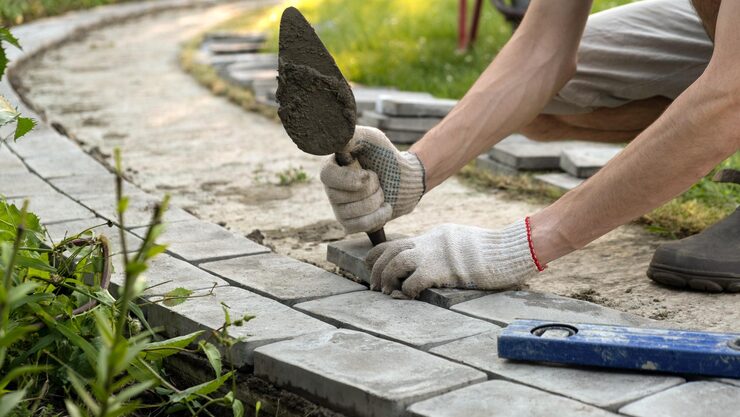
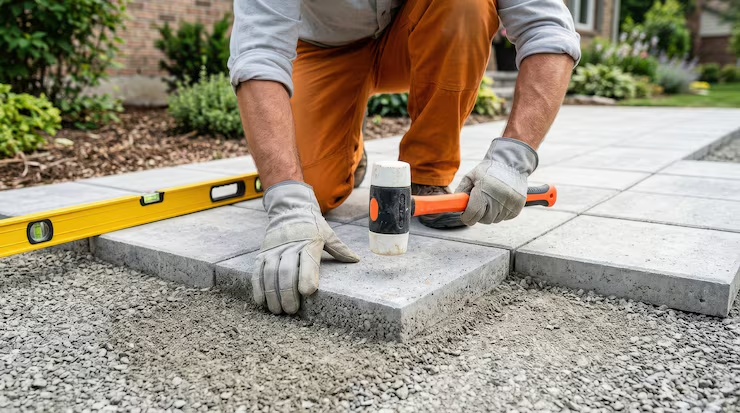
How a walkway performs over time traces back to what happens before the first stone goes down. Proper excavation removes topsoil and organic material that would otherwise decompose and settle under the path. A compacted gravel base, built to the right depth for the soil it sits on, gives water somewhere to go and gives the surface something solid to stand on through a freeze. Bedding sand or stone dust beneath the pavers lets each piece seat evenly and be reset individually if it ever shifts. Edge restraint – metal, plastic, or a stone border – holds the whole field together so units can’t walk outward under frost pressure or nearby plow activity.
Skip these steps and the damage shows up gradually: a dip where water collects and washes out the base, an edge that’s crept from where it was installed, joints that have opened and filled with weeds. That’s not a surface problem – it’s a base problem surfacing. Building it right the first time, matched to Sherborn’s ledge and mixed soil conditions, costs more up front and far less over the path’s life.
What drives the price
A new walk has to meet several existing things cleanly.
- The entry : The walk must arrive at the door at a sensible height. The threshold sets the finished level, so the work starts at the door and runs outward.
- The drive : Where a walk meets a drive, the levels and the drainage have to agree. A mismatch becomes a trip edge or a puddle.
- Walls and planting : Existing stone walls, foundation beds and mature trees constrain the route. Roots under a path are worked around, not cut through without thought.
- An older house : Scale, colour and pattern should follow the architecture. A narrow, dark stone walk suits an old house differently than a broad paver field does.

Planning a walkway that fits your property
Every Sherborn property we work on has its own combination of grade, tree cover, soil, and existing hardscape, and the right walkway plan comes from looking at all of it together rather than applying one layout to every lot. A long wooded approach calls for a different base depth and material than a short run across an open lawn. A path near conservation frontage needs its route planned with that boundary in mind from the start. An entry that ties into an existing stone wall or an older building calls for material choices that won’t clash.
We look at where water currently moves across the property, where the ledge sits close to the surface, which trees have root systems that will eventually reach the path, and how the new work will connect to the driveway and front door. That’s the groundwork that determines whether a walkway stays flat and solid for years or starts showing problems after the first couple of winters. Call (413) 337-3772 to talk through your property and get a plan that fits it, not a generic layout.
Before you call
It helps to know:
- Where the walk starts and where it needs to end
- Whether the route crosses a slope or a shared area
- Which material you lean towards, and whether the house is older
- Where water currently runs on the property
Questions people ask
What's the best walkway material for an older Sherborn home?
Natural stone like bluestone or granite generally suits older farmhouses and stone-wall properties best, since it ages in a way that matches the existing materials. Pavers are a reasonable alternative where budget or repairability matters more than matching an older look.
Why does a walkway need a deep base if it's not carrying vehicle weight?
Frost doesn't care about load. Water in the ground under a walkway freezes and expands the same way it does under a driveway, so the base still has to be deep enough and well-drained enough to resist that movement, or the surface will heave and settle unevenly.
Can a walkway be routed around tree roots and ledge instead of through them?
Yes, and on a wooded or ledge-prone lot that's often the better choice. Cutting through major roots or blasting ledge adds cost and can stress the tree; routing around both usually produces a more stable, less disruptive path.
How does conservation frontage affect where a walkway can go?
Properties near wetlands or conservation buffers may have limits on how close new hardscape can be built to that boundary. Planning the route with those limits in mind from the start avoids having to redo work later.
Next step
Call Driveway Specialists on (413) 337-3772. We are a family-run company in business since 1988, and we will walk the route with you and talk through material, grade and drainage before anything is priced.