
Walkway Installation in Stow, MA
Stow houses often sit well back from the road, past a gravel or crushed-stone drive that was never meant to double as a front path. If you’re adding a proper walkway from the drive to the door, or connecting a side entry to a patio near the orchard rows, the goal isn’t to fix a failure. It’s to put a surface in that looks right against an older farmhouse or a newer place on a long rural lot, and that stays flat through the winters that come after it.
That second part is where most walkway jobs in this area go wrong. A path looks simple on the surface, but what happens underneath decides whether it still looks good in a few years or starts to heave and gap at every joint. Stow’s mix of clay-heavy pockets and ledge outcrops means the same walkway design can behave differently from one lot to the next, which is why the layout and base work should be judged against the specific soil on site, not a generic spec sheet.
What’s under the surface
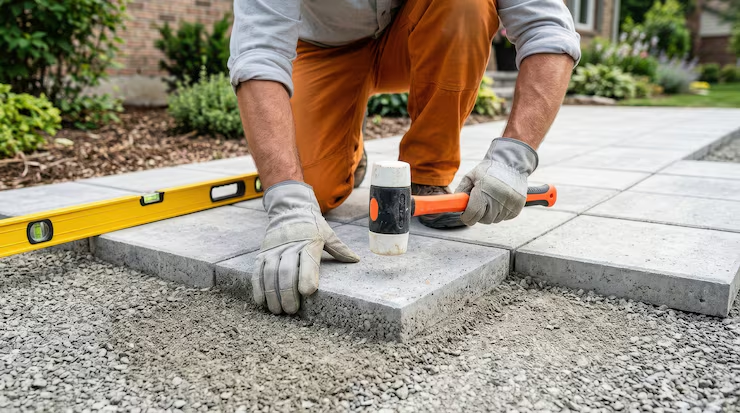
A walkway that lasts starts with excavation deep enough to remove topsoil and organic material, since anything that holds moisture and compresses unevenly will move with the frost. Below that goes a compacted base, usually crushed stone, placed in layers and compacted as it goes rather than dumped in all at once. The base is what carries the load and lets water drain through instead of pooling under the surface material.
On top of the base comes a bedding layer, then the surface itself, whether that’s pavers, natural stone, or a poured material. Edge restraint holds the whole assembly together at the sides. Without it, pavers creep outward over time, joints widen, and the clean line you started with turns ragged within a few seasons. None of this is visible once the job is finished. All of it is the reason one walkway stays flat and another goes wavy.
Frost is the mechanism behind almost every hardscape failure in Massachusetts. Water in the ground freezes, expands, and pushes upward unevenly, because no section of soil holds exactly the same moisture. A base built with proper drainage lets water move through and down rather than sitting and freezing in place. Skip that step, or skimp on base depth, and the frost does the work of pulling the walkway apart one winter at a time.


What Our Clients Say
Materials: the real trade-offs
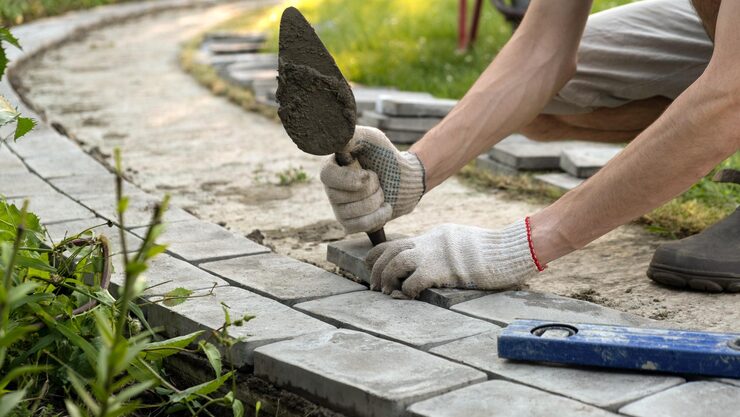
Concrete pavers are the cost-effective pick; a cracked or settled unit lifts out and resets easily. Natural stone suits an older Stow farmhouse but costs more and is harder to match later.
Drainage and grade
Any hard surface changes where water goes. A walkway must pitch away from the foundation and low spots prone to pooling and refreezing.
Tying into what's already there
A new walkway has to meet the existing drive, entry step, and often an older stone wall or garden bed without looking bolted on.
Long drives change the plan
In Stow, a long setback means the walkway is the real route guests and deliveries use, not just decoration. That shapes width, surface choice, and how it ties into a gravel or paved drive partway along its length.
Gravel drives and paved paths
Many Stow homes still have gravel driveways, and a paved walkway branching off needs a clean transition point. Done poorly, gravel migrates onto the hard surface. Done right, an edge restraint or small apron keeps the materials neatly separated.
Orchard and golf frontage
Properties near orchard rows or golf frontage in Stow often want a path that reads as part of the landscape, not a hard architectural line.
Choosing a material
The materials are not equal. Each suits some properties and not others.
Root systems on older lots
Mature trees on established Stow lots often send roots close to the surface along old path routes. A flexible, jointed walkway tolerates that minor movement far better than a rigid poured slab, which cracks when roots push beneath it.
Matching an older house
Farmhouses and colonials built decades ago often have a visual language in their stonework and trim. A walkway material picked to echo that, rather than contrast with it, usually reads as original to the property instead of added on.
Planning for snow removal
A rural walkway still gets shoveled or snow-blown every winter. A flush, properly edged surface stands up to that; a path with uneven joints or a soft edge gets chipped and lifted by a shovel blade over a few seasons.
Width and use
A path used daily by a family needs more width and a more durable surface than a seasonal garden path to a shed or orchard gate. Deciding how the walkway gets used in practice should come before choosing material.
Where this fits on a Stow property
Between the house, detached garage, and orchard or back acreage, most Stow properties have more than one walkway opportunity. Planning them as one connected layout, rather than separate projects, gives a more consistent look and better result.


Why the base work matters more here
Stow’s rural lots often have soil that hasn’t been disturbed the way a subdivision lot has. That can mean good natural drainage in spots, but more variation across one property too — a low wet patch near a stone wall, a dry sandy rise twenty feet away. A walkway crossing that ground needs a base built for the worst section, not the average. Skimping on depth or compaction where it’s wet shows up a year or two later as a dip, a cracked paver, or standing water right where you don’t want it.
This is also where the gravel-drive transition matters most. Many Stow properties still run gravel from the road to a turnaround or garage, with the walkway as the only paved surface on the lot. That path has to hold its own edge against gravel migration and plow activity without other hard surfaces to lean on. Getting the edge restraint and base depth right at that single transition point does more for the walkway’s long-term look than any material upgrade.
What drives the price
A new walk has to meet several existing things cleanly.
- The entry : The walk must arrive at the door at a sensible height. The threshold sets the finished level, so the work starts at the door and runs outward.
- The drive : Where a walk meets a drive, the levels and the drainage have to agree. A mismatch becomes a trip edge or a puddle.
- Walls and planting : Existing stone walls, foundation beds and mature trees constrain the route. Roots under a path are worked around, not cut through without thought.
- An older house : Scale, colour and pattern should follow the architecture. A narrow, dark stone walk suits an old house differently than a broad paver field does.

Getting started
A walkway on a Stow property works best when it’s planned against the actual lot, the drive it connects to, and the house it leads up to, not against a generic template. Stow’s older colonials and newer builds alike often have grade changes, mature trees, and established plantings that a cookie-cutter path design will fight against instead of working with. We’ve been building hardscape and paving work across Middlesex County since 1988, and that history means we’ve seen how frost heave, root systems, and drainage patterns behave on local soil over time, not just how a walkway looks the day it’s installed.
Before you call
It helps to know:
- Where the walk starts and where it needs to end
- Whether the route crosses a slope or a shared area
- Which material you lean towards, and whether the house is older
- Where water currently runs on the property
Questions people ask
How is a walkway different from a driveway project?
A walkway carries foot traffic, not vehicle weight, so the base doesn't need to be as deep or heavily compacted as a driveway. But it still needs proper excavation, drainage, and edge restraint, since frost affects a thin walkway base just as much as a thick driveway one.
Can a walkway tie into an existing gravel driveway?
Yes. The transition point needs a defined edge, usually a restraint or small apron, so the gravel doesn't migrate onto the paved or paver surface over time. This is a common setup on Stow's longer rural drives.
What material holds up best against tree roots?
Jointed systems like pavers or natural stone set in a flexible bedding layer tolerate minor root movement much better than poured concrete, which cracks where a root pushes against a rigid slab.
Does a walkway need to pitch away from the house?
Yes, in almost every case. Water has to go somewhere once a hard surface is in place, and pitching the walkway away from the foundation keeps it from pooling against the house or refreezing on the path itself.
How long does a walkway installation take?
It depends on length, material, and how much excavation and grading the site needs. We can give you a realistic timeframe once we've seen the property and discussed the design.
Next step
Call Driveway Specialists on (413) 337-3772. We are a family-run company in business since 1988, and we will walk the route with you and talk through material, grade and drainage before anything is priced.