
Walkway Installation in Acton, MA
A lot of Acton properties share the same front-yard problem: a long wooded driveway that handles the cars fine, but no real path from where you park to the front door. You end up cutting across the lawn, or stepping around the mulch bed, because the walkway was never part of the original build. On the older subdivision lots from the 1960s through the 1980s, there’s sometimes a narrow concrete strip that’s cracked and heaved for years and never been worth fixing properly. Either way, this is a project you choose to do, not one forced on you by a failure, which changes how you should think about it.
A front walkway is a small footprint doing a lot of work. It’s the first surface a visitor touches, it has to hold up under foot traffic in rain, snow, and ice, and it has to look right against the house it leads to. On Acton’s wooded lots, it also has to deal with tree roots, shade, and the moisture that shade holds onto, all of which push the design toward a surface that can flex slightly and shed water fast rather than sit flat and trap it.
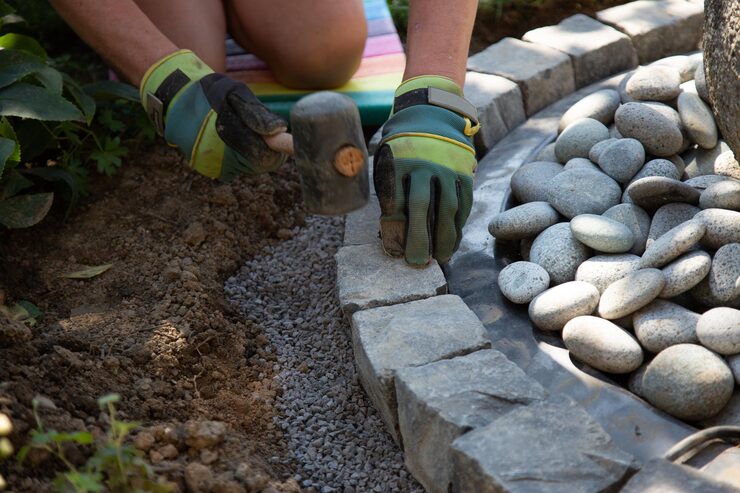
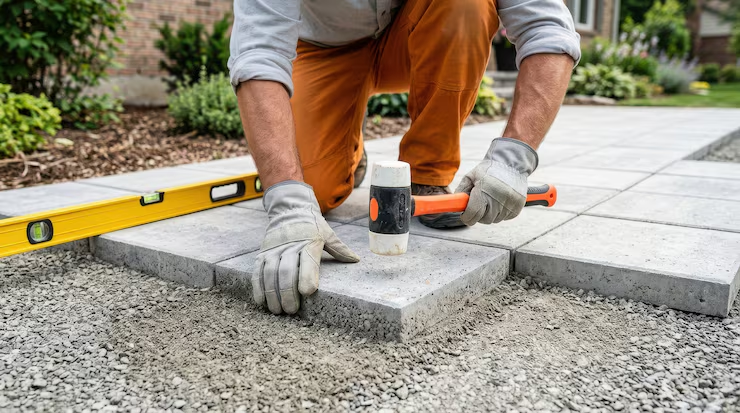
The surface material gets all the attention, but the work that decides whether a walkway lasts happens before any stone or paver goes down. That means excavating to a consistent depth, laying a compacted base that can shed water instead of holding it, setting bedding material at an even depth, and running edge restraint along both sides so the whole assembly stays locked together. Skip any one of these steps and the walkway will move with the frost within a few winters.
Massachusetts frost is the reason so many older walkways look wavy instead of flat. Water in the soil beneath the surface freezes, expands, and pushes upward. Where that happens evenly across a well-built base, nothing visible happens. Where the base is thin, inconsistent, or sitting over soil that holds water, the surface lifts unevenly, and you get the heaving and cracking that shows up every spring. On Acton’s sandy glacial soil this risk is lower than in towns with heavy clay, because sand drains and doesn’t hold the water that causes the worst heave. That’s a real advantage here, but it only pays off if the base is built to use it, with proper compaction and drainage rather than material dumped straight onto grade.
Tree roots deserve their own mention, since so many Acton lots have mature oaks and maples close to the front of the house. A walkway routed too close to a trunk will eventually get pushed up by a root that’s grown underneath it, no matter how good the base is. Part of planning the layout is deciding where the path can bend slightly to avoid a root zone, or where a permeable surface makes more sense so the tree keeps getting the water and air it needs.


What Our Clients Say
Materials: the real trade-offs
Concrete, pavers, and natural stone each age differently in Acton gardens, and none wins outright. Concrete’s cheapest and quickest to lay, but it’s one rigid slab—frost heave or a root crack shows permanently unless you replace that whole section.
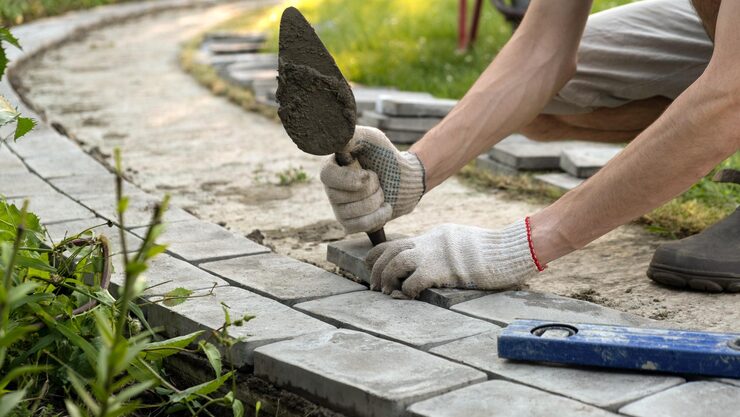
Pavers in Acton are set in sand over a compacted base, flexing slightly as ground shifts rather than cracking.
Natural stone, whether irregular fieldstone or cut bluestone, costs more and takes longer to lay, but it ages the way an older Acton property should, and it can be reset the same way pavers can if it shifts.
Repairability over time
Every material eventually needs some attention from frost, roots, or settling. The real question is what repair looks like: a patched slab that never quite matches, or a lifted and reset section that disappears back into the path.
This matters in Acton, where mature trees keep growing. A root that’s no trouble today can lift a path section in five years, and a unit-based surface handles that far better than a poured one.
Drainage comes first
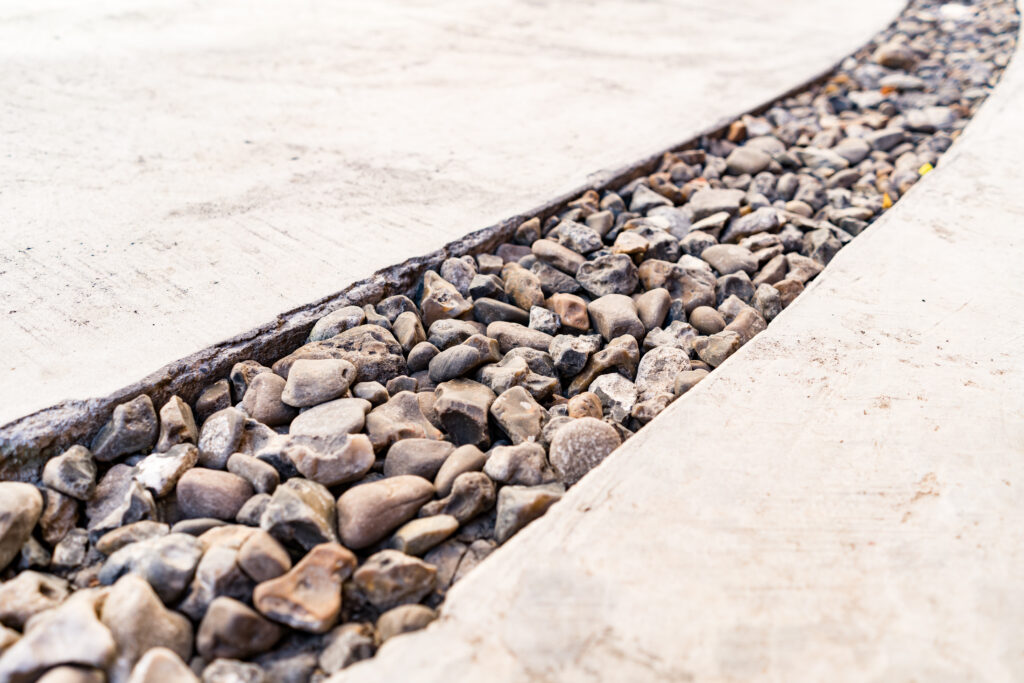
Any hard surface changes where water goes.
Choosing a material
The materials are not equal. Each suits some properties and not others.
Pitching away from the house is standard practice for a reason: water pooling against a foundation, especially one from an older Acton build, causes problems that cost far more than the walkway itself.
Shade and moisture
Wooded lots keep walkways shaded most of the day, which means they stay damp longer after rain and are slower to dry in winter. That damp surface grows moss and algae faster than an open, sunny path would.
Acton walkways face wet leaves, frost and winter grit, so surface texture matters.
Tying into what's already there
In Acton, a new walkway must meet the driveway edge, front step, and existing planting or retaining work. Clean transitions, matched heights, and consistent sightlines where materials meet are what make the entry look planned rather than patched together.
On older Acton homes, matching brick, fieldstone, or the original concrete’s tone and texture keeps a new walkway from looking like an obvious add-on against a house with decades of weathering already on it.

Where this fits in Acton
Acton’s mix of wooded lots and aging 1960s-80s subdivisions means two different starting points. On wooded properties, the walkway often has to work around established trees, follow a natural curve through the yard, and handle shade and root movement as a permanent condition, not a one-time obstacle. On subdivision lots nearing the end of their original construction life, replacement is frequently done alongside other entry work, since the existing concrete strip is usually original to the house and has already outlived any reasonable expectation for it.
The sandy glacial soil common across Acton is genuinely good news for this kind of work. It drains well, compacts predictably, and doesn’t hold the standing moisture that causes the worst frost heave in heavier soils. A properly built base on this ground has a real chance of staying flat for a long time, which isn’t something every Massachusetts town can say. That doesn’t mean excavation and compaction can be skipped or shortened; it means the effort put into the base actually pays off here instead of fighting against the soil the whole way.
What drives the price
A new walk has to meet several existing things cleanly.
- The entry : The walk must arrive at the door at a sensible height. The threshold sets the finished level, so the work starts at the door and runs outward.
- The drive : Where a walk meets a drive, the levels and the drainage have to agree. A mismatch becomes a trip edge or a puddle.
- Walls and planting : Existing stone walls, foundation beds and mature trees constrain the route. Roots under a path are worked around, not cut through without thought.
- An older house : Scale, colour and pattern should follow the architecture. A narrow, dark stone walk suits an old house differently than a broad paver field does.
Getting started
A walkway installation starts with a look at the actual site: the slope from the driveway to the door, the trees and roots already in play, the drainage pattern around the house, and the style of the house itself. Acton’s mix of older colonials near the center and newer builds out toward Nagog Hill means no two layouts are quite the same, so the material choice and path width follow from what the property actually needs, not a default package.
Before anything is excavated, we typically walk through:
- Existing grade and where water naturally runs off during heavy rain or snowmelt
- Root systems from mature trees that could heave a path over time
- How the walkway ties into the driveway, porch, or steps
- Material options, brick, bluestone, pavers, or concrete, based on the home’s style
Before you call
It helps to know:
- Where the walk starts and where it needs to end
- Whether the route crosses a slope or a shared area
- Which material you lean towards, and whether the house is older
- Where water currently runs on the property
Questions people ask
Does Acton's sandy soil make walkway installation easier?
Yes, in a meaningful way. Sandy glacial soil drains well and compacts predictably, so a properly built base holds its shape through freeze-thaw cycles better than it would on clay or poorly drained ground. The base still has to be excavated and compacted correctly to take advantage of it.
What's the best walkway material for a wooded Acton lot?
Pavers or natural stone generally hold up better than poured concrete where mature trees are present, because unit-based surfaces can be lifted and reset if a root causes movement, rather than cracking permanently like a single concrete slab.
Can a new walkway be matched to an older Acton house?
Yes. Matching material tone, texture, and scale to a house from the subdivision era, or an older colonial or ranch, is part of the design process, so the new path reads as original rather than added on.
Why does my current concrete walkway have cracks and uneven sections?
Most older walkways in Acton were poured without a proper compacted base, so winter frost movement pushes sections up unevenly over the years. A rebuild with correct excavation, base, and edge restraint addresses the cause rather than just patching the surface.
Next step
Call Driveway Specialists on (413) 337-3772. We are a family-run company in business since 1988, and we will walk the route with you and talk through material, grade and drainage before anything is priced.