
Walkway Installation in Medway, MA
Medway is a mix of two kinds of lot. There are newer subdivision homes on bigger parcels with long setbacks from the street, and there are older houses on rural roads where the walk from the driveway to the front door was never really built, just worn in over the years. Both situations end up with the same question: how do you put a path on the ground that still looks straight and sits flat ten years from now, instead of heaving at the first frost and turning into a trip hazard by the second winter.
A walkway is not a smaller driveway. Nobody drives on it, so the load is different, but the ground underneath still moves with the seasons the same way it does under a slab of asphalt. What makes a front path hold its line has almost nothing to do with the surface material and almost everything to do with what happens before that material goes down.
What’s under the surface
A proper walk starts with excavation to a consistent depth, not just scraping off the sod. That depth gets filled with a compacted base, usually crushed stone, run over in layers rather than dumped in all at once, because a base that isn’t compacted in lifts settles unevenly later no matter how solid it looks on installation day. On top of that comes a bedding layer that the actual walking surface sits in or on, and at the edges, some kind of restraint that stops the whole assembly from creeping sideways as the ground freezes and thaws underneath it.
Frost is the part that catches people out. Massachusetts ground freezes and releases multiple times in a normal winter, not just once. Every cycle pushes on whatever is in the ground. A base that was compacted properly and has somewhere for water to drain moves evenly, if it moves at all. A base that was skipped or rushed moves unevenly, and unevenly is what shows up as a wavy, lifted, or cracked walk by spring. This is also why a path that looks fine the week it’s installed can fail two winters later. The failure was built in from the start; it just took a few freeze-thaw cycles to show.
For a Medway lot with room to work, staging materials and running equipment isn’t the constraint it can be on a tighter in-town property. That generally means the job moves on a straightforward schedule once the design and material choice are settled, with the excavation and base work taking the bulk of the time and the surface itself going down relatively quickly once that’s right.
Call (413) 337-3772 to talk through what your property needs before anything gets dug.


What Our Clients Say
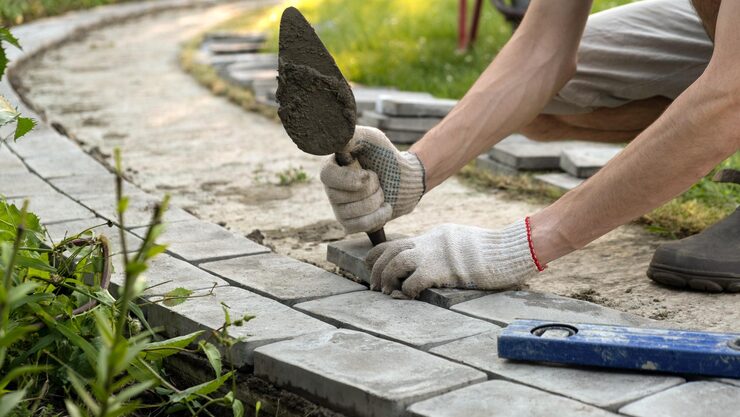
Materials: the honest trade-offs
Concrete, pavers, and natural stone all handle Massachusetts winters differently. Concrete cracks under freeze-thaw cycles, pavers flex and allow individual repairs, and stone offers lasting character but costs more. None suits every Medway home equally.
Poured concrete
Concrete gives a clean, uniform surface at a lower cost than stone, suiting Medway paths of any length. Its weak point is repair: a crack or frost-heave section usually means patching a visible seam, not swapping one piece.
Concrete pavers
Pavers flex slightly as a system, so minor ground movement across Medway's clay-rich soils shows less.
Natural stone
Fieldstone or bluestone suits an older Medway farmhouse better than a new build.
Brick
Brick reads traditional and pairs beautifully with the colonial-style homes common along Medway's rural roads.
Repairability over time
Ask how a material gets fixed, not just how it looks new.
Choosing a material
The materials are not equal. Each suits some properties and not others.
Where water goes
Any hard surface sheds water instead of absorbing it.
Grade near the entry
The first few feet near a front door or garage threshold take the most water and the most foot traffic. That section needs the tightest grading and the best-compacted base on the whole path.
Tying into the driveway
Where a walk meets the drive, the two surfaces should share a sensible transition, not a sudden lip.
Matching an older house
A lot of Medway's rural-road homes are decades old, with weathered brick or timber facades. A new concrete walk can look stark against them.
Working around what's already there
Existing retaining walls, mature trees, and planting beds all constrain where a path can run and how deep you can dig near roots without damaging them. Good layout works with these, not through them.


Why Medway lots suit this work
Medway’s newer subdivisions tend to have larger lots and wider frontages, which means there’s usually room to stage material, run a compactor, and excavate without squeezing past tight property lines or parked cars the way a denser in-town street would demand. That makes the logistics simpler, but it doesn’t change the underlying work. The excavation still needs to go to a consistent depth, the base still needs to be compacted in layers, and the edge restraint still needs to hold against frost the same way it would on a cramped suburban lot.
On the older rural-road properties, the opposite consideration applies: these homes often have mature landscaping, established grading around the foundation, and sometimes an existing informal path that’s worn into the lawn. The work there is less about room to maneuver and more about reading the existing grade correctly, so the new walk drains the way the yard has always drained rather than fighting it. Either way, the right approach starts with how the specific property sits, not a standard layout applied regardless of what’s actually there.
What drives the price
A new walk has to meet several existing things cleanly.
- The entry : The walk must arrive at the door at a sensible height. The threshold sets the finished level, so the work starts at the door and runs outward.
- The drive : Where a walk meets a drive, the levels and the drainage have to agree. A mismatch becomes a trip edge or a puddle.
- Walls and planting : Existing stone walls, foundation beds and mature trees constrain the route. Roots under a path are worked around, not cut through without thought.
- An older house : Scale, colour and pattern should follow the architecture. A narrow, dark stone walk suits an old house differently than a broad paver field does.

Getting started
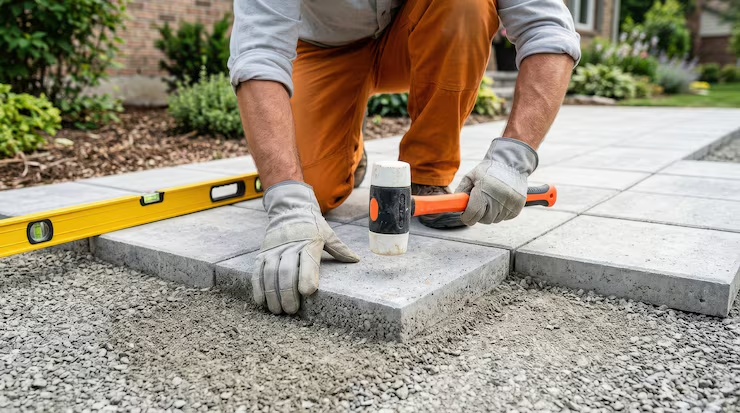
A walkway project starts with a close look at the site: the grade, how water moves across the yard, the soil underneath, what’s planted nearby, and what material actually suits the house. Medway properties vary a lot block to block, from older homes near the town center with mature trees and established plantings to newer builds on flatter lots, so the right approach for one driveway or front walk isn’t always right for the next. From there, excavation and base work set up everything that follows. Getting the depth, compaction, and drainage right at this stage matters more than people expect, since a weak base is the main reason walkways heave, settle, or crack within a few years. Once that groundwork is solid, the surface material goes down, whether that’s pavers, natural stone, brick, or poured concrete.
If you’re planning a front walk, side path, or connector between the driveway and the door on a Medway property, call (413) 337-3772 to arrange a time to look at the site and talk through materials that fit both the house and the budget.
Before you call
It helps to know:
- Where the walk starts and where it needs to end
- Whether the route crosses a slope or a shared area
- Which material you lean towards, and whether the house is older
- Where water currently runs on the property
Questions people ask
Why does a new walkway sometimes crack or heave after a year or two?
It almost always traces back to the base. If the crushed stone underneath wasn't compacted in layers, or there's nowhere for water to drain away from it, freeze-thaw cycles move it unevenly. The surface material just shows what the base is doing underneath it.
Can you match a walkway to an older Medway house instead of it looking new and out of place?
Yes. Natural stone, brick, and tumbled or antiqued pavers all read as more traditional than plain poured concrete, and they tend to sit better against an older colonial or farmhouse-style property on a rural road.
Do you need to tie the walkway into the existing driveway?
Not always, but where they meet should be planned rather than left as an abrupt edge. Matching materials or a clean, deliberate contrast both work; what doesn't work is an unplanned lip or seam where the two surfaces collide.
How does drainage affect where the walkway can go?
A hard surface sheds water instead of letting it soak in, so the path has to pitch away from the house and toward somewhere that can actually take the runoff. The layout sometimes has to shift to respect that, especially near a foundation or entry.
Next step
Call Driveway Specialists on (413) 337-3772. We are a family-run company in business since 1988, and we will walk the route with you and talk through material, grade and drainage before anything is priced.