
Cobblestone Aprons and Edging in Weston, MA
A long drive through trees that ends at a cobblestone apron reads differently than one that just stops at a strip of asphalt meeting the road. In Weston, where lots run deep and drives can wind a few hundred feet through woods before they reach a garage or turning circle, the street-to-drive transition and the edge of the drive itself are two of the few places the whole approach is seen up close, at walking pace, from a car window. That is what cobblestone aprons and edging are for: the entry point, and the line that holds the drive’s shape along its length.
This is hardscape work, not a driveway repair. Nobody calls about a failed apron the way they call about a cracked driveway. The asphalt or gravel further up may be sound. The question is how the drive presents itself where it meets the road, and whether the edge holds its line against frost, plow blades, and years of cars pulling in slightly off-center.
What is actually happening below the stone
A cobblestone apron that stays flat and square for decades, and one that heaves and gaps within a few winters, differ entirely in what is underneath, not in the stone on top. The sequence is excavation to a stable subgrade, a compacted base that can take point loads without shifting, a bedding layer that lets each stone sit level, and an edge restraint that keeps the whole field from migrating outward. Massachusetts frost moves water in the soil through repeated freeze-thaw cycles every winter, and that movement pushes sideways against anything not properly restrained. An apron without a real edge restraint will slowly splay at the corners first, since that is where lateral pressure concentrates and where plow blades catch hardest.
On a long Weston drive with real grade change, the apron at the street is often not the only place this matters. Wherever the drive crosses a slope transition, or where a secondary pull-off meets the main drive, the same edge-and-base logic applies. Treating the apron as an isolated pad, rather than part of a continuous drainage and base system, is where a lot of otherwise good-looking work starts to fail within a handful of seasons.
Stone choice matters almost as much as the base beneath it. Granite cobbles, whether reclaimed or new-cut, hold their edges under wheel loads far better than softer stone, and a tumbled or antique finish tends to suit the wooded, older-estate character common around Weston better than a sharp, modern cut. Jointing sand or a hardened joint compound closes the gaps between stones; a loose joint invites weeds and frost heave at every seam, while a well-packed one sheds water to the base below rather than holding it against the stone.


What Our Clients Say
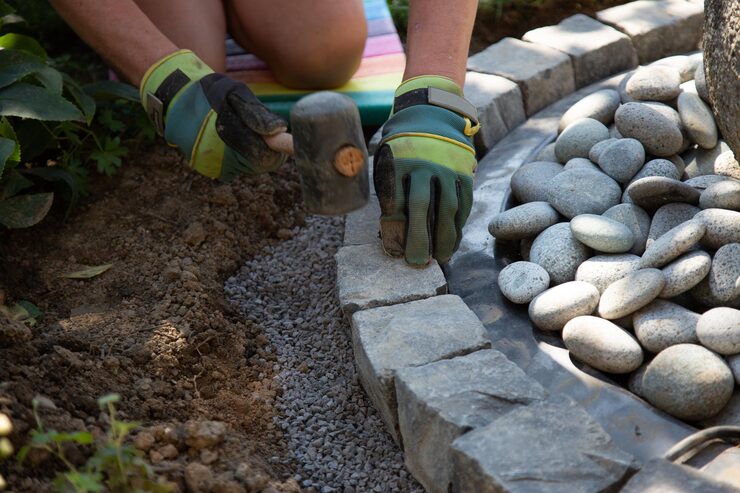
What the work involves below the surface
The stone is the last and smallest part of the job. A cobblestone apron stays flat or goes wavy depending on what is underneath it.
Granite cobblestones hold their edge and age beautifully on Weston driveways, but cost more and need a mason who sets them tight against frost heave.
Reclaimed cobblestone has already settled and weathered, giving Weston driveways an aged, authentic edge from day one.
Belgian block edging is the standard restraint where an asphalt drive meets cobblestone in Weston.
Water has to leave the apron somewhere. On sloped Weston drives, that means pitching the stone away from the garage, not just toward the road, with edging set deep enough to resist frost heave and snowplow blades each winter.
Ledge near the surface changes the excavation plan around Weston driveways. Where blasting or breaking rock isn’t practical, base depth, cobblestone apron thickness, and the drainage path all need rethinking before edging is set.
Materials and the trade-offs
Drainage and grade decide more of this project than the stone choice does. A flat suburban apron just needs a slight pitch away from the garage door. A Weston drive with real elevation change behind it is different: water running down a few hundred feet arrives at the street transition with real volume and speed, and the apron has to shed it without channeling onto the road or under the garage slab. That usually means a crown or cross-pitch built into the base, sometimes a drain line tied in before the stone goes down, not a fix applied afterward. Grade at the end of a long drive also has to account for the house’s own gutters and any existing stormwater work, since it all meets the same low point.

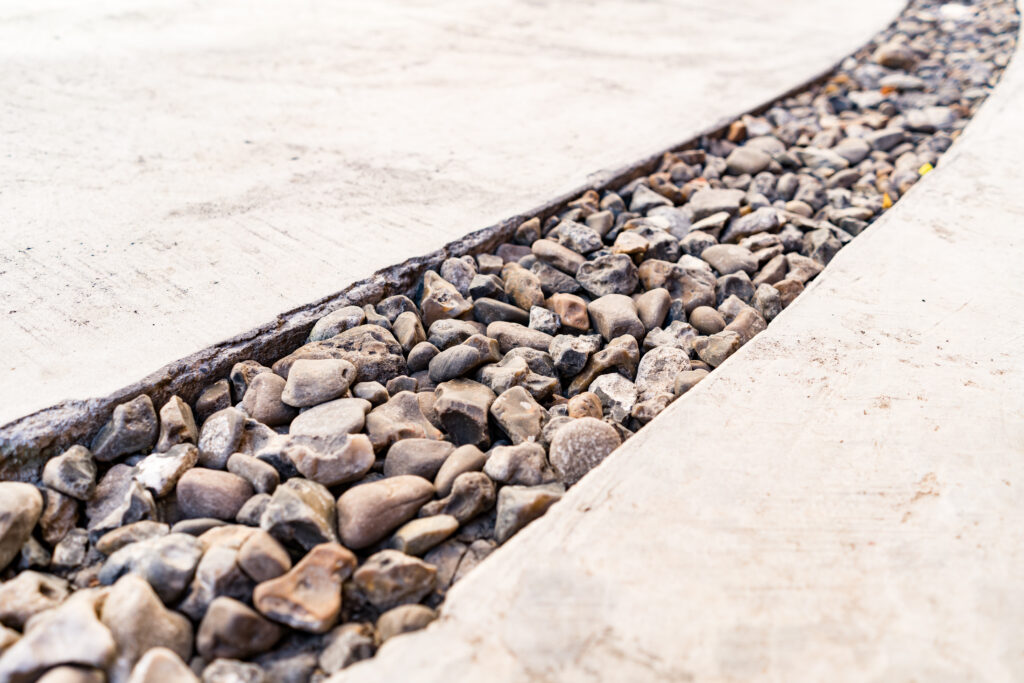
Few Weston aprons go in on a blank site. There’s almost always an existing drive, an entry sequence, and often a stone wall, gate, or mature plantings that new work has to sit against without looking bolted on. Matching an older house means reading what’s already there: fieldstone foundations, granite curbing elsewhere on the property, or a formal entry that calls for tighter, cut stone rather than a rustic reclaimed look. The apron and edging are usually the first hardscape a visitor actually walks or drives across, so that transition from road to drive sets the tone for everything behind it.
Weston’s lots are large enough that the apron and edging work as their own design element, separate from the driveway surface further up. A long private drive through woods gives the eye time to adjust before reaching the house, and the entry point carries more visual weight than it would on a short suburban lot visible from the street all at once. That’s part of why cobblestone shows up more often here than elsewhere: it suits a property where the approach itself is part of the experience, not just the route to a garage.
Significant grade and occasional ledge also mean this work benefits from someone who has actually handled Weston sites before, rather than treating it as a standard town-lot job scaled up. The base and drainage principles are the same everywhere, but the margin for error on a long sloped drive with rock near the surface is smaller, and redoing a failed apron on a drive that length costs far more than catching the problem early.

Where this suits Weston properties
Long wooded drives
A drive running a few hundred feet through trees gives the apron real visual weight as the first thing a visitor actually touches before reaching the house.
Significant grade change
Drives with real elevation drop need an apron built to shed water fast at the street transition, not just a flat pad with a slight pitch.
Estate-scale approaches
Where the entry sequence matters as much as the destination, cobblestone and cut edging set the tone before a car even reaches the main drive.
So tar and chip suits a longer, gentler Weston drive with some room around it. It is a poor match for a short, steep or shared one, or one that opens straight onto the walk.
Questions we hear
Does the apron need to match the driveway surface?
No. It's common on Weston properties to pair an asphalt or gravel drive with a cobblestone apron and edging at the street, since the apron is doing a different job: presenting the entry and handling the street transition rather than carrying the full length of travel.
What happens if there's ledge where the apron needs to go?
Shallow granite ledge is common across Weston. It can limit how deep the base excavation goes, which changes the drainage plan and sometimes the material choice. This needs checking before the job is priced, not after work starts.
Can edging be added to an existing apron without redoing the whole thing?
Sometimes, if the existing base is sound and the problem is just a splaying or missing edge restraint. If the base itself has shifted with frost over the years, edging alone won't hold and the apron needs to come up.
How does grade affect where water goes at the apron?
On a sloped drive, water gathers speed as it runs down toward the street. The apron has to be built with a crown or cross-pitch that moves that water off to the side rather than letting it pool at the transition or run onto the road.
Next step
Call us at (413) 337-3772. Tell us about the lot, the slope and what you want the frontage to look like. We have been working in this area since 1988, and we will tell you plainly what suits your property.