
Walkway Installation in Westwood, MA
Westwood lots tend to give you room to work with. Generous frontage, mature trees set back from the house, a curving drive that disappears into the yard before it reaches the garage. A front walk here is rarely just a strip of concrete from driveway to door. It is the first thing a visitor sees after they get out of the car, and on an established lot with real landscaping around it, it either looks like it belongs there or it looks like it was dropped in afterward.
Most of the walkway’s performance has nothing to do with what you can see. It is in the excavation depth, the base material, how well that base is compacted, and what holds the edges in place once the ground starts moving every winter. Massachusetts frost does not politely stay under the walkway. It heaves unevenly, it pushes against anything that was set without enough depth or drainage, and over a few winters that shows up as lippage between units, a wavy surface, or a crack running straight through a slab. Get the base right the first time and none of that happens. Get it wrong and no amount of surface material fixes it.
What’s actually under a good walkway
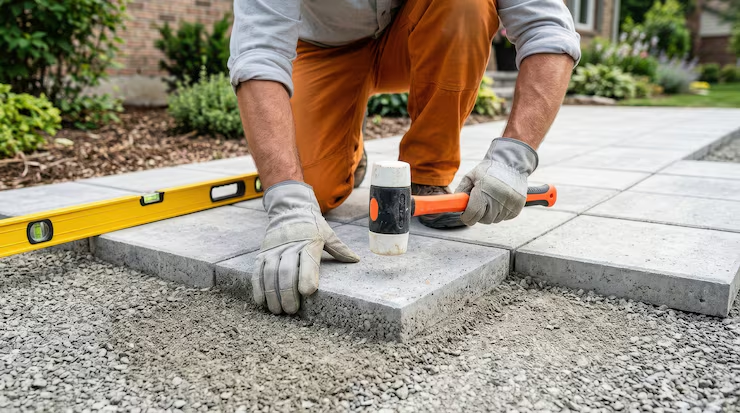
A properly built walk starts with excavation well below grade, a compacted gravel base sized to the soil underneath, and a bedding layer that lets pavers or stone settle evenly rather than shifting under foot traffic. Edge restraint, whether it is steel, aluminum, or a stone soldier course, keeps the sides from creeping outward as the base flexes with the seasons. None of this is visible once the job is finished. All of it is the reason one walkway is flat in year ten and another is a tripping hazard by year three.
On the kind of lot common in Westwood, root systems from mature oaks and maples are the detail that changes the plan. A path routed too close to a large tree will get pushed and cracked as roots grow, no matter how good the base is. Part of laying out a walkway on a wooded lot is deciding where to route around root zones rather than through them, and where a slightly longer path is the one that actually lasts.


What Our Clients Say
Choosing a surface material
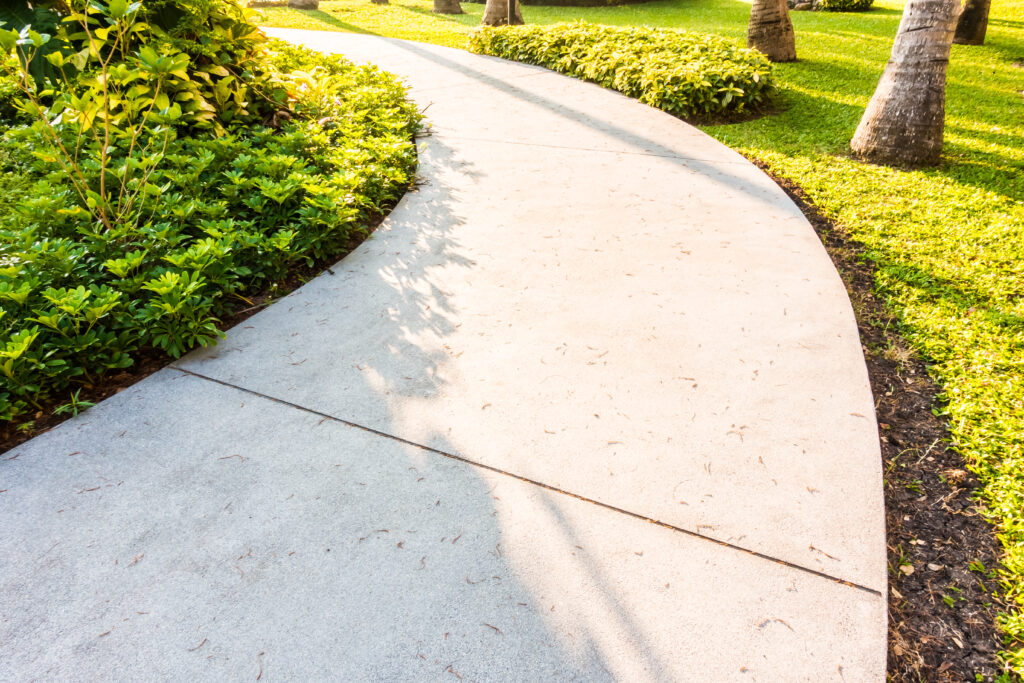
Concrete, pavers and natural stone each behave differently once installed. Poured concrete costs least upfront and looks clean and formal, but it’s one slab: a frost crack means cutting out and replacing the section, and patched repairs always show.
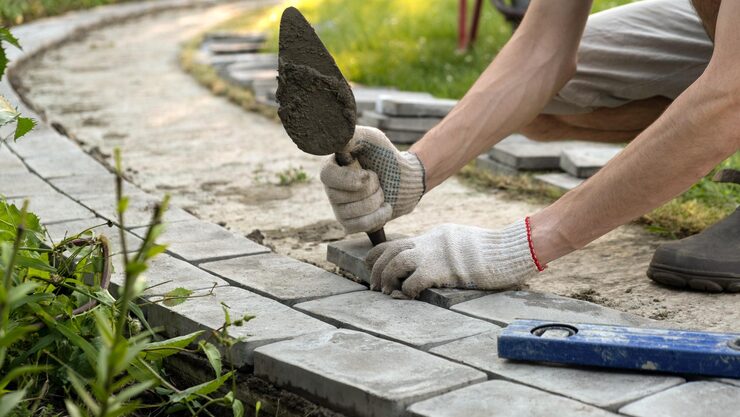
Pavers cost more at installation but are built from individual units, so a section that heaves or settles can be lifted, the base corrected, and the same pavers reset without replacing the whole walk.
Natural stone, whether irregular fieldstone or cut bluestone, ages the way the house around it ages. It is the most expensive material and the least forgiving to install, but it holds its character for decades.
None of these materials is simply better for Westwood walkways. Concrete suits a tight budget and a straightforward, direct run between entryways. Pavers suit a property where long-term repairability and style matter more than the lowest upfront number.
Stone suits an older or higher-end Westwood home where matching existing fieldstone walls or foundations is part of the goal, and where the higher upfront cost is justified by decades of unchanged, low-maintenance performance underfoot.
Where water goes
Every hard surface changes how rainwater moves across a Westwood yard.
Choosing a material
The materials are not equal. Each suits some properties and not others.
Pitching the walk away from the house, and tying the grade into existing drainage rather than fighting it, is not a finishing touch. It is decided before a single paver goes down, at the excavation and base stage.
On a wooded lot, shaded sections of a walkway stay damp longer after rain, which affects both surface choice and how quickly moss or algae becomes a maintenance issue in the years after installation.
Tying into what's already there
A walkway rarely stands alone. It meets the driveway at one end and the entry at the other, and it often runs past existing stone walls, planting beds, or a stoop that was built years before the path was planned.
Matching an older Westwood home means thinking about the transition points as much as the walk itself: how the new surface meets old granite steps, how width and material read against a brick or clapboard entry.
A walkway that ignores what’s already on the Westwood property, dropping a modern paver pattern against a traditional fieldstone foundation, for example, looks like a bolted-on addition rather than a natural extension of the home’s existing character and curb appeal.


Where this fits in Westwood
The property type most common in Westwood, a wooded lot with real setback from the street and an established landscape already in place, is exactly where a well-planned walkway earns its cost. There is usually enough distance between the driveway and the front door that a bare concrete strip looks like an afterthought, and enough mature planting nearby that the surface material has to hold its own next to stone walls, hedges, and old trees rather than stand apart from them.
These are also lots where the ground itself varies more than it would on a flat, cleared subdivision. Root zones, partial shade, and drainage patterns shaped by decades of tree growth all affect where a path can go and how its base needs to be built. A walkway plan that treats a Westwood lot like a blank rectangle usually runs into one of these issues within a few seasons. One that accounts for the existing trees, grade, and drainage from the start holds up the way the rest of the property already has.
What drives the price
A new walk has to meet several existing things cleanly.
- The entry : The walk must arrive at the door at a sensible height. The threshold sets the finished level, so the work starts at the door and runs outward.
- The drive : Where a walk meets a drive, the levels and the drainage have to agree. A mismatch becomes a trip edge or a puddle.
- Walls and planting : Existing stone walls, foundation beds and mature trees constrain the route. Roots under a path are worked around, not cut through without thought.
- An older house : Scale, colour and pattern should follow the architecture. A narrow, dark stone walk suits an old house differently than a broad paver field does.

Getting started
A walkway on a lot like this is worth planning properly rather than treating as a quick concrete pour. Driveway Specialists has worked across Norfolk and Middlesex County properties, including neighboring towns like Dedham and Needham, since 1988, and can walk the site with you to talk through material, routing around existing trees, and how the new walk should tie into your driveway and entry. Westwood's older neighborhoods often mean mature landscaping, established grade changes, and existing hardscaping that a new walkway has to respect rather than fight, so we look closely at drainage, slope, and where water tends to collect before any layout is set. We'll talk through options like poured concrete, pavers, or natural stone, weigh how each holds up through a New England winter, and discuss edging and base work that keeps the path stable for years rather than heaving after the first freeze-thaw cycle.
Before you call
It helps to know:
- Where the walk starts and where it needs to end
- Whether the route crosses a slope or a shared area
- Which material you lean towards, and whether the house is older
- Where water currently runs on the property
Questions people ask
Why does a new walkway crack or go uneven after a couple of winters?
In almost every case it traces back to the base, not the surface material. If excavation wasn't deep enough or the compacted gravel base wasn't sized correctly for the soil, frost movement pushes unevenly against the surface each winter. The visible crack or wave shows up months or years after the real problem was built in.
Can a walkway be routed around mature trees instead of removing them?
Yes, and on a wooded Westwood lot that's usually the better plan. Routing around root zones rather than through them, even if it adds a few feet to the path, avoids the heaving and cracking that happens when roots grow under a surface laid too close to a large tree.
Is poured concrete or paver walkway better for an older home?
It depends on the house and the budget. Concrete is less expensive and clean-looking but repairs as a visible patch if it cracks. Pavers cost more upfront but individual units can be reset if the base shifts, which matters more over a longer ownership horizon.
Does a new walkway affect drainage near the house?
It can, which is why grade is decided at the excavation stage, not added afterward. A walk pitched toward the house instead of away from it will direct rainwater toward the foundation, so getting the pitch right before installation matters more than the surface material chosen.
Next step
Call Driveway Specialists on (413) 337-3772. We are a family-run company in business since 1988, and we will walk the route with you and talk through material, grade and drainage before anything is priced.