
Cobblestone Aprons and Edging in Maynard, MA
A lot of Maynard’s housing stock sits close to the street on small, narrow parcels, a legacy of its mill-town layout. The drive is often short, the frontage is tight, and the line between public pavement and private property is only a few feet from the front door. On a property like that, the apron and the edging aren’t a minor finishing touch. They’re the first thing anyone sees, and they take the hardest physical punishment on the whole property: plow blades, delivery trucks, salt, and every freeze-thaw cycle New England throws at it each winter.
This work is a hardscape project, not a paving repair. The goal is usually to improve how the entry reads against an older house, tie a short drive into the street cleanly, and put down an edge that won’t heave or spread over the next several winters. Cobblestone, whether reclaimed granite or a manufactured concrete paver made to look like it, does that job differently than poured asphalt or a plain concrete ribbon, and it’s worth understanding how before committing.
What’s actually underneath matters more than what’s on top. Everything visible rests on what you can’t see: excavated subgrade, a compacted base layer, a bedding course, and an edge restraint holding the whole assembly in place. In Massachusetts, frost is the variable that decides whether this stays flat or goes wavy. Water in the subgrade freezes, expands, and lifts unevenly. A base that’s been properly excavated and compacted, with drainage able to move water away rather than trap it under the stone, resists that movement. A base that’s shallow or skipped entirely will heave within a few seasons, and cobblestone set on a thin bed will rock loose, gap, and eventually need to be pulled and reset.
Edge restraint is the other half of it. Cobblestone without a buried edge restraint migrates outward under the first winter of plow pressure and foot traffic. With one, the pattern holds its line for the long term. This is the detail that separates work that looks good for one season from work that still looks right years on.
Choosing between reclaimed granite and manufactured concrete cobble is also a real decision, not just a budget line. Reclaimed granite carries the weight and texture of the region’s older streetscapes, holds up to decades of plowing, and tends to suit the colonials and mill-era homes common around Maynard. Manufactured concrete cobble gives more control over color and pattern, costs less to source, and is easier to match if a section ever needs replacing after utility work or a hard winter. Neither is automatically the right call; it depends on the house, the budget, and how the apron needs to tie into existing walkways or a stone wall nearby.
A few things worth asking before work starts:
- How deep will the base excavation go, and what material is used for the compacted base layer?
- What edge restraint method will be used, and is it installed below grade where it won’t be visible?
- How will the apron handle drainage toward the street without pooling near the garage or front steps?


What Our Clients Say

What the work involves below the surface
The stone is the last and smallest part of the job. A cobblestone apron stays flat or goes wavy depending on what is underneath it.
Materials and the trade-offs
Reclaimed granite cobblestone resists freeze-thaw and ages beautifully on older Maynard homes, though it costs more and installs heavier.
Repairability also differs. Individual granite setts can be lifted and reset without disturbing the whole apron. Poured materials can’t be spot-repaired the same way, which matters once a tree root or a frost lens shifts one section.
Drainage and grade decide the outcome
Water has to go somewhere once a hard surface replaces bare ground.
On a short, flat Maynard lot, that grade might only be an inch or two across the whole apron, but getting it wrong turns the cobblestone entry into standing water and sheet ice every winter, cracking mortar joints and heaving pavers by spring.
Tying into what's already there
Cobblestone edging reads best when it matches rather than competes: picking up a stone wall, a brick walk, or the age of a Maynard house itself, rather than introducing a new material language that fights the existing property.
Materials and the trade-offs
On a tight Maynard lot, a full cobblestone driveway can overwhelm the property and the budget. The smarter approach is a cobblestone apron and edging package: a border of granite or cobble sets framing an asphalt or concrete drive, rather than cobble across the whole surface. This keeps cost and scale proportional to the property while still adding the textured, old-New-England look that suits Maynard’s mix of historic mill-town homes and newer infill construction.
We size the apron to match the width of the driveway at the street, tying it visually into existing granite curbing, stone walls, or walkways already on site. Edging is set on a compacted base with mortar or polymeric sand joints so it resists frost heave through Massachusetts winters. Because only the border uses premium stone, you get a custom, upgraded entrance without paying for cobble across the full drive.
- Defines the driveway edge and protects adjacent lawn or planting beds
- Complements existing stonework, walls, or walkways
- Mortared or sand-set joints built to handle freeze-thaw cycles


Fitting the work to a mill-town lot
Short, narrow drives change how this gets built as much as what it’s built from. There’s often little room to stage materials or maneuver equipment, so a lot of the planning on a Maynard job happens before anyone breaks ground: figuring out where stone gets staged, how compaction equipment gets in and out without damaging adjacent planting beds or a neighbor’s fence line, and how close the work sits to a shared driveway or a sidewalk that’s technically the town’s.
Where the apron meets a town-accepted road, the curb cut and the transition itself fall under the town’s authority, not the homeowner’s. That’s a different conversation than edging along a private walk or a side yard, and it changes what can be changed without a separate approval step. On a property set close to the street, as much of Maynard’s older housing is, this boundary often sits only a few feet from the front steps, so it pays to know which side of that line any given section of work falls on before deciding on a layout.
Starting the work
Every one of these jobs starts the same way: a look at the actual lot, the existing drive or walk it has to tie into, the grade, and what’s feeding water toward or away from the house. That’s the only way to size the work correctly and recommend a material that fits the property rather than a generic spec. Driveway Specialists has worked on properties across Middlesex County, including tight, older lots like the ones common in Maynard and nearby Concord and Stow, for more than 35 years as a family-run contractor.
On an initial visit we’re checking the things that decide how an apron or edging run actually performs over time:
- Where the driveway meets the street apron and how town frost-heave patterns have treated the existing pavement
- Soil and base conditions typical of Maynard’s older neighborhoods, since many lots still sit on fill or shallow ledge
- Existing edging, walls, or plantings the new cobblestone needs to match or butt against
- Drainage paths so water sheds away from the foundation instead of pooling at the new border
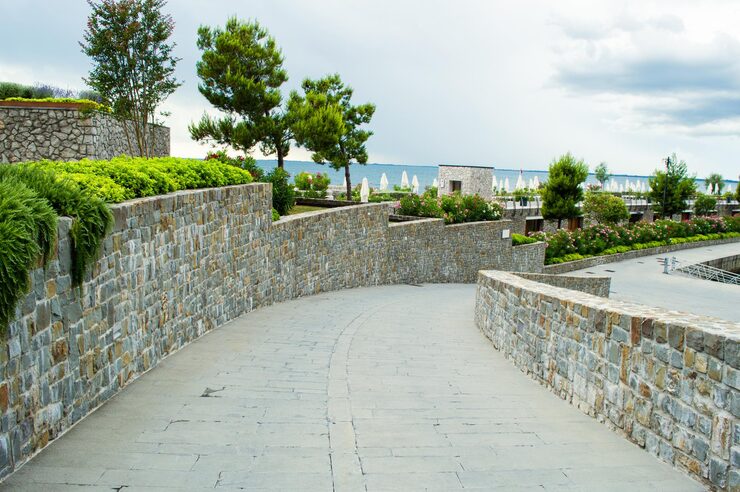
Where this suits Maynard properties
Tight frontages
Short setbacks mean the apron and edge are the first thing visitors see. A narrow cobble border frames the entry without needing to rebuild the whole drive surface.
Older homes near the street
Mill-era houses sit close to the road with little buffer. Cobblestone edging ties a modern drive back into the age and material of the original house.
Shared or narrow access drives
Lots with tight side-by-side drives benefit from a clearly defined edge, keeping plow blades and tires off planting beds and property lines during winter.
So tar and chip suits a longer, gentler Maynard drive with some room around it. It is a poor match for a short, steep or shared one, or one that opens straight onto the walk.
Questions we hear
Does cobblestone edging need a different base than an asphalt driveway?
Yes. It needs its own excavated and compacted base plus a buried edge restraint to keep the stones from spreading, even where it sits right next to an asphalt surface built differently.
Can a cobblestone apron be added to an existing driveway without replacing it?
Often, yes. The apron and edging can be built as a border around an existing drive surface, which is usually the more proportional and affordable approach on a small lot.
Who is responsible for the apron where it meets the street in Maynard?
Where the apron meets a town-accepted road, the curb cut and transition fall under the town's authority rather than the homeowner's, which affects what can be changed without a separate approval step.
Does granite cobblestone or concrete cobble hold up better to Massachusetts winters?
Reclaimed granite resists flaking and spalling under freeze-thaw better over the long term, while manufactured concrete cobble costs less up front but can wear and fade differently with age.
Next step
Call us at (413) 337-3772. Tell us about the lot, the slope and what you want the frontage to look like. We have been working in this area since 1988, and we will tell you plainly what suits your property.