
Walkway Installation in Ashland, MA
Most houses in Ashland sit on a short, straight drive with a plain stretch of lawn or concrete running between it and the front door. That gap gets walked across every day, in every season, and on a lot of post-war ranches and split-levels it was never actually built for the job. It’s grass that’s worn to dirt, a cracked concrete strip from the original build, or a few paving stones laid straight on the soil years ago that now rock underfoot. A proper walkway fixes that, and it also does something a driveway repair never will: it changes how the front of the house reads from the street.
This is different work from driveway paving, even though the materials sometimes overlap. A walkway is narrower, it’s walked rather than driven, and it has to look right up close, not just hold weight. The decisions are different too – joint pattern, edge line, how it meets the step and the drive, whether it matches an older house or a newer one near the Framingham line. None of that is about tonnage or traffic load. It’s about getting a detail right that someone will look at from three feet away, every single day.
What’s underneath decides whether it stays flat
A walkway that goes wavy, or sprouts a step where there shouldn’t be one, almost always failed below the surface, not on top of it. Massachusetts frost moves the ground every winter. Water in the soil freezes, expands, and pushes upward. If the base under a walk is topsoil, or a thin bed of sand dropped straight on the existing grade, that movement happens unevenly along the path’s length, and the surface follows it. Pavers lift at one joint and sink at the next. A concrete slab without a proper base cracks along the weak line and one side drops.
The fix is the same principle as a driveway, scaled to a narrower footprint: excavate below the frost-affected zone, lay a compacted gravel base that drains instead of holding water, bed the surface material correctly, and restrain the edges so the whole thing moves together instead of in pieces. Done that way, a walk in Ashland sits flat through freeze-thaw cycles because the ground under it isn’t holding water to freeze in the first place. Skip the base and the surface material almost doesn’t matter – it will move regardless of whether it’s pavers, brick, or poured concrete.


What Our Clients Say
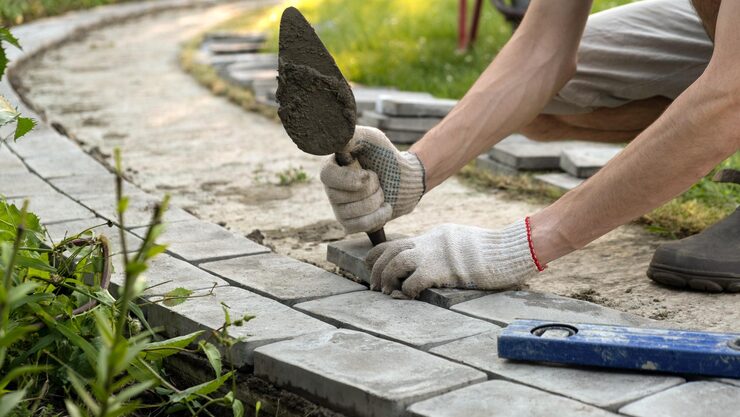
Materials: the trade-offs, not a brochure list
Concrete, pavers and natural stone each handle Ashland winters differently, and each ages differently too. None of them is the right answer for every house, and the honest comparison matters more than a feature list.
Poured concrete costs the least per square foot and gives a clean, uniform line that suits a simple Ashland ranch front. It can crack with frost movement, and repairs rarely blend in – usually a patch or full repour.
Concrete pavers cost more up front but handle frost heave better, because each unit can move slightly without cracking the whole path. A damaged paver lifts out and gets replaced on its own, with no visible scar.
Natural stone, bluestone or fieldstone, suits an older Ashland house with a settled, less uniform look. It costs the most and needs a precisely built base, since irregular stones rely entirely on bedding to sit level and stay there.
Brick splits the difference in price and reads as traditional against a colonial or cape. It’s more prone to spalling from repeated freeze-thaw than dense concrete pavers, so edge restraint and drainage matter even more with brick.
Repairability is worth weighing before cost. A unit-based surface – pavers, brick, stone set individually – lets you fix one section without redoing the whole walk. A poured slab doesn’t give you that option.
Choosing a material
The materials are not equal. Each suits some properties and not others.
Grade and water: the part that's invisible until it isn't
A hard surface doesn’t absorb rain like lawn does, so every walkway changes where water goes. We pitch each path with a slight cross-slope so water sheds off the surface instead of pooling or running toward your Ashland home.
On a flat Ashland lot that’s a simple fix. Where the path runs alongside a foundation or crosses a slope down from the house, getting the pitch wrong can send water somewhere you’ll regret, including straight at the foundation wall.
This is also where a walkway interacts with the lawn around it. A path set below grade becomes a channel for water and ice. Graded correctly, Ashland walkways shed water into surrounding soil without turning into a trench or dam.
Tying into what's already there
A new walkway rarely stands alone. It meets the driveway at one end, the front step or porch at the other, and it usually runs past existing planting beds, a retaining wall, or a concrete apron poured decades ago.
Matching materials at that junction matters. A paver walk meeting an asphalt drive needs a clean edge detail, not a ragged transition.


Where this fits in Ashland specifically
Ashland’s mix of older ranch-style frontage and newer subdivision lots near the Framingham line gives two fairly different starting points. On the older post-war homes, the front walk is often the original narrow concrete strip, cracked and settled after decades of frost cycles, and replacing it is usually the single biggest visual change you can make to the front of the house without touching the structure itself.
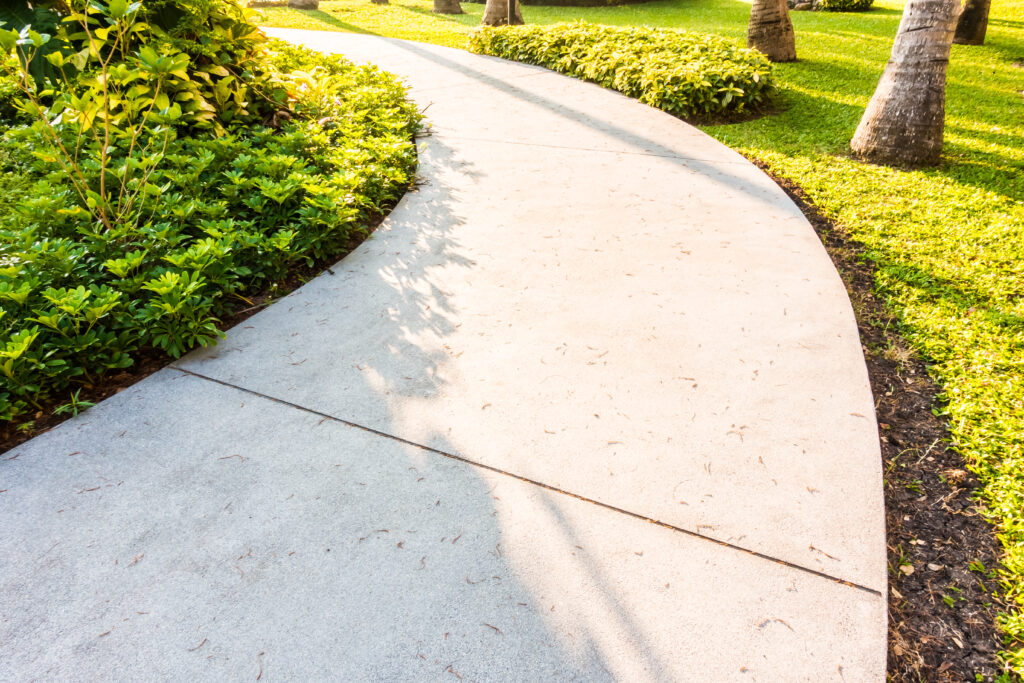
On newer construction near the Framingham side of town, the builder-grade walk is sometimes adequate but plain – a straight slab with no detailing – and homeowners often want to widen it, add a curve, or upgrade the material to something that matches a later landscaping investment. Either way, the short, straight driveways common across Ashland mean the walkway is usually a compact, well-defined project: a clear run from drive to door, not a sprawling network of paths. That keeps the scope predictable and the base work straightforward, since there’s no long, sloped run to manage for drainage the way there would be on a steeper lot.
What drives the price
A new walk has to meet several existing things cleanly.
- The entry : The walk must arrive at the door at a sensible height. The threshold sets the finished level, so the work starts at the door and runs outward.
- The drive : Where a walk meets a drive, the levels and the drainage have to agree. A mismatch becomes a trip edge or a puddle.
- Walls and planting : Existing stone walls, foundation beds and mature trees constrain the route. Roots under a path are worked around, not cut through without thought.
- An older house : Scale, colour and pattern should follow the architecture. A narrow, dark stone walk suits an old house differently than a broad paver field does.

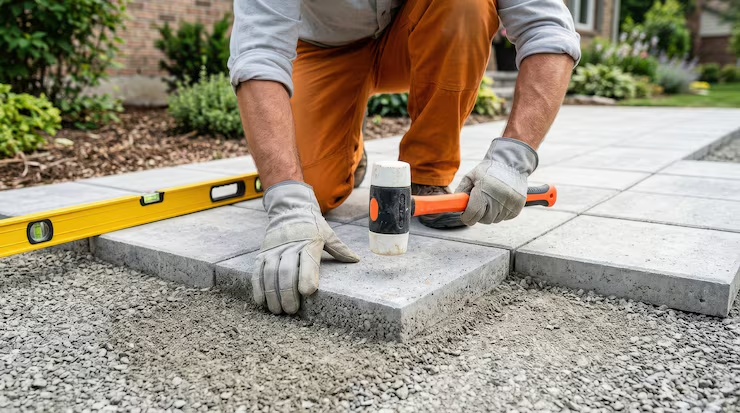
Getting started
If the walk at your Ashland home has gone uneven, cracked, or just looks tired next to the rest of the property, the fix starts with what’s underneath it, not the material on top. Frost heave, poor drainage, and roots from mature trees common to older Ashland lots are usually why a walkway fails years before it should. Driveway Specialists has been doing this kind of hardscape work across Middlesex County since 1988, and we start every project by looking at your grade, your soil, and what’s already built before recommending a material. A proper base, compacted gravel, set to the right depth and pitched to move water away from your foundation and steps, matters more than whether you choose pavers, natural stone, or poured concrete on top.
- Site evaluation of grade, soil, and drainage patterns
- Material recommendation suited to your home’s style and budget
- Proper base preparation so the walkway lasts through New England winters
Call (413) 337-3772 to talk through what would actually hold up on your property.
Before you call
It helps to know:
- Where the walk starts and where it needs to end
- Whether the route crosses a slope or a shared area
- Which material you lean towards, and whether the house is older
- Where water currently runs on the property
Questions people ask
How is a walkway different from a driveway project?
A walkway is narrower, carries foot traffic instead of vehicle weight, and the visual detail matters more since people see it up close every day. The base principles are similar, but the material choices and design decisions are different.
Will frost affect a new walkway in Ashland?
It will if the base isn't built to handle it. A properly excavated, compacted gravel base with good drainage keeps water from pooling and freezing under the surface, which is what causes heaving and cracking.
Can a cracked concrete walk be replaced with pavers instead?
Yes. Many Ashland homes have original concrete walks from the original build that have cracked over the decades. Switching to pavers or stone on a proper base gives you a surface that can be repaired section by section instead of needing a full repour.
How does a new walkway tie into an existing driveway?
The transition needs a clean edge detail where the two materials meet. We look at what's already there, asphalt, concrete, or pavers, and design the junction so it reads as intentional rather than patched together.
Next step
Call Driveway Specialists on (413) 337-3772. We are a family-run company in business since 1988, and we will walk the route with you and talk through material, grade and drainage before anything is priced.