
Walkway Installation in Littleton, MA
A lot of Littleton properties share the same problem: a long gravel drive that works fine for a car but leaves no proper way to walk from the parking area to the front door. Others have an old asphalt or gravel path that has heaved, drifted, or simply disappeared into the lawn after years of frost and mowing. Either way, a proper walkway is less about fixing something broken and more about finishing a property that was never quite finished.
On the larger, more rural lots common around Littleton, a walkway also has to do real work. It often runs a reasonable distance from the driveway or a detached garage to the entry, crossing lawn, maybe a slope, maybe tree roots from the white pines and maples that line a lot of these frontages. That is a different job from a short concrete step-to-sidewalk path in a denser town, and it should be designed as one, with grade changes, root zones, and sightlines all worked out before anyone breaks ground.
What holds a walkway flat for years
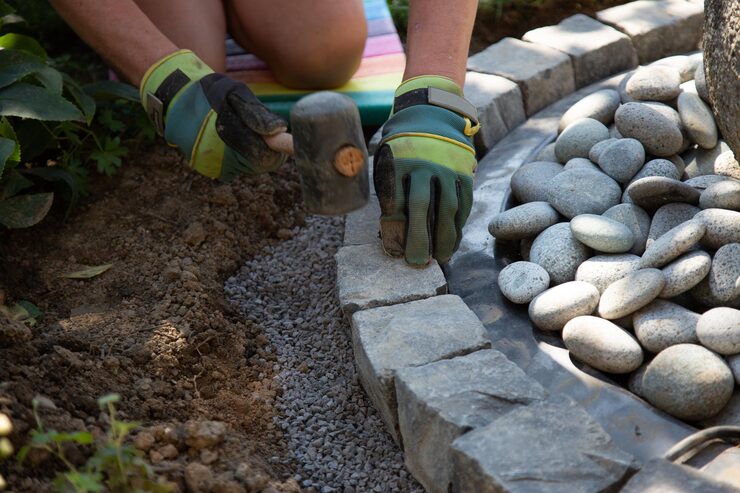
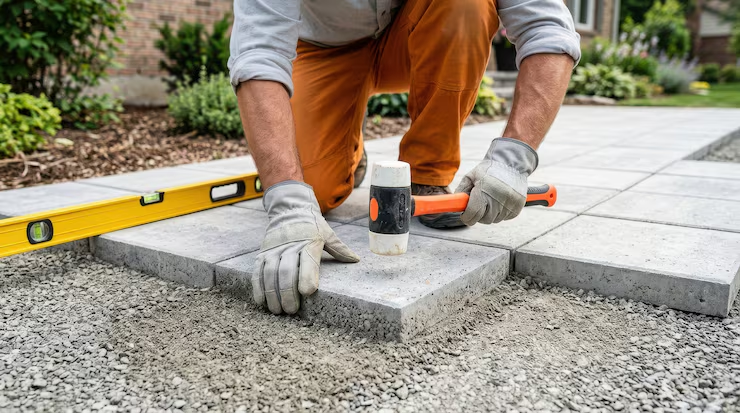
Everything that matters is underneath. A walkway that goes wavy, cracks at the joints, or develops a lip at one edge almost always failed below the surface, not on top of it. The process is excavation to a workable depth, a compacted base course, a bedding layer suited to the surface material, and edge restraint that keeps the whole assembly from spreading sideways under frost.
Frost is the part most installers rush. Massachusetts ground freezes and heaves every winter, and it does not heave evenly. A walkway built on a thin, poorly compacted base moves with that heave: unit pavers rock loose, poured surfaces crack along weak points, and edges without proper restraint migrate outward a little more each year until the whole path looks crooked underfoot and uneven to the eye. A walkway built on a correctly compacted base and held with real edge restraint moves as one piece, if it moves at all, which is the difference between a path that still looks right in year ten and one that needs patching by year three.
Littleton’s sandy, well-drained soil is actually an advantage here. Sand drains fast and compacts predictably, which means a well-built base sits on a foundation that is not fighting standing water or frost-prone clay. That does not make the base work optional. It makes it worth doing properly, because the ground is cooperating rather than working against the installation, and that cooperation only pays off if the compaction and layering are done to spec rather than eyeballed.
A few details worth deciding early, before material even gets ordered:


What Our Clients Say
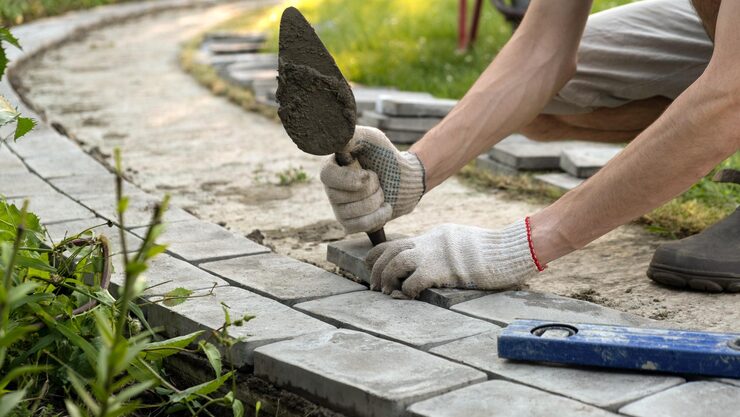
Materials: the honest trade-offs
Concrete pavers hold up well to freeze-thaw, can be reset individually if one settles, and age without much drama. Natural stone looks right against an older New England house but costs more and is harder to repair piece by piece.
Poured concrete walkways
Poured concrete gives a clean, uniform surface at a lower material cost, but it cracks as one slab, not as separate units, and a crack usually means patching or replacement rather than a quick fix.
Brick and reclaimed material
Brick suits period homes and settles gracefully, but individual bricks can spall under repeated freeze-thaw. It is a good look for the right house, not a universal choice.
Where drainage has to go
Any hard surface sheds water instead of absorbing it. A walkway pitched toward the house, or toward a low spot near the foundation, moves a problem indoors. Grade has to carry water away, always.
Grade on sloped lots
Littleton's rolling terrain means more walkways cross a real grade than in flatter towns.
Root pressure from mature trees
Pines and maples near the path line will push roots under a surface over time.
Choosing a material
The materials are not equal. Each suits some properties and not others.
Tying into the driveway
Where a walkway meets a gravel or asphalt drive, the transition needs a clean edge and matched grade. A mismatched tie-in is where water pools and where the two surfaces start pulling apart from each other.
Matching the entry and steps
The walkway width and material should read as part of the same approach as the front steps and porch, not as an unrelated add-on poured later. Small proportion decisions matter more than people expect.
Working with existing walls and beds
Littleton properties often pair retaining walls, garden beds, and mature plantings with a new walkway. Thoughtful layout routes around root zones, grade changes, and existing stonework rather than disturbing them, preserving established landscaping while still achieving a clean, functional path.
Matching an older house
A lot of Littleton’s housing stock is older colonial and farmhouse-style construction. A walkway material and pattern that respects that, rather than looking like a modern insert, holds its value better.
Gravel-to-hard-surface conversions
Converting a gravel path to pavers or concrete is common work around Littleton.

Why this fits long rural frontages
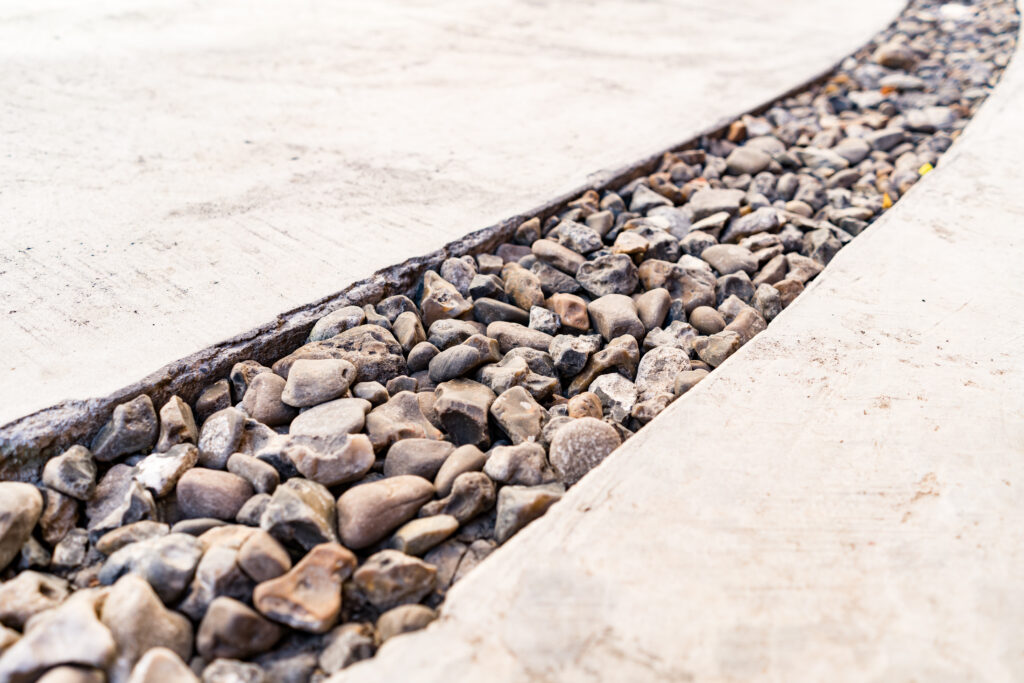
Littleton’s lot sizes mean a lot of distance between the road, the driveway, and the front door. That distance is exactly where a defined walkway earns its keep: it sets a clear path across lawn or gravel, keeps foot traffic off soft ground near the house, and gives a long frontage a sense of arrival it did not have before. On a property with a detached garage or a driveway that curves well away from the entry, a walkway is often the single change that makes the approach to the house feel intentional rather than accidental. It also solves a practical problem specific to rural lots: without a defined surface, foot traffic wears a bare path through grass that turns to mud every spring thaw. A properly based walkway, built for the sandy soil and frost conditions here, replaces that with something that stays flat, drains on its own, and does not need re-grading every year the way a worn grass track does.
What drives the price
A new walk has to meet several existing things cleanly.
- The entry : The walk must arrive at the door at a sensible height. The threshold sets the finished level, so the work starts at the door and runs outward.
- The drive : Where a walk meets a drive, the levels and the drainage have to agree. A mismatch becomes a trip edge or a puddle.
- Walls and planting : Existing stone walls, foundation beds and mature trees constrain the route. Roots under a path are worked around, not cut through without thought.
- An older house : Scale, colour and pattern should follow the architecture. A narrow, dark stone walk suits an old house differently than a broad paver field does.
Getting started
A walkway project starts with a look at the ground: the grade between driveway and door, the soil, root zones, and how the path should relate to the house and existing hardscape. From there the material choice follows from budget, look, and how much long-term repair work you want to take on.
Every property on a Littleton lot is laid out a little differently, and a walkway that works well on one frontage can be the wrong call on the next one fifty yards away. That is worth a site visit rather than a guess over the phone. Call (413) 337-3772 to set up a time to walk the property and talk through what fits. Driveway Specialists has worked on hardscape and driveway projects across Middlesex County, including plenty of the long, sandy, rural lots that make up a lot of Littleton, since 1988, and the approach here starts with what is actually underground, not with a catalog of materials.
Before you call
It helps to know:
- Where the walk starts and where it needs to end
- Whether the route crosses a slope or a shared area
- Which material you lean towards, and whether the house is older
- Where water currently runs on the property
Questions people ask
Why does a walkway heave even when the driveway next to it doesn't?
A walkway is usually thinner and built with less base depth than a driveway, so frost has an easier time moving it. If the base wasn't compacted properly or edge restraint is missing, the walkway moves independently of the driveway beside it.
Can an existing gravel path be converted without starting from scratch?
Often yes. The gravel is usually removed and the area excavated to proper depth for a new base, but the existing route and grading can inform the new layout, which saves some planning work.
Do tree roots near the house rule out a walkway in that spot?
Not necessarily. Routing around major root zones, or accepting a shallower excavation near a trunk, usually lets the walkway go in without major disturbance to the tree.
How does pitch work on a walkway that runs close to the house?
The surface should slope gently away from the foundation and toward a safe runoff point, the same principle as grading a driveway, just on a smaller scale and over a shorter run.
Next step
Call Driveway Specialists on (413) 337-3772. We are a family-run company in business since 1988, and we will walk the route with you and talk through material, grade and drainage before anything is priced.