
Walkway Installation in Walpole, MA
Most Walpole properties fall into one of two patterns: a subdivision lot with a straight concrete walk poured the same week as the house, or an older place on one of the outer rural roads with a path that was never really planned, just worn in over the years. Either way, homeowners usually call us because the existing walk looks tired next to a drive or entry that has since been redone, or because it was never built well in the first place and has started to heave, sink, or pitch water toward the foundation instead of away from it.
A walkway is not a smaller, cheaper version of a driveway. It carries foot traffic, not a loaded vehicle, so the engineering underneath can be lighter, but the standards for how it looks and how it ages are higher. People notice a walk up close, every day, at a slower pace than they notice a driveway from a car window. That changes the decisions worth making.
What’s under the surface decides what you see on top
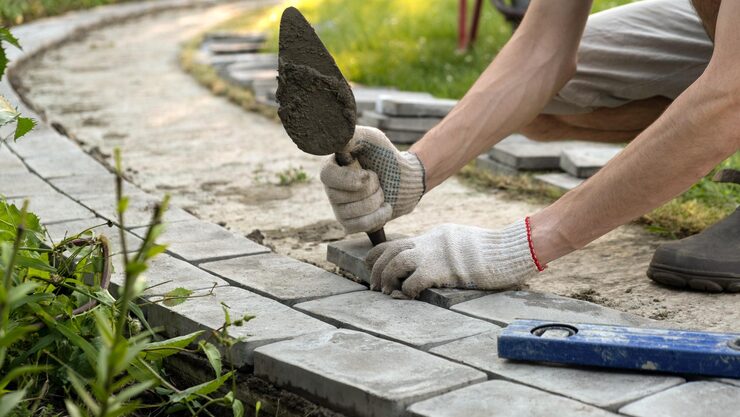
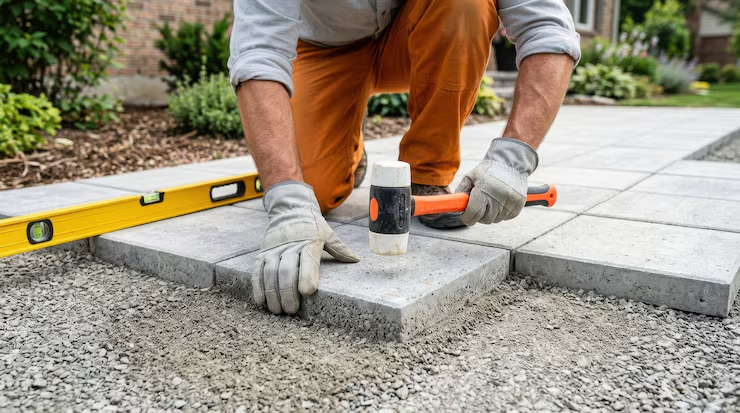
The visible part of a walkway is a bedding layer and the surface material sitting over compacted base. Everything that eventually goes wrong with a walk – heaving, settling, joints opening, edges dropping – starts below that surface, not on it. In Walpole’s mixed soils, that means removing organic topsoil down to a stable subgrade, placing a crushed stone base, and compacting it in lifts rather than all at once. Skip a lift or skimp on compaction and the base keeps settling under its own weight for a year or two after installation, which is exactly when a brand-new walk starts looking uneven.
Frost is the other half of the equation. Massachusetts ground freezes and thaws repeatedly over a winter, and any water trapped in or under the base expands with each freeze. An open-graded stone base drains that water down and away before it can lift the surface. A base built from the wrong material, or over soil that holds water, heaves unevenly because different sections freeze and thaw at different rates. That is why a poorly built walk goes wavy in patches rather than sinking evenly – the movement is not uniform, so the surface stops being flat.
Edge restraint matters more on a walkway than people expect, because a walk is narrow. Without a proper edge, paver or brick walks spread sideways under years of foot traffic and the joints open up. A concrete walk without control joints cracks wherever stress finds the weakest point instead of where you planned for it.


What Our Clients Say
Drainage and grade come first
Every Walpole walkway starts with where water goes once the ground is covered.
Tying into the drive and entry
A walkway rarely stands alone—it meets a driveway, steps, or a front door, and that transition is where poor installs show.
Matching an older Walpole house
Walpole’s older homes, particularly away from the subdivisions, often call for a walk that looks like it has always been there. Fieldstone, brick, or tumbled pavers sit better against an older facade than a sharp-edged poured slab ever will.
Working around existing walls and planting
Retaining walls, garden beds, and established shrubs often sit close to the old walk line. We excavate and build around them where we can, protecting root systems and mature plantings instead of clearing the yard back to bare dirt.
Straight, level lots make this easier
Most Walpole subdivision lots are flat and regular, which keeps excavation and base work straightforward. That’s a genuine advantage – less grading, fewer surprises, consistent base depth, and a faster path from excavation to a finished, properly compacted walkway surface.
Rural lots need more grading judgment
On Walpole's outer rural roads, lots vary more in slope and soil.
Choosing a material
The materials are not equal. Each suits some properties and not others.
Concrete: low maintenance, unforgiving cracks
Poured concrete gives a clean, formal line and needs little upkeep. The trade-off is permanence in the wrong direction – once it cracks, that crack does not go away, and patch repairs rarely disappear into the original surface.
Pavers: repairable, more upfront cost
Paver walks cost more to install but age better in practical terms. A section that settles or cracks lifts out and resets individually, without disturbing the rest of the walkway or leaving a visible patch behind.
Natural stone: the look, the risk
Fieldstone and bluestone give the most traditional look, especially near an older home. They also demand the most precise base and setting work, since irregular stone is far less forgiving of shortcuts than a uniform paver.
Edge restraint prevents spreading
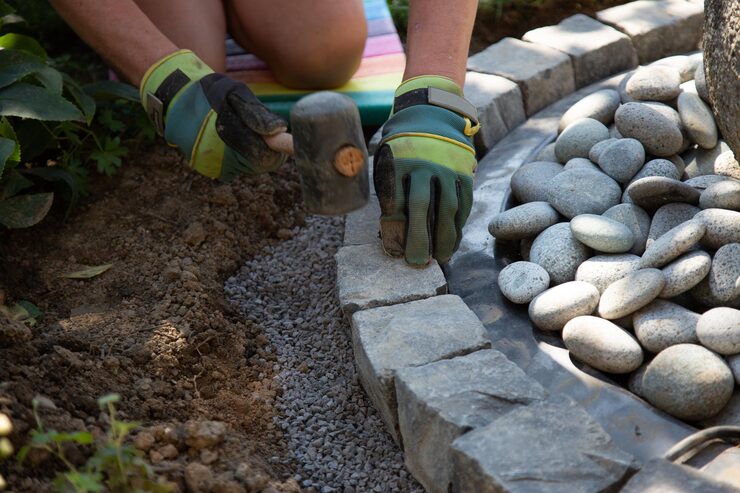
A narrow walk without solid edge restraint slowly spreads under years of foot traffic. Paver and stone walks need a buried edge to hold the line; without one, joints widen and the surface loses its shape over time.
Control joints in concrete walks
Concrete cracks somewhere eventually – the only choice is whether you decide where. Control joints cut at the right spacing give the slab a planned place to crack, keeping the surface looking intentional instead of damaged.

Where this fits a Walpole property
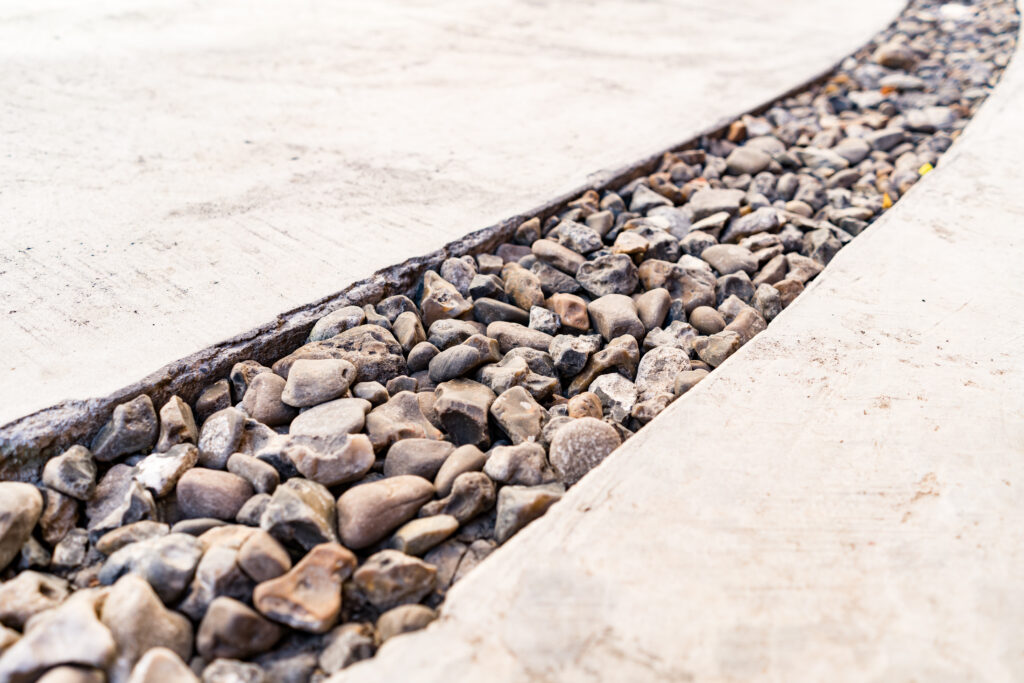
Walpole’s mix of planned subdivisions and older rural lots means no single walkway design answers every property. A newer subdivision home usually wants a walk that complements a recently redone driveway and a modern entry – clean paver lines or a well-finished concrete slab that reads as deliberate, not an afterthought from the original build. An older home on a rural road, often set back with mature trees and established gardens, tends to suit something that looks like it has aged alongside the house: fieldstone set with tight, settled joints, or brick laid in a traditional pattern.
What stays constant across both situations is the groundwork. Base depth and compaction, drainage pitched away from the foundation, and solid edge restraint matter the same amount whether the finished surface is poured concrete or hand-set bluestone. The visible material is the decision homeowners spend the most time on, and it’s a real decision worth getting right, but it only lasts if what’s underneath it was built to handle a Massachusetts winter before the first stone or form board ever went down.
What drives the price
A new walk has to meet several existing things cleanly.
- The entry : The walk must arrive at the door at a sensible height. The threshold sets the finished level, so the work starts at the door and runs outward.
- The drive : Where a walk meets a drive, the levels and the drainage have to agree. A mismatch becomes a trip edge or a puddle.
- Walls and planting : Existing stone walls, foundation beds and mature trees constrain the route. Roots under a path are worked around, not cut through without thought.
- An older house : Scale, colour and pattern should follow the architecture. A narrow, dark stone walk suits an old house differently than a broad paver field does.
Getting started
If your front walk has started to heave, crack, or simply looks out of step with the rest of the property, the fix starts with an honest look at what’s happening below ground, not just what you can see. We’ve been building walkways and driveways across Norfolk County since 1988, as a family-run crew that still shows up to look at the job ourselves before anyone talks materials or layout.
We’ll walk the site with you, talk through what the soil and grade on your lot actually call for, and lay out the material options with their real trade-offs – not a sales pitch, just what holds up and what doesn’t given how your property sits. Whether you’re in one of Walpole’s subdivisions or out on one of the rural roads, the same groundwork principles apply, and we’ll tell you plainly if a simpler approach suits your situation better than the more expensive one.
Call (413) 337-3772 to set up a time to look at your walkway and get a straight answer on what it needs.
Before you call
It helps to know:
- Where the walk starts and where it needs to end
- Whether the route crosses a slope or a shared area
- Which material you lean towards, and whether the house is older
- Where water currently runs on the property
Questions people ask
Can a walk be built on a steep Walpole lot?
Yes. The route usually changes. It may zigzag, step up in stages or include landings. The base and drainage matter more on a slope, not less.
Do I need the walk pitched away from the house?
Yes. A walk that falls toward the foundation sends water to the wrong place. The pitch is gentle and almost invisible.
Pavers or poured concrete?
Pavers can be lifted and reset if the ground moves. Concrete cannot be repaired cleanly once it cracks. Concrete is simpler for a long straight run, and pavers allow more variety and easier repair.
Can you match a walk to an older house?
Usually. Material, colour, scale and pattern all matter, and we can talk through what suits the architecture before anything is ordered.
Why does the base matter more than the surface?
Frost lifts what sits above it. A deep, well-compacted, free-draining base gives frost nothing to work with, and that is why a well-built walk stays flat.
What does a walkway cost?
It depends on length, material, slope and access. We quote after seeing the site.
Next step
Call Driveway Specialists on (413) 337-3772. We are a family-run company in business since 1988, and we will walk the route with you and talk through material, grade and drainage before anything is priced.