
Driveway Paving in Sharon, MA
If you’re looking at a Sharon driveway that’s cracked through to the base, heaving where the frost gets under it, or simply never existed because the house is new, you’re trying to figure out who to call and what it’s actually going to take. That’s what this page is for.
A lot of driveways in Sharon run long, through trees, toward houses set well back from the road near the lake or along the wooded side streets off Route 27 and Route 1. That length and that tree cover change what a paving job here actually involves, and it’s worth understanding before you start calling contractors.
What happens when you call
We come out and look at the actual drive, not a satellite photo of it. That means walking the length of it, checking the grade, checking where water goes when it rains, and digging a test spot or two to see what’s actually under the current surface. In Sharon that last part matters more than in a lot of towns, because conditions vary block to block. Much of the town sits over sandy, well-draining glacial soil, which is good news for a base. But a lot of lots are wooded and rolling, and where a drive winds through mature trees, roots have often pushed into the base from underneath, and the canopy keeps the surface shaded and damp longer after rain or snow than an open drive would.
We measure square footage, check how the drive sheds water along its length, and look at where it meets the garage or house grade. On a long drive through trees, we’re also looking at root intrusion near the edges and whether tree cover means the surface will stay wetter longer through the fall and spring, which affects how the asphalt holds up over time.
None of that shows up in a phone quote. A contractor who prices your driveway without walking it is pricing the driveway they imagine, not yours.
Once we’ve seen the ground, we can tell you plainly whether you’re looking at a full replacement or whether the existing base is sound enough to build on. That’s the first real decision, and it’s the one that determines almost everything else about cost and timeline.
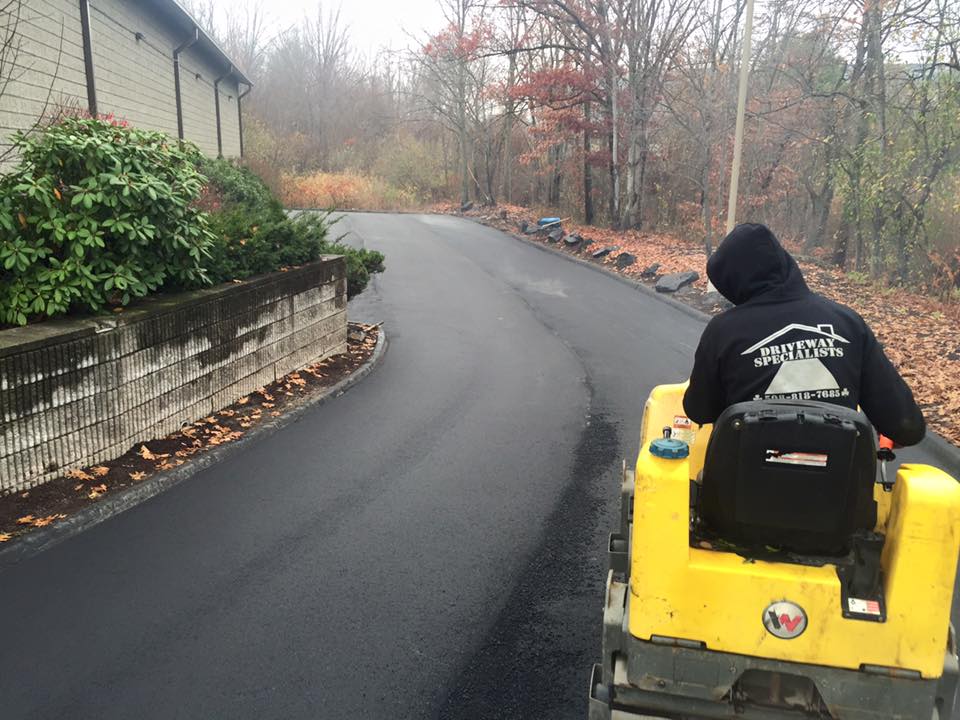
For a long wooded drive, the base work usually matters more than the surface asphalt. We typically excavate down past the organic topsoil and root mat, since paving over leftover loam or shallow roots is what causes dips and heaving a year or two later. A compacted gravel base, built up in layers, gives the asphalt something stable to sit on even as the ground around it stays damp longer under tree cover. Where a drive runs near low-hanging branches or close to the lake side of a property, we also think about drainage swales or a slight crown in the paving itself, so water sheds off to the sides instead of pooling and refreezing on the surface through a Massachusetts winter.


What Our Clients Say
Why the Base Is the Job
The surface is the part you see. The base is the part that decides whether that surface lasts. Under sandy soil, which covers much of Sharon, water moves down and away from the base instead of sitting under it. That's a real advantage. But a long drive through trees and over rolling ground can still trap water in low spots or where roots have disturbed the compacted base beneath the asphalt. Tree roots in particular push up and shift stone that took real effort to compact correctly the first time. A new surface over a compromised base will crack again in the same places, usually within a season or two, because paving only hides a weak foundation, it never fixes one.
Full Replacement or Overlay
An overlay, a new layer of asphalt over the old, only works when the base underneath is still sound: no major cracking through to the subgrade, no soft or heaving spots, no standing water after rain. On a wooded Sharon lot, root heave under a long drive is the thing that most often rules an overlay out, and mature trees close to the pavement edge are common across town. If roots have lifted or cracked the base, paving over it just buries the problem under a fresh surface that will fail the same way, often within a season or two. Drainage matters too: a drive that pitches toward the garage or holds water along one edge usually needs the base rebuilt, not resurfaced.

What Drives the Price
Square footage is only the starting point. A long wooded drive in Sharon often needs more excavation than a short flat one, because the base has to be dug out past wherever roots have pushed into it, and that material has to be hauled off site rather than reused. Access matters too: a paver and roller have to get down a narrow, tree-lined drive and still have room to turn, which isn't always simple on a lot with mature trees crowding the edges or a tight turn off the street. Grade and drainage factor in, especially on sloped Sharon lots where water needs somewhere to go besides the garage. The apron where the drive meets the road or an existing driveway adds its own prep. Old asphalt or a failing base underneath can mean extra tear-out before paving even starts.
What drives the price
Several things set the cost of a driveway, and each one is visible only on site.
- Square footage : The area to be paved, plus any widening, turnaround or parking pad you want added.
- Depth of excavation : How far down the old material has to come out, and how much of the base has to be rebuilt.
- Material removed : The old asphalt has to be hauled away, and the amount depends on what is there.
- Access: A paver, a roller and delivery trucks all need to get in and turn around. Tight Sharon frontages can limit what equipment fits, which changes how the work is staged.
- Grade: A steep drive is harder to prepare, harder to compact and harder to drain correctly.
- Drainage: If water needs to be moved off the drive and away from the house, that work is part of the job.
- The apron: On many Sharon lots the apron meets the sidewalk with very little room between the street and the house. How that transition is built affects both the drive and the walk, and we look at it closely.
Anyone who gives you a firm figure without having stood on your driveway is guessing. When the guess is wrong, the extra cost shows up later as shortcuts in the base.
Scheduling Around the Season
Paving in Massachusetts is seasonal work, and that holds true in Sharon as much as anywhere in Norfolk County. Cold ground and wet weather affect compaction, so jobs get scheduled around the stretch of the year when conditions cooperate, which means booking ahead matters if you want a particular window. Once we’re on site, you’ll need to keep vehicles off the drive and clear of the work area while it’s being built. After paving, the surface needs time to firm up fully, and how you treat it that first season, keeping heavy loads and sharp turns off it, matters for how it holds up over the years that follow.
Trees, Roots and Edges
A driveway that runs under oaks or maples carries two problems a clear, open drive doesn’t have. First, roots grow toward the compacted, moisture-holding soil under a driveway, and over years they can lift the base from underneath, which shows up as humps or cracks in the surface above. Second, shade keeps the asphalt damp longer after rain, which accelerates wear at the edges. In Sharon’s wooded neighborhoods, we often cut back the base further from problem roots than the surface damage alone would suggest, because the spot where you see cracking today usually isn’t the only spot the roots have reached.
Call for a Site Visit
If your Sharon driveway is past patching or you’re starting from bare ground, the next step is the same either way: someone needs to look at the ground before any number means anything. We’ve been doing this work across Norfolk and Middlesex counties, including nearby Canton and Stoughton, since 1988, family-run the whole way through. Call (413) 337-3772 to get a time scheduled.
FAQs
How do I know if my Sharon driveway needs full replacement or just an overlay?
It comes down to the base. If there's no major cracking through to the subgrade, no soft spots, and no standing water, an overlay can work. If roots have pushed into the base or it's cracked through, an overlay just buries the problem. We check this on site before recommending either.
Do tree roots really affect a driveway's base?
Yes. Roots grow toward the moisture held under a compacted driveway base and can lift it from underneath over time. This is common on wooded Sharon lots and often shows up as humps or cracking well before the whole surface looks damaged.
Why can't I get a firm quote over the phone?
Price depends on things that only show up on site: depth of excavation, how much material has to come out, access for equipment, grade, drainage, and the apron. A phone quote without seeing the drive is a guess, and guesses tend to grow once work starts.
When is driveway paving scheduled in Sharon?
Paving is seasonal work in Massachusetts because cold and wet ground affect how well the base compacts. We schedule jobs for the stretch of the year when conditions are right, so it's worth calling ahead to get on the schedule.
What do I need to do once paving starts?
Keep vehicles off the drive and clear of the work area during construction. Once the job is done, give the surface time to firm up and avoid heavy loads or sharp turns on it through that first season.
Call us
If your Sharon driveway has reached the end of its life, or you are putting one in for the first time, call (413) 337-3772. We will arrange a time to see the site, measure it, and tell you what it needs.