
Cobblestone Aprons and Edging in Natick, MA
A straight asphalt driveway meeting the street is functional and forgettable. In Natick, where lots range from tight older streets near the center to lakeside properties near Lake Cochituate and newer subdivisions in South Natick, the apron and the edge are often the only part of the hardscape a passerby actually registers. A cobblestone apron marks the transition from public road to private property with a visible line, and edging holds that line where plain asphalt or a soft lawn border would slowly lose it. This is not a repair job. It is a decision about how the front of the property reads, and how well that detail survives a Massachusetts winter.
Everything about whether it survives comes down to what happens before the first stone goes down. Cobblestone set on a shallow bed of sand over compacted gravel will shift within a few winters, because frost under New England soil does not move evenly. Water trapped under the stones freezes, lifts unevenly, and the line that was straight in October is wavy by spring. A proper installation means excavating well past the visible edge, building a compacted base that can shed water instead of holding it, and bedding the stones so they lock together rather than ride independently on the base.
Edge restraint is the whole job
The stones themselves rarely fail. What fails is the restraint behind them – the hidden edge that keeps the first course from creeping outward under the weight of a car tire clipping the apron, or a plow blade catching it in January. Without a proper restraint, cobblestone edging drifts a little every season until the line is gone. With one, it holds position for the long term, which is the entire point of paying for stone instead of a painted line in asphalt.
Drainage runs underneath all of it. An apron sits at the lowest point of most driveways, right where the grade meets the street, so it collects whatever water is coming down the drive. If the base under the cobblestone doesn’t let that water through, it pools at the stone and freezes there first. Pitching the work away from the garage and toward the street, or into a drain where the town or site allows it, is part of the design, not an afterthought.
Natick’s mix of property types means this work looks different lot to lot. A tight frontage near the village center asks for a narrow, crisp apron that doesn’t fight the sidewalk. A lakeside lot with mature shade trees needs an edge detail that tolerates root movement without cracking. A newer South Natick subdivision with a wide curb cut has room for a bolder cobblestone pattern that can carry visual weight on its own.


What Our Clients Say

What the work involves below the surface
The stone is the last and smallest part of the job. A cobblestone apron stays flat or goes wavy depending on what is underneath it.
Matching what's already there
Older Natick homes often have fieldstone walls, brick steps, or granite curbing nearby.
Granite vs. concrete cobblestone
Real granite cobblestone costs more upfront but resists Natick's freeze-thaw cycles almost indefinitely, holding sharp edges and color for decades.
Grade at the street line
The apron carries every drop of water the driveway sheds.
Root heave near shade trees
Many Natick lots, especially near Lake Cochituate, carry mature oaks and maples with aggressive surface roots. Edging set too rigidly nearby will crack or heave within a season.
Tying into existing walls
Cobblestone edging rarely stands alone.
Materials and the trade-offs
What the excavation actually involves
Before any stone is set, the existing asphalt or lawn edge comes out to a depth that reaches below the frost-affected zone. The soil underneath gets checked and, where needed, replaced with a compacted gravel base that drains rather than holds water. This step is invisible once the job is finished, which is exactly why it gets skipped on cut-rate installs and exactly why it matters most. A base that holds water through a Natick winter will heave the stones above it regardless of how well they were set.
On lakeside lots with naturally damp soil, this base layer does more work than elsewhere, since the water table sits closer to the surface for more of the year. On drier, sandier ground further from the lake, the same base performs with less margin for error, though it is never skipped.


Choosing a pattern that fits the house
A single soldier course of cobblestone along the apron edge is the simplest, most durable option, and it suits older homes near the Natick village center where restraint reads better than ornament. A double or triple course, or a fan pattern at the curb cut, suits larger South Natick lots where the driveway itself is wide enough to carry more visual interest without looking busy.
The choice also affects maintenance. A single course is easy to reset if one stone shifts. A complex pattern with multiple stone sizes takes more care to repair cleanly if it’s ever disturbed by utility work or a hard winter. Neither choice is wrong, but it’s worth deciding with the long-term upkeep in mind rather than only the day it’s installed.
Color selection usually follows the house, not the driveway. Granite in gray or a warm tan tone sits well against most Natick siding and stonework, while a stark white or heavily varied multi-color stone can clash with an older New England facade.
Starting the project
Most cobblestone apron and edging projects in Natick start with a site visit, because the right base, pattern, and stone size depend entirely on the lot: how close the water table sits, whether there are roots to work around, and what’s already built nearby in the way of walkways, plantings, or an existing driveway edge. Driveway Specialists has worked across Middlesex County properties like these since 1988, and the family-run crew that shows up to look at the job is the same one that does the installation, not a separate sales team handing off to subcontractors.
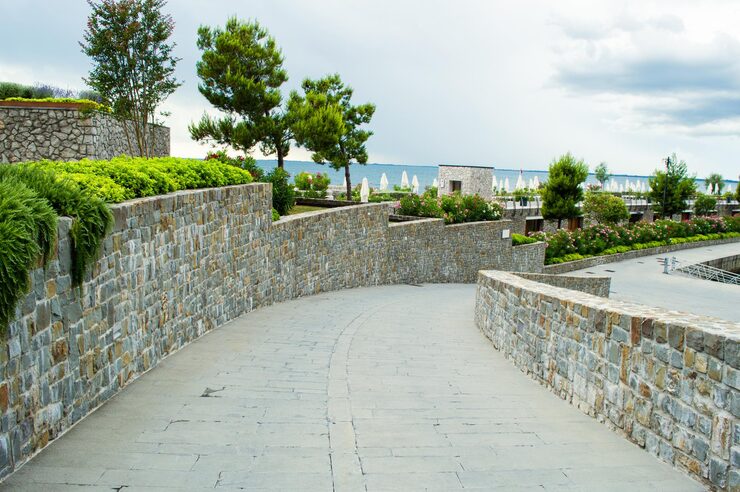
Where this suits Natick properties
Village-center frontages
Older lots near the Natick village center often have narrow frontages close to the sidewalk, where a crisp single-course apron holds the line without crowding the street.
Lakeside lots near Cochituate
Shaded, damp lots close to the lake need a base built for standing moisture and an edge detail flexible enough to handle root movement from mature trees nearby.
South Natick subdivisions
Newer homes with wider curb cuts have room for a bolder cobblestone pattern and a clean, durable apron that matches the scale of the driveway behind it.
So tar and chip suits a longer, gentler Natick drive with some room around it. It is a poor match for a short, steep or shared one, or one that opens straight onto the walk.
Questions we hear
Is cobblestone edging just decorative, or does it do structural work?
Both. It marks the line visually, but a properly restrained edge also stops the adjoining asphalt or paver surface from spreading outward over time, which is a real structural job, not just an aesthetic one.
Can cobblestone edging be added to an existing asphalt driveway without redoing the whole drive?
Yes. The apron and edge are a separate project from the driveway surface itself, and in most cases the existing drive can stay as it is while the edge detail is rebuilt around it.
Does cobblestone need to match the driveway material?
No. Cobblestone is commonly used as a contrasting border against asphalt, concrete, or paver driveways. The contrast is usually the point – it defines the edge rather than blending into it.
How does frost affect cobblestone differently than asphalt?
Asphalt can flex slightly and crack without the individual pieces moving. Cobblestone is made of individual units, so if the base beneath shifts with frost, the stones themselves move out of line rather than just cracking in place.
Next step
Call us at (413) 337-3772. Tell us about the lot, the slope and what you want the frontage to look like. We have been working in this area since 1988, and we will tell you plainly what suits your property.