
Walkway Installation in Dedham, MA
A front walk in Dedham has to do two jobs at once: get people safely from the street or driveway to the door, and look like it belongs to the house. In the older, close-set neighbourhoods near the center, that often means a narrow strip of ground between a tight driveway and a foundation planting bed, with no room for error in the layout. Out toward the Westwood line, lots open up and a walkway can curve through lawn, connect a patio, or run the full width of a wider frontage. Both situations are hardscape decisions, not paving decisions, and they come down to what goes in before the surface ever goes down.
A walkway fails the same way a driveway does: not because the top layer wore out, but because what is underneath moved. New England frost does not ask permission. Water gets under a walk, freezes, expands, and lifts. Thaw it, and the ground settles again, but rarely back to where it started. Do that every winter for a few years and a walkway that was flat starts to rock underfoot, open gaps at the joints, or heave a section a half-inch above its neighbor. The fix is not a thicker surface. It is proper excavation, a compacted base that drains instead of holding water, and edge restraint that keeps the whole assembly from creeping sideways as the ground moves under it.
Built to move with the ground, not against it
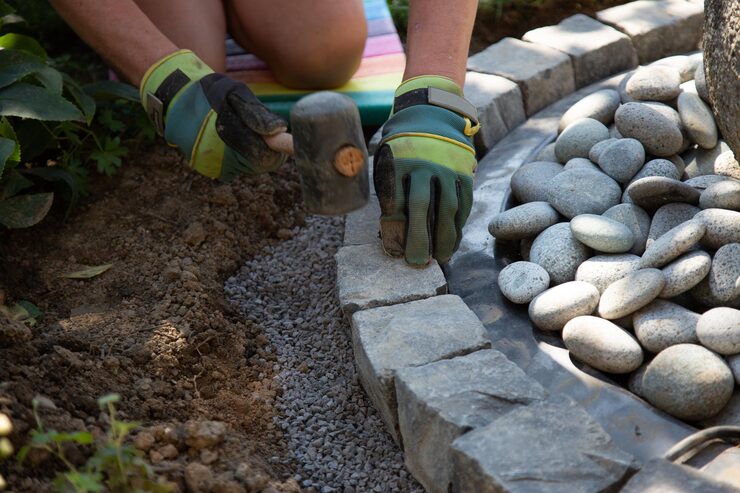
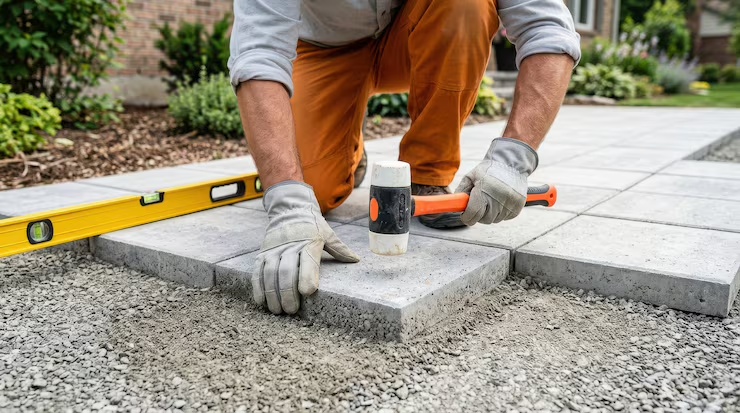
We excavate to a depth that gets below the organic topsoil and into stable subgrade, place and compact a crushed stone base in lifts so it actually locks together, and bed the surface material on a layer that lets water pass through rather than pool against the underside. Edge restraint, whether it is a hidden aluminum edge or a mortared border depending on the material, keeps the perimeter from spreading. None of that is visible once the job is done. All of it decides whether the walkway still looks right in five winters.


What Our Clients Say
Material and look
Material choice sets the maintenance load for decades. In Dedham’s freeze-thaw winters, a walkway that gets re-laid when a paver heaves is a different project than one needing a cracked concrete slab cut out, patched, and left visibly mismatched.
Concrete walkways
Poured concrete is the lowest-maintenance option and reads clean against a traditional Dedham colonial. It can crack over time with New England frost heave, and a cracked slab is harder to repair invisibly than a single replaced paver.
Paver walkways
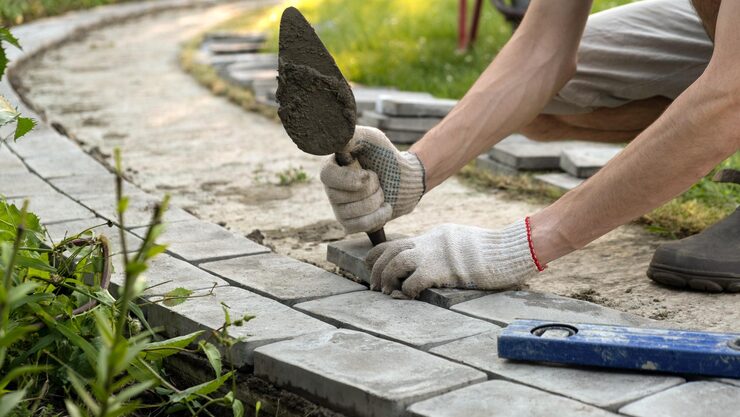
Pavers handle Dedham’s frost heave better because individual units shift slightly without cracking the whole surface. A heaved paver simply lifts out and resets in minutes, keeping walkways level and safe through decades of New England freeze-thaw cycles.
Natural stone and bluestone
Irregular or cut bluestone suits older Dedham properties with period detail, from colonial-era homes to Craftsman bungalows. It costs more up front than concrete or pavers, and if a single piece cracks or stains, matching it later can be difficult.
Brick walkways
Brick pairs naturally with the brick and clapboard common on Dedham’s older streets. It’s repairable piece by piece, but needs a properly compacted gravel base and sand setting bed, or it settles unevenly within a few seasons.
Where water goes once the ground is sealed
A walkway removes a strip of absorbent lawn.
Choosing a material
The materials are not equal. Each suits some properties and not others.
Pitch away from the foundation
Walkways that run close to a foundation need a slight cross-slope away from the house. Skip it and water tracks along the slab edge toward the basement wall instead of out to the lawn.
Joints and permeable options
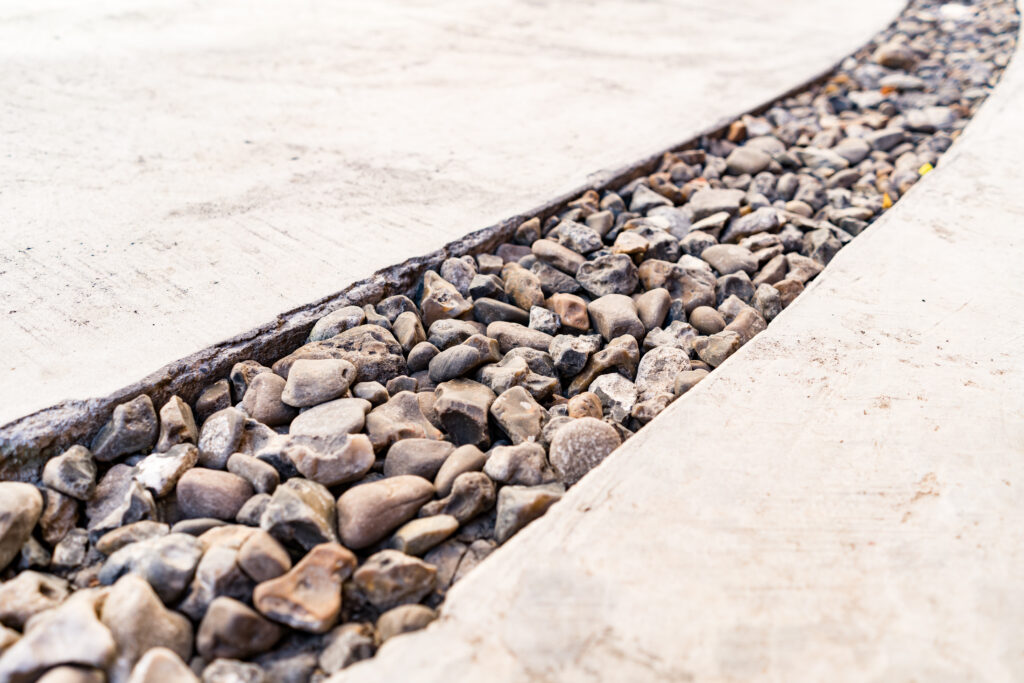
Permeable joints or open-graded base material let some water pass straight through instead of sheeting across the surface. On tighter Dedham lots, that reduces how much runoff the walkway sends toward a neighbor’s yard.
Tying into the driveway and entry
A walkway rarely stands alone. It meets the driveway apron, the front step, and sometimes an existing Dedham retaining wall, and the transition at each point is where sloppy work shows first.
Matching the driveway edge
Where a Dedham walkway meets an asphalt or paver driveway, the join needs a clean, level transition. A mismatched edge becomes a trip point and a spot where water collects, pools, and refreezes each winter, cracking both surfaces over time.
Working around mature trees
Dedham’s older neighborhoods have mature oaks and maples close to the house. Roots can lift a walkway from below, so the base and layout need to account for root paths already in the ground.

Planning for narrow Dedham lots
On the tighter, close-set streets near the center of Dedham, side yards are often three or four feet wide. A walkway there has to be planned around what equipment can actually reach the work area, and how material gets staged without blocking a shared driveway strip for days. Wider lots toward Westwood give more room to work with but raise a different question: how long a run of walkway makes sense, and where it should branch to a patio or side door instead of just the front entry. We walk the property first and plan the layout and material around what the lot actually allows, not a standard template. Access matters just as much here as it does on a driveway job. A narrow gap between two houses limits what can be wheeled in, which affects how base material gets placed and compacted properly rather than just dumped and tamped from the ends.
What drives the price
A new walk has to meet several existing things cleanly.
- The entry : The walk must arrive at the door at a sensible height. The threshold sets the finished level, so the work starts at the door and runs outward.
- The drive : Where a walk meets a drive, the levels and the drainage have to agree. A mismatch becomes a trip edge or a puddle.
- Walls and planting : Existing stone walls, foundation beds and mature trees constrain the route. Roots under a path are worked around, not cut through without thought.
- An older house : Scale, colour and pattern should follow the architecture. A narrow, dark stone walk suits an old house differently than a broad paver field does.
Getting started on a Dedham walkway
Every walkway job starts the same way: a look at the actual ground, not a quote off a square-footage number. We check drainage, grade, root locations, and how the walk needs to meet the driveway or entry before recommending a material. That is true whether the job is a short connector between a Dedham driveway and front door or a longer path through a larger Westwood-line lot. We have been doing this kind of site-specific hardscape work across Norfolk and Middlesex County since 1988, as a family-run crew, and we would rather talk through the trade-offs on your property than sell a material that does not fit it. If you are planning a walkway in Dedham, call (413) 337-3772 to set up a time to walk the site and talk through what makes sense for your lot.
Before you call
It helps to know:
- Where the walk starts and where it needs to end
- Whether the route crosses a slope or a shared area
- Which material you lean towards, and whether the house is older
- Where water currently runs on the property
Questions people ask
How long does a walkway installation take in Dedham?
It depends on length, material, and site access. A short connector walk is quicker than a longer run tying into a patio or multiple entry points, and narrow side-yard access on older Dedham lots can add time versus an open, wider frontage.
Can a walkway be installed without disturbing existing landscaping?
Often, yes, with careful excavation and staging, though mature tree roots and tight planting beds close to the house sometimes require adjusting the layout slightly to avoid major root damage.
Will the walkway match my existing driveway or patio material?
It can be matched or deliberately contrasted. Pavers and brick are easier to coordinate with an existing driveway or patio than pouring new concrete to match aged concrete exactly.
What causes a walkway to heave or crack over time?
Frost moving through an inadequate base is the main cause. Water that gets trapped under the surface freezes, expands, and lifts sections unevenly, which is why base preparation matters more than the surface material itself.
Do I need a permit for a walkway in Dedham?
Requirements vary by property and scope of work. It is worth checking with the town before work begins, particularly if the walkway affects drainage toward a neighboring lot or the public right-of-way.
Next step
Call Driveway Specialists on (413) 337-3772. We are a family-run company in business since 1988, and we will walk the route with you and talk through material, grade and drainage before anything is priced.