
Retaining Walls in Stow, MA
Stow sits on old orchard and farm ground, and a lot of it slopes more than it looks like it does from the road. A gravel drive runs a few hundred feet back from the frontage, climbs or drops through a grade change, and somewhere along that run the bank next to it is either eroding slowly or has already been patched with whatever was lying around. A retaining wall is how you stop fighting that slope instead of managing it every spring. It is also how you turn a drop next to a drive, a barn, or a paddock into usable, level ground.
A retaining wall is not a decorative edge sitting on top of the dirt. It is a structure holding back soil and water, and almost everything that determines whether it still looks right in fifteen years happens before the first visible course goes in.
What happens below grade
The work starts with excavation well behind the face of the wall, not just under it. A crushed stone base goes in and gets compacted in layers, because an uncompacted base settles unevenly later and takes the wall with it. Drainage stone goes in behind the wall face, usually with a perforated pipe at the base, so water moves through the structure instead of pressuring it from behind. That last part matters more in Massachusetts than almost anywhere, because standing water behind a wall freezes, expands, and pushes. A wall that handles freeze-thaw well is one built so water never has a reason to sit there.
Base rock sized and compacted correctly, combined with the right amount of batter, or backward lean, gives the wall somewhere to put that outward pressure instead of resisting it with weight alone. That is the difference between a wall that stays straight for decades and one that bows after a few winters.
On a Stow property, where the slope being retained is often a working bank next to a drive or orchard row rather than a neat landscaped berm, we also look at what is above the wall. Water running off a field, an orchard row, or higher ground needs somewhere to go other than straight into the fill behind the new wall. Getting that drainage path right during excavation is cheaper than fixing it after the wall is finished.


What Our Clients Say
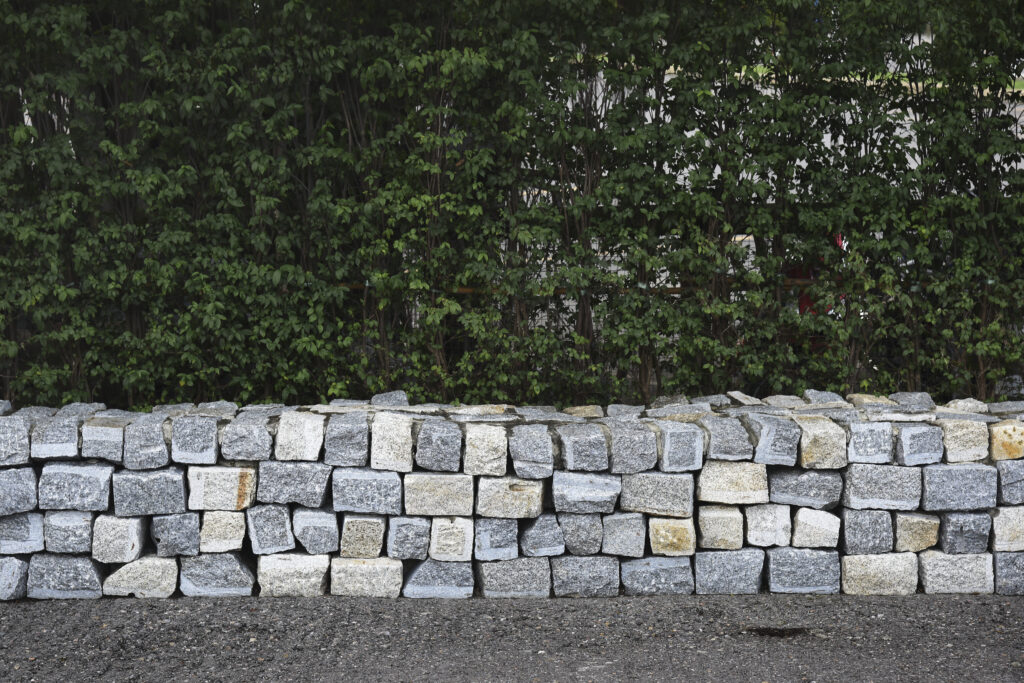
What holds a wall up is underground
The part you see is the smaller part of the job. Below it, the work runs in a fixed order.
Segmental concrete block is budget-friendly and holds a clean line along sloped Stow driveways.
Mortared stone gives Stow retaining walls a tighter, formal face that suits period properties.
Timber walls are the cheapest short-term option, but in Stow's wet, clay-heavy soil they tend to rot and lean within a limited number of years.
Gravity walls under roughly three or four feet can usually be built without engineering.
Grade on either side of a retaining wall decides where water goes next.
Drainage behind the wall
Materials and what they actually cost you later
Segmental retaining wall block is the most common choice in Stow: consistent, relatively affordable, and faster to install than cut stone. It holds a straight, engineered line well, which suits a wall doing a clear structural job beside a drive or parking area. It ages fine, but as concrete – it won’t gain character over time.
Natural fieldstone, dry-laid or mortared, costs more in material and labor since every stone is hand-fit. On a property with orchard frontage or an older farmhouse, it usually suits the setting better and weathers into the land instead of sitting on top of it. Dry-laid stone is also easier to repair; if a section settles, you rebuild just that section without hunting for a matching run.
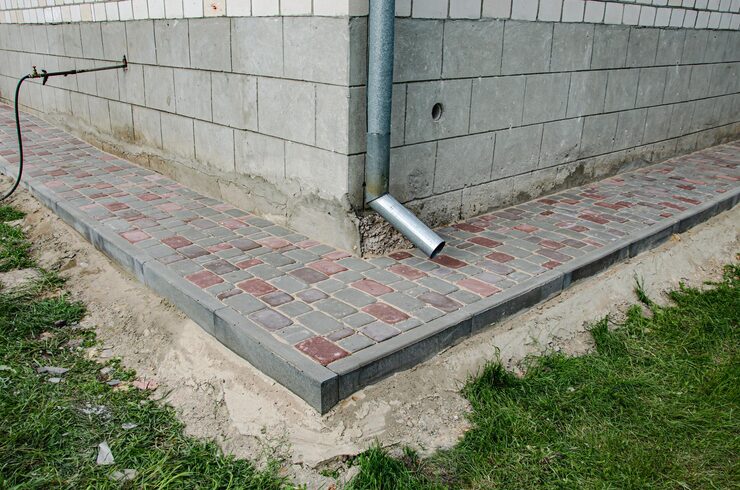

Choosing the material
Drainage, grade, and why pitch isn't optional
Every retaining wall changes where water moves across a property. Water that once sheeted slowly down a slope now hits a vertical face and has to go somewhere – down through drainage stone and pipe if the wall’s built correctly, or around the ends and back into the soil you’re trying to protect if it isn’t.
Grading has to work with that, not against it. Soil behind the wall should pitch slightly away from the structure, and any hard surface below it – drive, patio, path – needs to pitch away from both the house and the wall’s footing. On Stow properties with long drives and real elevation change, we’re often solving drainage for the whole run, not just the section the wall occupies. A wall built without that bigger picture can fix one erosion problem and quietly create a wet spot twenty feet away.
Tying it into what's already there
Few retaining walls in Stow get built on a blank slope. There’s usually a gravel drive already in place, mature trees close to the bank, maybe an older stacked-stone wall from the property’s farming days, or plantings someone has been maintaining for years. The new wall has to sit against all of that without looking like it was dropped in from somewhere else.
That can mean matching a stone tone to an existing farmhouse foundation, stepping the wall in sections to follow a slope rather than cutting one straight run, or keeping the cap height consistent with a wall someone can also sit on near a patio or drive turnaround. Root systems from mature trees also factor into excavation planning – cutting through major roots near an old oak or apple tree to set a footing can stress or kill the tree, so the wall’s path sometimes has to work around it rather than through it. On an orchard-adjacent lot, that’s not a minor consideration.


Where retaining walls make sense on Stow lots
Stow’s lots tend to be larger and less uniform than closer-in suburbs, with real grade change between the road and the house, and between the house and outbuildings, paddocks, or orchard rows. That’s exactly the situation retaining walls solve well: holding a bank beside a long gravel drive so it stops eroding into the driving surface, carving level ground out of a slope for a parking pad or equipment storage, or stepping a steep yard into usable terraces instead of a slope nobody can mow or plant.
Because so many Stow properties still run on gravel rather than paved drives, walls here often do double duty – holding grade and defining the edge of the driving surface itself, which keeps gravel from migrating downhill after every storm. A wall built with the right base and drainage underneath it holds its line through winter freeze-thaw instead of shifting with the ground around it.
Questions we get asked
Does a retaining wall in Stow need an engineer?
Shorter gravity walls, generally under roughly three to four feet, can often be built without engineering. Taller walls, or any wall holding back a driveway, parking area, or structure, should have an engineer review the design before work starts.
Can a retaining wall be built around existing trees?
Often yes. On orchard and wooded lots we plan the excavation path to avoid major root systems where possible, since cutting through them to set a footing can damage or kill a mature tree. This sometimes means stepping or curving the wall rather than running it straight.
Will a retaining wall help with gravel migrating downhill on my drive?
Yes, when it's built for that purpose. A wall set at the edge of a gravel drive on a slope holds the base material in place and stops it from washing or sliding downhill after rain, reducing how often the drive needs new gravel added.
What's the real difference between segmental block and natural stone?
Segmental block is faster to install, more affordable, and holds a clean engineered line. Natural fieldstone costs more but suits rural and older properties better visually, weathers naturally, and is easier to repair section by section if it ever settles.
Why do some retaining walls bow or lean after a few winters?
Usually it comes down to drainage and compaction. Without stone and a pipe behind the wall to move water through, it sits behind the wall face, freezes, expands, and pushes. Poor base compaction causes the same kind of movement from below.
Next step
Call us and we will come look at the slope, the access and the water. We will tell you what the wall needs and what it will cost to do properly.