
Cobblestone Aprons and Edging in Wayland, MA
Wayland’s lots run large and wooded, and most driveways here are long enough that the street-to-drive transition becomes its own piece of work. A cobblestone apron marks that point cleanly: where town road ends and your property begins, where mowed edge gives way to drive, where a grade change needs something solid to hold it. This is not a repair job. It is the detail that finishes a long approach and keeps it looking right for years.
What makes cobblestone different from a poured or stamped edge is that it is built from individual units set into a bed, not a single slab. That matters in a climate where the ground moves every winter. A continuous slab cracks where it cannot flex. Individual stones shift slightly with the frost and settle back, which is why a well-built cobblestone edge outlasts a poured concrete apron on the same soil, season after season, without the hairline cracks that eventually widen into real gaps.
What happens below the surface
The visible stones are the smallest part of the job. Underneath, there is excavation down past the topsoil, a compacted base layer that drains rather than holds water, and a bedding layer the stones actually sit in. The edge restraint, a buried border that keeps the outer row of stones from creeping outward, is what separates work that stays straight for years from work that walks itself apart. Frost heave in Massachusetts does not destroy hardscape by cracking it outright. It destroys it by moving the base unevenly, a quarter inch here, none there, until the surface that was flat is now wavy. Compaction and drainage are what stop that movement before it starts, and skipping either step is the single most common reason an apron fails within a few winters instead of lasting decades.
On a wooded Wayland lot, roots complicate the excavation. Mature oaks and maples send roots out further than the canopy suggests, and cutting through a major root to get a straight base can stress or kill the tree. Part of laying out an apron correctly here is routing the excavation around what is already established, sometimes shifting the line of the apron a foot or two rather than cutting through root mass that took decades to grow. It also means working with a slight curve or offset where a straight line simply is not worth the cost to a healthy tree.
Drainage deserves its own mention on these lots. Long driveways cut through sloped, wooded ground tend to funnel runoff toward the street, and the apron sits right at that low point. A base layer that is built to drain, rather than one that traps water against the stones, keeps the apron from becoming the spot where ice forms first every winter. That is a small design decision made during excavation, not something fixed afterward.
Stone selection and pattern matter too, since an apron is seen daily and up close. Options generally include:


What Our Clients Say

What the work involves below the surface
The stone is the last and smallest part of the job. A cobblestone apron stays flat or goes wavy depending on what is underneath it.
Materials: the real trade-offs
Granite cobblestone costs more up front and outlasts almost anything else in freeze-thaw. Concrete pavers cost less, look sharper when new, but fade and chip faster and are easier to repair piece by piece if that happens.
Reclaimed versus new stone
Reclaimed granite cobblestone carries wear that reads as age rather than damage, and suits an older Wayland house better than uniform new-cut stone, which looks sharper but takes years to settle visually into a wooded, established property.
Where water goes
Hard surfaces shed water rather than absorb it. On a sloped Wayland lot, that means grading runoff away from the house toward ground that can soak it in, not pooling against a foundation or a tree’s root flare.
Pitch is not optional
An apron that looks level but pitches the wrong way sends water toward your Wayland garage or house instead of away. Getting that pitch right in the base layer is far cheaper than fixing drainage after the stone’s set.
Tying into what exists
A new apron has to match the drive surface it meets, the walkway or steps at the entry, and any stone walls already on the property. On an older house, matching tone and texture matters more than matching it exactly.
Materials and the trade-offs
Matching the edge to the house
A lot of Wayland’s housing stock sits on large parcels set well back from the road, often behind stone walls or mature plantings that have been there for decades. Cobblestone edging reads naturally against that kind of frontage in a way that a poured concrete curb or a sharp modern paver border does not. The stone texture, even when new, has a weight and informality that suits a long gravel or asphalt drive winding through trees. It also gives you a practical edge for the groundskeeping and plowing that a property this size requires. A plow driver working a long drive in the dark needs a visible, physical edge to follow, not a painted line or a soft gravel shoulder that disappears under the first few inches of snow. Cobblestone gives the plow something to find and something that survives repeated contact without chipping apart the way a thinner asphalt lip would.


Where this pairs with other work
Cobblestone aprons rarely happen in isolation on a property like this. They tend to come up alongside a driveway resurfacing, a new entry walkway, or a retaining element where the grade drops toward the house. If you are already planning drive work, the apron and edge are worth designing at the same time rather than as an afterthought, because the base work overlaps and doing it once is more efficient than opening the same ground twice. The same applies if there is an existing stone wall or fieldstone feature on the property. Matching the cobblestone’s color and finish to what is already there, rather than treating it as a separate decision, is what makes the finished property read as one coherent piece of work instead of a driveway with a feature bolted onto the front of it. On a conservation-adjacent lot, this is also the point to confirm the edge sits clear of any wetland buffer before work starts, since the stone itself is not the issue but its placement can be.
Getting started
If you have a long drive that needs a proper entrance statement, or an existing edge that has started to spread and crumble under plow pressure, call Driveway Specialists at (413) 337-3772. Getting started is simple: we walk the property with you and look at the grade, the existing driveway materials, drainage patterns and the tree layout on site before recommending anything, because on a Wayland lot those factors decide what actually works and what will fail within a season or two. Many of the properties we see here have mature trees close to the pavement, so root flare and soil heave often shape where we can set a stable apron edge. We’ll also check how snow gets pushed and piled in winter, since that pressure is usually what breaks down a weak border first.
- A short on-site consultation to assess grade, soil and existing edging
- Honest guidance on cobblestone sizing and pattern options suited to your entrance
- A clear plan for drainage and plow-season durability before any work begins
From there, we’ll outline next steps and a realistic timeline for your project.
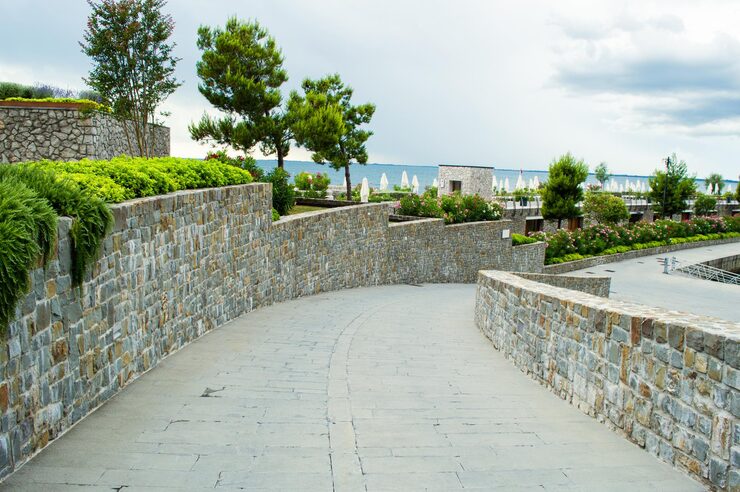
Where this suits Wayland properties
Long driveway entrances
A cobblestone apron at the base of a long wooded drive marks the transition from road to private property and gives plows a clean edge to find under snow cover.
Grade changes near the street
Where a drive drops or rises off the road, cobblestone edging holds the asphalt or gravel in place and stops the shoulder from slumping into the ditch line.
Conservation-adjacent frontages
On lots bordering wetland buffers, a defined cobblestone edge keeps the hard surface contained and makes the boundary between drive and natural ground unambiguous.
So tar and chip suits a longer, gentler Wayland drive with some room around it. It is a poor match for a short, steep or shared one, or one that opens straight onto the walk.
Questions we hear
Why use cobblestone instead of a poured concrete apron?
Cobblestone is set in individual units that can shift slightly with frost movement and settle back. A poured slab has no give, so it cracks where the ground beneath it moves unevenly over a New England winter.
Will tree roots cause problems with the installation?
On wooded lots, yes, roots often run further than the canopy. Rather than cutting through major roots, we usually adjust the apron's excavation line to work around what is established, which protects the tree and avoids future heave.
Does cobblestone edging help with plowing?
It gives plow operators a solid, visible line to follow along a long drive, which matters more on wooded Wayland lots where a soft gravel shoulder disappears under snow cover and is easy to catch and tear up.
Can this work be done near a wetland buffer?
The stone itself is not the concern, but placement near a conservation boundary needs to be checked before work starts. We confirm the layout on site rather than assuming based on the lot's general size.
Next step
Call us at (413) 337-3772. Tell us about the lot, the slope and what you want the frontage to look like. We have been working in this area since 1988, and we will tell you plainly what suits your property.