
Driveway Paving in Chestnut Hill, MA
When a driveway in Chestnut Hill finally gives out, it usually shows up as heaving at the edges, a surface gone gray and brittle, or a slope where water now cuts its own channel toward the street. These are short, often ornamental drives attached to large older homes near the Newton-Brookline line, and the finish expectations are high even where the square footage is modest. You are not choosing between a dozen identical quotes. You are choosing who understands what sits under that surface and who is going to put it back correctly.
A phone estimate on a drive like this is a guess dressed up as a number. We come out, walk the grade with you, and look at what the existing surface is telling us before we talk price.
What we look at on the visit
On a Chestnut Hill property that usually means the width and turning radius near the garage or street, the pitch across a short run, whether mature trees nearby have already pushed roots under the edges, and how water currently moves off the lot. Many of these homes sit on lots shaped decades ago, with mature plantings close to the drive and little room for a paver or roller to maneuver without careful staging. That access question alone can change how a job is sequenced, and on a tight lot it can add a day to the schedule before any asphalt goes down.
We also check the base. A driveway that looks rough on top can still have sound gravel underneath, which changes the whole scope of work. One that looks fine on top but is soft or spongy when you walk it after rain usually has a base problem that no amount of fresh asphalt will fix. We tell you which one we are looking at before we talk numbers, not after.
Drainage gets particular attention here. A lot of these properties were graded before anyone thought much about where water would go once the lot filled in with trees and additions. We look at:
- Where runoff currently collects or pools near the foundation or garage apron
- Whether the existing pitch carries water away from the house or toward it
- How curb height or an abutting sidewalk affects the edge transition
- Any low spots where standing water has already started breaking down the surface
Getting that pitch right the first time matters more on a short, visible drive than on a long one, because every inch of grade is doing more work and is also more visible from the street and the front door.
The goal of that first visit is a scope that matches the ground, not a template quote. Two driveways of the same size in Chestnut Hill can need very different work depending on grade, tree cover, and what was built underneath them originally. We would rather spend an extra fifteen minutes on site than hand you a number that falls apart once we start digging.


What Our Clients Say
Why the Base Decides Everything
Asphalt is only as good as what is under it. In this part of Massachusetts the soil varies block to block, and a drive built on a thin, compacted base will fail years before one with proper depth and drainage, even if both got the same surface course. Chestnut Hill's mix of clay-heavy pockets and ledge-close lots makes this especially true; what works on one street can be wrong two doors down. Freeze-thaw cycles are what expose a weak base. Water gets under the pavement, freezes, expands, and the edges or seams crack open. Proper grading and a compacted gravel base give that water somewhere to go instead of pooling under the surface.
Full Replacement or Overlay
An overlay works when the base below is still sound: no major heaving, no soft spots, no chronic standing water. We check this by looking at how the existing surface has failed. Surface-only cracking and fading usually means the base is fine. Widespread heaving, alligator cracking, or a drive that stays damp well after rain usually means the base has already failed. Paving over a failed base is money spent twice, once now and again in a few years when the same cracks come back through the new surface.

What Drives the Price
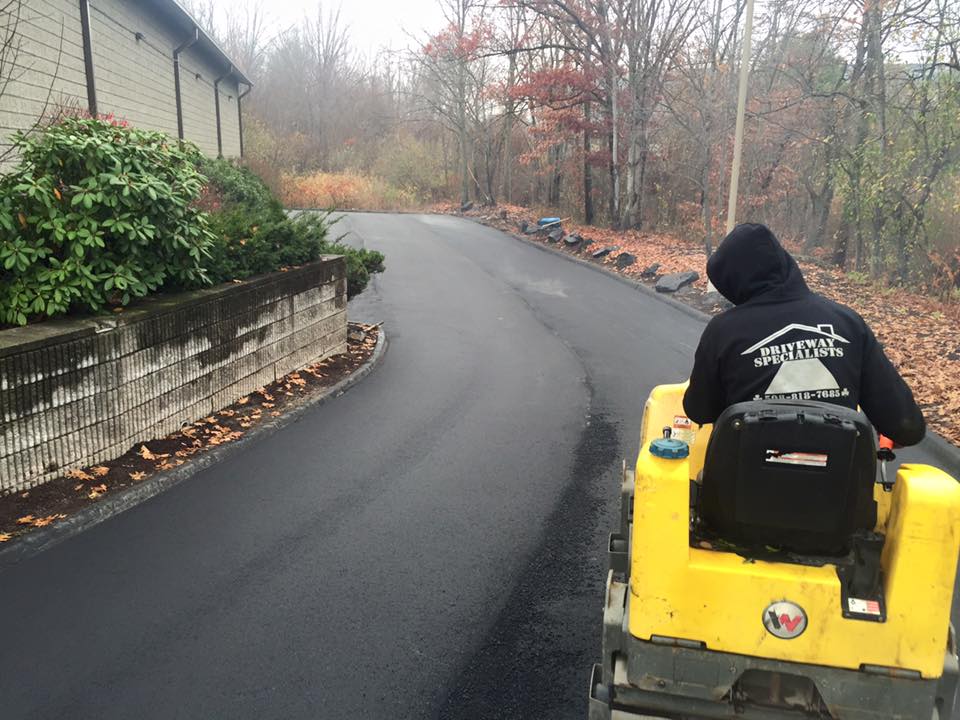
Square footage is only the starting point. The real cost drivers are depth of excavation, how much old material has to come out and be hauled away, access for equipment on a tight lot, the grade across the drive, drainage provisions, and the apron where the drive meets the street or shared way. Chestnut Hill's mature tree canopy adds its own variables: root systems that complicate excavation without damaging the trees, leaf litter that affects drainage design, and canopy cover that can slow curing in certain conditions. A short drive with heavy tree cover and a tricky turning radius can cost more to do right than a longer, open drive elsewhere, because the equipment work and root management take more time than the paving itself. Stone walls, mature plantings, and narrow carriage-style lots common to the area also limit staging space for crews and material.
What drives the price
Several things set the cost of a driveway, and each one is visible only on site.
- Square footage : The area to be paved, plus any widening, turnaround or parking pad you want added.
- Depth of excavation : How far down the old material has to come out, and how much of the base has to be rebuilt.
- Material removed : The old asphalt has to be hauled away, and the amount depends on what is there.
- Access: A paver, a roller and delivery trucks all need to get in and turn around. Tight Chestnut Hill frontages can limit what equipment fits, which changes how the work is staged.
- Grade: A steep drive is harder to prepare, harder to compact and harder to drain correctly.
- Drainage: If water needs to be moved off the drive and away from the house, that work is part of the job.
- The apron: On many Chestnut Hill lots the apron meets the sidewalk with very little room between the street and the house. How that transition is built affects both the drive and the walk, and we look at it closely.
Anyone who gives you a firm figure without having stood on your driveway is guessing. When the guess is wrong, the extra cost shows up later as shortcuts in the base.
Scheduling Around New England Weather
Paving in Massachusetts is a seasonal trade. Asphalt needs the right conditions to compact and bond properly, which pushes most of the work into the warmer months, and good contractors book up well ahead of that window. If your drive is already failing, it is worth getting on a schedule early rather than waiting for the problem to get worse through another freeze-thaw cycle. We will talk through realistic timing when we see the site, rather than promising a date before we know the scope.
What to Expect During the Work and After
Once a date is set, you will need to keep cars off the drive and clear the area so equipment can get in and turn. The first season after paving is when the surface settles in, and we will tell you what normal settling looks like versus what is not. Keeping plow blades and edgers away from the new edges that first winter matters more than most homeowners expect.
Talk to Someone Who Will Look Before They Quote
If your driveway in Chestnut Hill has reached the point where patching no longer holds, or you are putting one in for the first time, the next step is a site visit, not a phone number. Driveway Specialists has been doing this work as a family-run business since 1988, across Norfolk, Middlesex and eastern Worcester counties, and we will tell you plainly whether your drive needs an overlay or a full rebuild. Call (413) 337-3772 to set up a time to look at it.
FAQs
How do I know if my Chestnut Hill driveway needs a full replacement instead of an overlay?
Look at how it has failed. Surface cracking and fading with a firm, dry base underneath usually means an overlay will hold. Heaving, alligator-pattern cracking, or soft spots after rain point to a failed base, which an overlay will not fix for long. We confirm this on site before recommending either.
Why do short, small driveways in Chestnut Hill sometimes cost more than longer ones elsewhere?
Cost follows access and complexity, not just square footage. Tight turning radii, mature trees close to the drive, and careful grading around an older home's foundation all add time, even on a small footprint.
Can you give me a firm price over the phone?
No, and any contractor who does without seeing the site is guessing. Depth of excavation, base condition, grade, drainage, and access all change the cost, and none of those can be judged from a phone call.
When is the best time to book paving work in this area?
Asphalt work is seasonal in Massachusetts because the material needs the right conditions to compact and bond. Booking early in the season, especially once your drive shows clear signs of failure, gives you more flexibility than waiting.
What should I do with my new driveway through its first winter?
Keep plows and edging tools clear of the new edges, since that first season is when the surface is still settling. We walk through the specifics with you once the job is finished.
Call us
If your Chestnut Hill driveway has reached the end of its life, or you are putting one in for the first time, call (413) 337-3772. We will arrange a time to see the site, measure it, and tell you what it needs.