
Cobblestone Aprons and Edging in Carlisle; MA
A long gravel or asphalt drive through the woods in Carlisle usually works fine for three hundred feet, then arrives at the street looking unfinished. Two-acre zoning means most frontages here are generous and the house is often set well back, so the place where the drive meets the road carries more visual weight than the drive itself. A cobblestone apron closes that gap: a defined, durable transition that reads as intentional from the street, instead of a dirt track trailing off into pavement. Edging does similar work along the length of the drive, holding a gravel or asphalt surface to a clean line as it winds through trees instead of letting it ravel into the leaf litter each fall.
Both jobs are hardscape, not paving repair, and the decision is different from fixing a cracked driveway. You are choosing materials and a layout that will sit in front of the house for decades, next to existing stone walls, mature trees and, in a lot of Carlisle’s older properties, fieldstone that was already there before the driveway was. The work has to match that, not compete with it, which is why most aprons here use a granite or weathered fieldstone cobble rather than a uniform, new-looking unit that would stand out against an old stone wall or a fieldstone foundation.
The part nobody sees decides whether the apron stays flat or starts rolling within a few winters. That means excavating below the frost-affected zone, laying a compacted base that can shed water instead of holding it, bedding the stone correctly, and setting a real edge restraint against the sides. Massachusetts frost does not just heave flat ground, it also pushes sideways against anything without a solid edge. Cobblestone without proper restraint migrates outward a little every winter until the pattern opens up and the joints fail. Carlisle’s near-surface ledge adds another wrinkle: excavation depth is often limited by rock, not by soil, so the base design has to work within whatever depth is actually achievable on a given lot rather than an assumed depth, and in some cases that means adjusting the apron’s thickness or jointing pattern to compensate for a shallower base than the textbook calls for.
Drainage has to be solved before any stone goes down. On a wooded lot, water comes off the canopy, off the road crown, and off the grade of the drive itself, and a hard apron at the bottom of a slope becomes the collection point for all three unless it is pitched to carry water away from the garage and off to the side. Get that wrong and the apron looks fine until the next heavy rain finds the lowest point in the pattern.
Edging deserves the same attention as the apron itself, not an afterthought once the drive surface is down. A few points worth settling before work starts:
- Whether the edge sits flush, slightly raised, or recessed below the gravel line, since each affects plowing and mowing differently
- How tight the curve radius can be where the drive bends through trees without cutting roots unnecessarily
- Which stone size and spacing will hold gravel in place without trapping leaves and needles against the base


What Our Clients Say
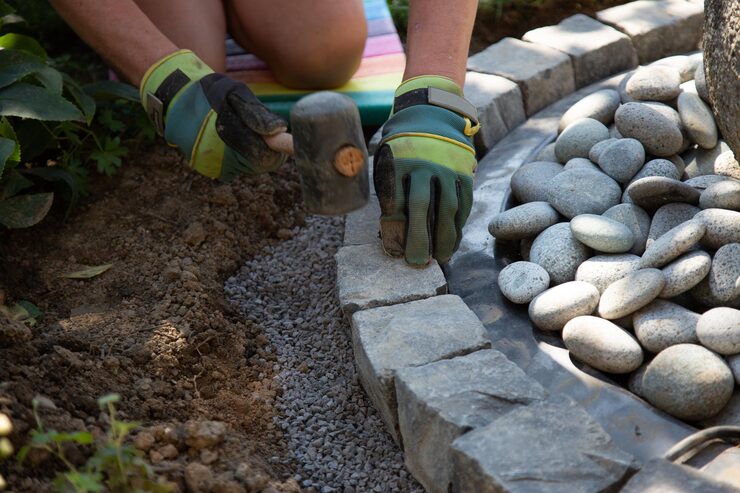
What the work involves below the surface
The stone is the last and smallest part of the job. A cobblestone apron stays flat or goes wavy depending on what is underneath it.
Granite cobblestone holds its edge and ages beautifully against ledge outcrops and stone walls common on wooded Carlisle lots. It costs more upfront, but a properly compacted gravel base keeps roots and frost heave from undoing the apron for decades.
Concrete pavers cost less and come in more finishes, but surface wear and colour fade show sooner, especially against Carlisle's wet winters.
Belgian block edging reads as traditional against an older Carlisle farmhouse or stone wall, and resists plow damage better than a poured curb.
A buried steel or aluminum edge restraint holds asphalt or gravel drives across Carlisle properties to a clean, straight line without visual bulk.
Reclaimed granite cobblestone costs more upfront but fits naturally next to decades-old stone walls, where new-cut stone can look out of place for years.
Materials and the trade-offs
Material choice usually comes down to what’s already on the property. Granite cobblestone, new-cut or reclaimed, sits comfortably next to old stone walls and fieldstone, and it shrugs off plow blades and frost heave better than most alternatives — important on a Carlisle drive a plow truck works all winter. It costs more and takes longer to lay well, but it’s also the easiest material to repair years later without the patch standing out. Concrete pavers cost less and come in stone-look finishes, but they wear and fade differently than real stone, so matching a repair gets harder as the original run ages. Poured concrete edging is the cheapest option, but it’s also the most likely to crack or chip under a plow blade, and once it cracks, the fix is a visible patch rather than a swapped stone.
- Granite cobblestone: slowest, costliest, most durable and repairable
- Concrete pavers: budget-friendly, but ages unevenly
- Poured concrete: cheapest, least plow-tolerant

Where the apron ties into the road matters for who is responsible for it. Most Carlisle driveways meet a town-accepted road, which means the curb cut and the point of connection are governed by the town, while everything back from that line, including the apron detail and edging, is the owner’s choice. That split is worth understanding before design starts, because it affects how far back toward the street the cobblestone pattern can extend and what has to stay a plain transition. On the smaller number of private ways in town, that line does not exist in the same way and there is more latitude in how the apron is shaped.
Matching the house matters as much as matching the geology. An older Carlisle farmhouse with a stone wall along the frontage calls for a different cobblestone pattern and jointing than a newer build on a cleared two-acre lot. Getting the paving book right the first time avoids an apron that looks like it was added on rather than built with the property, which is usually the actual goal behind this kind of work.
Mature oaks and maples here send roots well past the drip line, and lots backing onto conservation land carry buffers where disturbance has to stay minimal. Both shape how a cobblestone apron or edging run gets planned in Carlisle. Digging too close to an established oak can damage roots and stress or kill the tree over the following seasons, so the layout is set around root locations rather than a straight line on a drawing. Where a property borders conservation land, work tends to stay within the existing footprint instead of pushing the hard surface outward, since disturbed ground near a buffer zone is harder to justify and slower to settle. None of this rules cobblestone out on these lots; it just means the plan gets decided on site, after walking the specific trees and boundary, rather than from a standard template.
If your drive winds through trees to a frontage that just stops, or edges keep breaking up under the plow, that’s the kind of work Driveway Specialists has handled across Middlesex County since 1988. Call (413) 337-3772 to talk through what your lot needs.

Where this suits Carlisle properties
Long wooded drives
A cobblestone apron gives a quarter-mile drive through trees a clear, finished arrival point at the street instead of pavement that trails off into gravel.
Lots with existing stone walls
Where a fieldstone wall already runs along the frontage, cobblestone edging extends that material language instead of introducing something new and mismatched.
Drives near conservation buffers
On lots abutting conservation land, work that stays within the existing footprint and avoids expanding disturbed ground suits both the site and the setting.
So tar and chip suits a longer, gentler Carlisle drive with some room around it. It is a poor match for a short, steep or shared one, or one that opens straight onto the walk.
Questions we hear
Does a cobblestone apron need town approval in Carlisle?
If your drive meets a town-accepted road, the curb cut itself is the town's business and any change to it should be checked with the town first. Everything back from that connection point, including the cobblestone pattern and edging, is the owner's decision. On private ways, that line doesn't apply in the same way.
Can cobblestone work around mature trees without harming them?
Yes, but the layout has to be planned around root locations rather than a fixed drawing. On established oaks and maples, roots often extend well past the drip line, so excavation depth and placement get adjusted on site to avoid cutting through major roots.
How does Carlisle's ledge affect the base for an apron?
Near-surface rock can limit how deep the base excavation goes. Rather than assuming a standard depth, the base and drainage plan has to work with whatever depth is actually achievable once the ledge is located on your lot.
Is cobblestone a good match for an older Carlisle farmhouse?
Often, yes. Granite cobblestone, particularly reclaimed stone, sits naturally next to older stone walls and fieldstone in a way that newer paver materials usually don't, and it tends to suit the look of an older property better over time.
Next step
Call us at (413) 337-3772. Tell us about the lot, the slope and what you want the frontage to look like. We have been working in this area since 1988, and we will tell you plainly what suits your property.