
Walkway Installation in Hopkinton, MA
Hopkinton’s newer subdivisions sit on hilly, graded lots with long drives that climb from the street to the garage, and a front walk on these properties often has to manage a real change in elevation between the driveway and the entry. Older homes nearer the marathon start sit lower and closer to the road, with shorter, flatter frontage and mature trees overhead. Both situations call for a walkway that is built to move with frost rather than fight it, and both start with the same question: what is actually going to hold this surface flat for years, not just this season.
A front walk is one of the first things anyone sees when they pull in or walk up, and it gets more daily foot traffic than almost any other surface on the property. It also takes the worst of New England’s freeze-thaw cycle because it is narrow, shallow, and often shaded. Getting the base right matters more here than on a wide driveway, because there is less surface to hide movement.
What’s underneath decides what you see
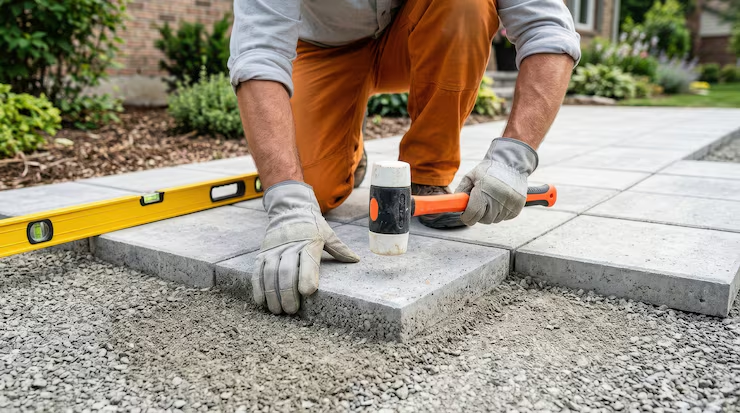
Everything that goes wrong with a walkway later – heaving sections, gaps between pavers, a step that is no longer level with the door – starts with what was or wasn’t done below grade at installation. That means excavating below the frost-susceptible topsoil, laying a compacted gravel base deep enough to let water drain instead of pool and freeze, bedding the surface material correctly, and setting a proper edge restraint so the sides don’t splay outward over time. Skip any one of those steps and the walkway above ground looks fine for a year or two, then starts telling on itself every winter.
On Hopkinton’s hillier lots, the base also has to manage water coming downslope from the driveway or the yard above. A walkway built without that in mind becomes a channel every time it rains, washing out bedding sand from underneath the pavers at the low end. The fix isn’t a thicker base everywhere – it’s grading the base and the subsurface drainage to carry water around the walkway instead of under it.
Material choice matters just as much as what’s underneath it, and the trade-offs are real rather than cosmetic. Concrete pavers hold their line well, are simple to lift and reset if one section settles, and come in enough finishes to match a newer colonial or a center-entrance antique. Natural stone – fieldstone or bluestone – looks right against an older Hopkinton home near the common, ages well, and costs more to install and to repair if a single piece cracks. Poured concrete gives a clean, low-maintenance surface but is harder to patch invisibly if frost does crack a section. None of these is the right answer for every house. The right one depends on the house, the grade, and what you’re willing to maintain.


What Our Clients Say
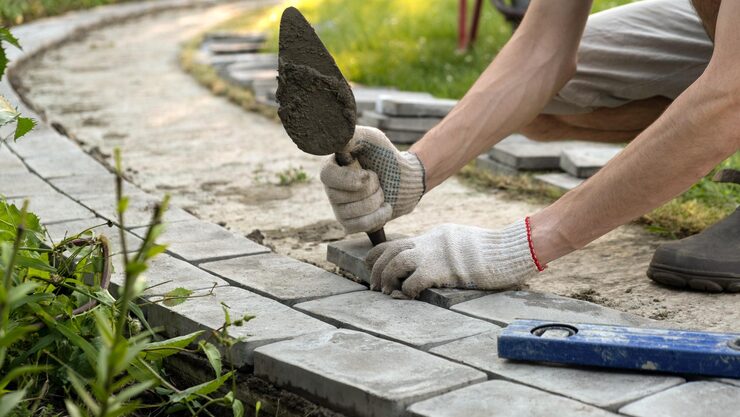
Grading and pitch away from the house
A walkway has to shed water away from the foundation and the driveway, not toward them. On sloped Hopkinton lots, that means setting pitch deliberately with proper base grading, not assuming the ground will manage runoff on its own.
Excavation and base depth
Depth below grade depends on soil and drainage, not a fixed number.
Compaction before anything else
A base that isn't mechanically compacted in layers will settle unevenly under foot traffic and frost, no matter how good the surface material looks on day one.
Edge restraint
Without a rigid edge, pavers and stone drift outward over successive Hopkinton freeze-thaw cycles. A properly set restraint, anchored well below grade, keeps the whole walkway locked together, holding joint lines tight and edges crisp for the long run.
Concrete pavers
Pavers are easiest to repair – lift one, reset it, move on – and hold color well through New England winters.
Natural stone
Fieldstone and bluestone age gracefully and suit the older homes near Hopkinton's town center, complementing stone walls and granite foundations common in the area.
Choosing a material
The materials are not equal. Each suits some properties and not others.
Poured concrete
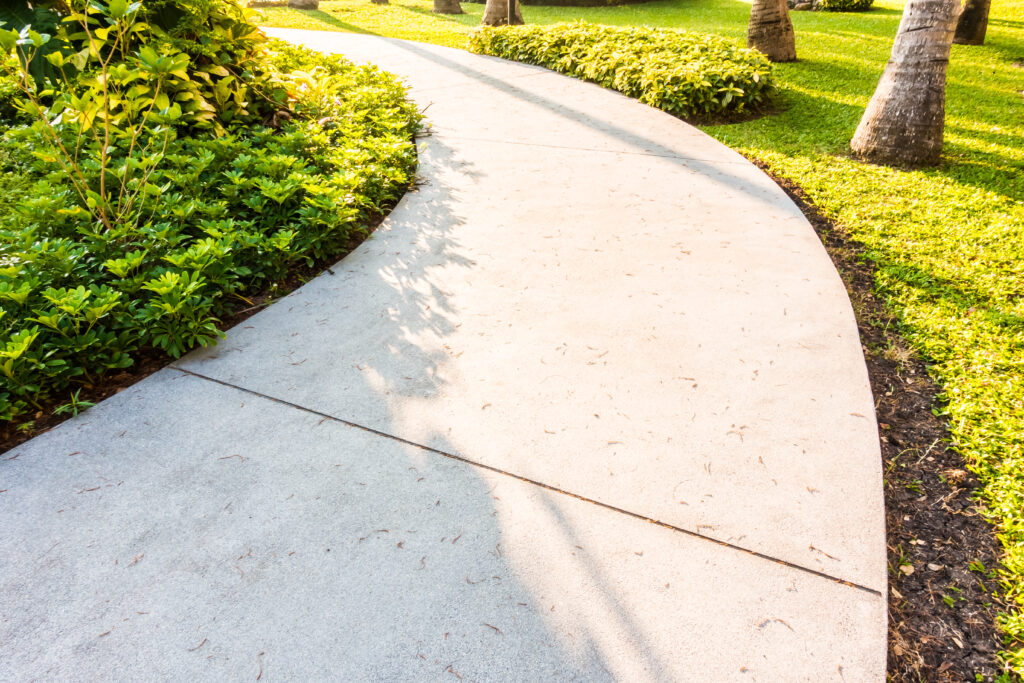
Poured concrete gives Hopkinton walkways a seamless, low-maintenance surface that resists weeds and wear for decades.
Tying into the driveway
Where the walk meets the driveway, material, height, and joint lines should read as one plan, not two separate projects stitched together at the edge.
Tying into the entry
The last few feet by the door take the most wear and the most water runoff from the roofline. That section needs a base built for standing moisture.
Matching an older house
Homes near Hopkinton's historic center often call for natural stone or a muted, irregular paver that complements original architecture, rather than a bright, uniform modern finish.
Working around trees and roots
Mature trees common on older Hopkinton lots mean roots can heave a walkway from below years after installation.


Where this fits Hopkinton properties
Across Hopkinton’s two distinct housing patterns – sloped subdivision lots and older homes near the common – the common thread is ground that moves with frost and water that has somewhere to go, whether downhill or off a roofline. A walkway installed with the base and pitch built for that reality holds its line through the kind of winters this part of Middlesex County gets, rather than needing attention every spring. On a long subdivision drive, a well-built walk also becomes the visual transition between the paved drive and the house, which is worth getting right the first time rather than patching a shortcut later.
What drives the price
A new walk has to meet several existing things cleanly.
- The entry : The walk must arrive at the door at a sensible height. The threshold sets the finished level, so the work starts at the door and runs outward.
- The drive : Where a walk meets a drive, the levels and the drainage have to agree. A mismatch becomes a trip edge or a puddle.
- Walls and planting : Existing stone walls, foundation beds and mature trees constrain the route. Roots under a path are worked around, not cut through without thought.
- An older house : Scale, colour and pattern should follow the architecture. A narrow, dark stone walk suits an old house differently than a broad paver field does.

Start with a look at your property
Hopkinton properties vary widely — stone-wall colonials near the Center with mature plantings, newer homes on sloped Milford Street-area lots, and everything in between near the Sudbury Reservoir watershed. Each of those settings calls for a different approach to a walkway. The right base depth, material, and drainage plan all depend on your specific grade, soil conditions, and how the new walk needs to tie into your driveway, porch, or front entry without creating puddling or frost heave down the line.
Driveway Specialists has worked hardscape and paving projects across Middlesex County since 1988, as a family-run crew that takes time to size each job to the ground it’s going on rather than installing a one-size-fits-all path. We look at drainage patterns, existing grade, soil composition, and how foot traffic actually moves across your property before recommending material and layout.
- Grade and drainage assessment
- Soil and base evaluation
- Material options suited to your home’s style
Call (413) 337-3772 to talk through what your property needs before anything gets dug.
Before you call
It helps to know:
- Where the walk starts and where it needs to end
- Whether the route crosses a slope or a shared area
- Which material you lean towards, and whether the house is older
- Where water currently runs on the property
Questions people ask
How is a walkway base different from a driveway base in Hopkinton?
A walkway carries foot traffic, not vehicle weight, but it's narrower and often shaded, so it takes frost movement harder relative to its size. The base still needs full excavation, compaction, and drainage – just sized for the load it actually carries.
What material holds up best on a sloped Hopkinton lot?
Concrete pavers are usually the most practical choice on graded subdivision lots because individual sections can be reset if the slope causes settling, without disturbing the rest of the walk.
Can a new walkway tie into an existing driveway apron?
Yes, and it should be planned together rather than treated as a separate project. Matching height, material, and joint lines at the connection point avoids an obvious seam between the two surfaces.
Do tree roots near older Hopkinton homes cause problems later?
They can, particularly with mature oaks and maples close to the walk. Routing the path around major root zones during installation is far less disruptive than rebuilding a heaved section years later.
Next step
Call Driveway Specialists on (413) 337-3772. We are a family-run company in business since 1988, and we will walk the route with you and talk through material, grade and drainage before anything is priced.