
Driveway Paving in Lexington, MA
If you’re looking at a Lexington driveway that’s heaved, alligatored, or gone soft at the edges, you already know patching won’t fix it twice. The same goes for a new build or an addition where the driveway still needs to go in. Either way, the question is the same: who do you call, and what actually happens when they show up.
We’ve been doing this work across Middlesex County since 1988, and Lexington’s housing stock gives us a pretty consistent starting point. A lot of the driveways we see here sit in front of mid-century colonials and capes on lots that were laid out decades ago, with mature oaks and maples that have had fifty or sixty years to send roots wherever they please. Near the center, some properties sit close enough to historic districts that access and sightlines factor into how we stage the work. Out toward Shaker Lanes and North Lexington, lots tend to run a bit larger, which usually gives us more room to maneuver equipment but doesn’t change the basic groundwork. None of that is a problem. It’s just what we plan around before we quote anything.
What happens when you call
We come out and walk the site with you. That means looking at the existing surface, but more importantly, looking at what’s under it and around it: where the grade falls, whether there are roots pushing up near the edges, how the drive drains after rain, and where a paver and roller can actually get in and turn. On an established Lexington lot, that last point matters more than people expect. A driveway that looks straightforward from the street can have a tight turn around a garage corner or an overhanging tree limb that changes how we stage equipment and deliveries.
We measure square footage, note the depth of any existing failure, and check whether the base underneath is sound or has already broken down. New England frost heave is the usual culprit behind the cracking and settling we see on older Lexington driveways, and a base that hasn’t been built deep enough simply won’t hold up through another freeze-thaw cycle. That visit is what the quote is built on. Anyone willing to give you a firm number over the phone, without seeing the ground, is guessing at the one thing that actually determines cost and lifespan.
From there we tell you plainly whether you’re looking at a full replacement or whether the existing base can carry a new surface. We don’t default to the bigger job, and we don’t recommend an overlay just because it’s cheaper up front if the base underneath won’t hold it. A few things we’ll walk through with you on site:


What Our Clients Say
Why the base decides everything
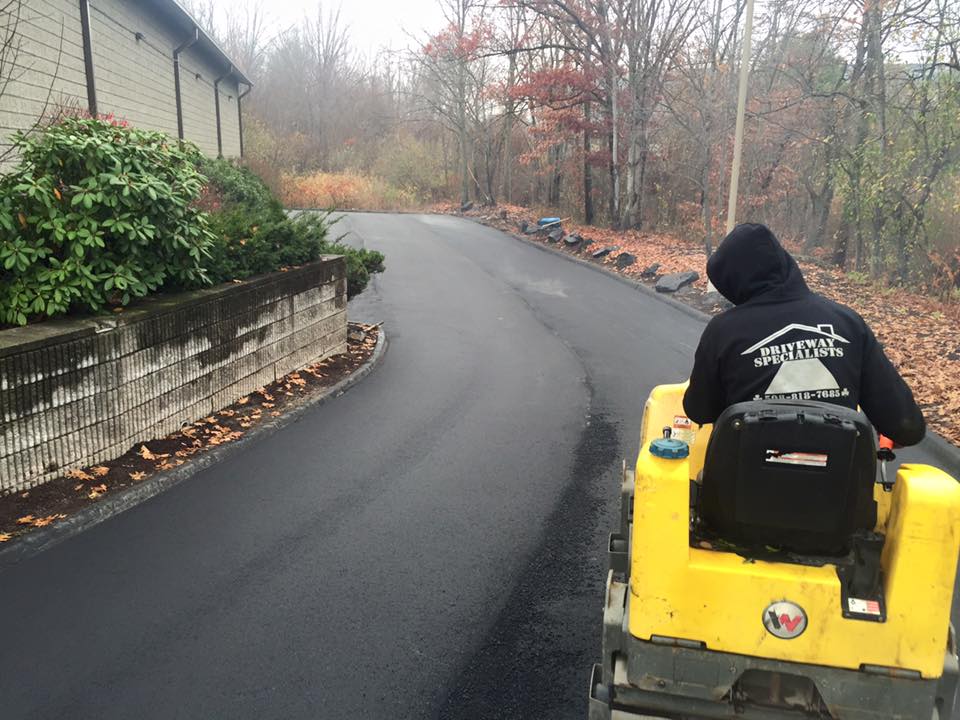
Asphalt is only as good as what’s underneath it. In Lexington, soil varies lot to lot, but tree cover is the constant. Roots from mature trees lift and crack a base from below, and shaded ground stays damp longer after rain or snowmelt, which softens whatever base material is there. A thin or compromised base will telegraph every one of those problems straight through a new surface within a season or two.
Full replacement or overlay
An overlay only makes sense when the base below is still sound: no major cracking through to the subgrade, no soft or spongy spots, no standing water after rain. If the base has already failed, an overlay just gives you a smooth surface over a problem that’s still moving underneath, and you’ll see reflective cracking again within a season or two.
On older Lexington properties, where a driveway may have been resurfaced once or twice already without the base ever being addressed, full replacement is often the honest answer. Clay-heavy soils common around Lexington don’t forgive a weak base, so we dig a test section before quoting either option. We’ll check drainage, measure existing asphalt depth, and look for signs the subgrade has shifted. Then we’ll tell you straight which approach your driveway actually needs, and why, before any work starts or a contract gets signed.

What drives the price
Square footage is the starting point, but depth of excavation, how much old material has to come out, and how easily we can get equipment onto the site all move the number. Grade matters too: a drive with any real pitch needs drainage planning built into the base, not just a flat spread of material. Lexington's mix of older, mature-tree lots and newer subdivision sites means soil conditions and root interference vary block to block, which affects how much base prep a driveway actually needs. The apron where the drive meets the road is its own line item, since it sees different stress and sometimes different ownership rules depending on whether the road is town-accepted. Material choice, whether asphalt, concrete, or pavers, shifts both upfront cost and long-term upkeep.
What drives the price
Several things set the cost of a driveway, and each one is visible only on site.
- Square footage : The area to be paved, plus any widening, turnaround or parking pad you want added.
- Depth of excavation : How far down the old material has to come out, and how much of the base has to be rebuilt.
- Material removed : The old asphalt has to be hauled away, and the amount depends on what is there.
- Access: A paver, a roller and delivery trucks all need to get in and turn around. Tight Lexington frontages can limit what equipment fits, which changes how the work is staged.
- Grade: A steep drive is harder to prepare, harder to compact and harder to drain correctly.
- Drainage: If water needs to be moved off the drive and away from the house, that work is part of the job.
- The apron: On many Lexington lots the apron meets the sidewalk with very little room between the street and the house. How that transition is built affects both the drive and the walk, and we look at it closely.
Anyone who gives you a firm figure without having stood on your driveway is guessing. When the guess is wrong, the extra cost shows up later as shortcuts in the base.
Scheduling around the Massachusetts season
Paving in Massachusetts runs on a seasonal window, and good contractors book up inside it. We’ll give you a realistic timeframe once we’ve scoped the job rather than a date pulled out of the air. Once work is scheduled, you’ll need to shift vehicles off the drive and keep off the new surface for the period we specify, since a freshly placed driveway needs that time to set up properly before it’s driving on normal New England freeze-thaw cycles.
Getting your first season right
The first winter is the real test of any new driveway. Edges that weren’t properly backfilled or compacted are what plows catch first, and water that isn’t directed away from the slab is what works into hairline gaps and expands when it freezes. We build the edge detail and drainage with that in mind from day one, rather than leaving it as something to deal with later.
Next step
If your Lexington driveway is past patching, or you’re starting from bare ground, the next step is a site visit, not a phone quote. Call Driveway Specialists at (413) 337-3772 and we’ll walk the property, tell you what the base actually needs, and give you a number built on what’s really there.
FAQs
How do I know if my Lexington driveway needs full replacement or just an overlay?
It comes down to the base. If the ground beneath the surface is still solid, with no major cracking or soft spots, an overlay can work. If the base has already broken down, an overlay just hides the problem for a season or two before it reflects back through. We check this at the site visit before recommending either.
Why do driveway edges crack first in Lexington?
New England's freeze-thaw cycle is the main driver. Water works into small gaps at the edges, freezes, expands, and widens the gap. Unprotected or poorly compacted edges are also what plows catch, which is why edge detail is part of the build, not an afterthought.
Do mature trees affect driveway paving in Lexington?
Yes. Many Lexington lots have oaks and maples with root systems that have had decades to spread. Roots can heave a base from below, and the shade keeps the ground damp longer after rain, which softens a weak base faster than an open, sunny drive would.
Can you give me a firm price over the phone?
No, and you should be cautious of anyone who does. Price depends on square footage, excavation depth, how much old material comes out, access for equipment, grade, and drainage. We scope all of that during a site visit before quoting.
When can paving work start and how long before I can use the driveway?
Paving is seasonal in Massachusetts, so timing depends on when you call and current booking. We give a realistic schedule once we've seen the site. Afterward, you'll need to keep vehicles off the new surface for the period we specify so it can set up properly.
Call us
If your Lexington driveway has reached the end of its life, or you are putting one in for the first time, call (413) 337-3772. We will arrange a time to see the site, measure it, and tell you what it needs.