
Walkway Installation in Chestnut Hill, MA
Chestnut Hill homes sit back from the street behind short, formal drives and mature plantings. The front walk is often the first hard surface a visitor actually steps on, and on a property like this it has to look as considered as the house it leads to. A cracked, heaving, or mismatched walk stands out fast against stone walls, boxwood, and a brick or stone facade that has not changed in decades.
Walkway work is a different job from driveway paving. Nobody is driving a car over it, but that does not make it simpler. A walkway is narrow, usually curved or segmented around planting beds and steps, and it sits closer to the house foundation, existing walls, and mature root systems than a drive ever does. Every decision, from base depth to joint pattern, is visible at close range in a way that asphalt forty feet from the door is not. A seam that would go unnoticed on a long driveway reads as a flaw on a four-foot-wide walk that someone crosses slowly, on foot, looking down.
What happens below the surface
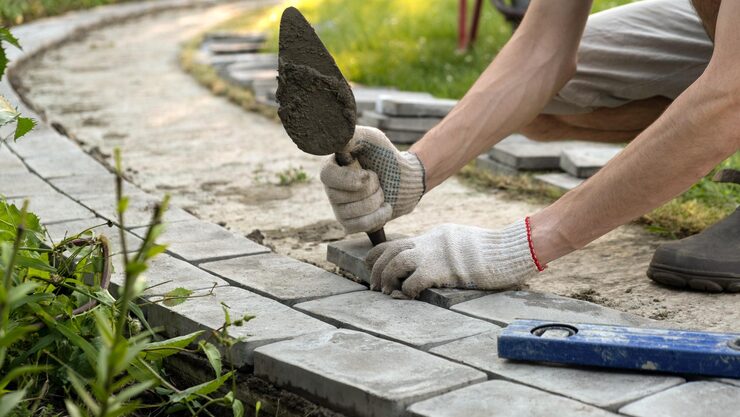
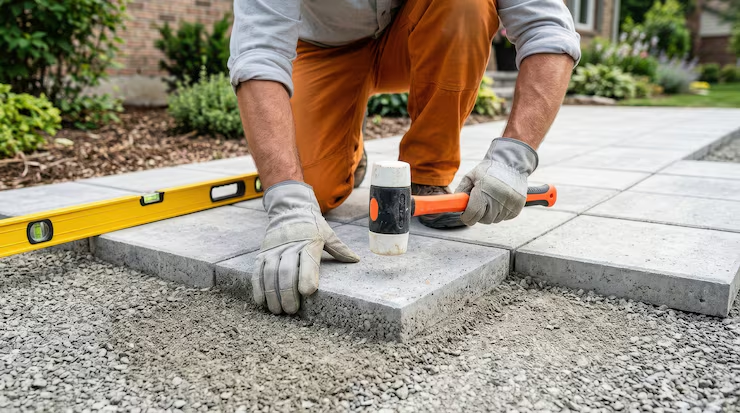
A walkway that stays flat through a Massachusetts winter does so because of what is under it, not what is on top. Proper work means excavating below the frost-affected zone, laying a compacted gravel base that lets water drain through rather than pool underneath, and setting the bedding layer so each paver or stone sits level and supported. Edge restraint, whether a hidden aluminum edge or a mortared border, keeps the whole assembly from creeping outward as the ground freezes and thaws each year.
Skip any of those steps and the walk still looks fine the first season. It is the second and third winter that show the shortcuts, with one paver heaving half an inch above its neighbor or a joint opening along the edge where the base was never compacted properly. Near mature trees, root flare is another factor worth planning for before the first stone goes down; a base that ignores a nearby root system will get pushed out of level within a few years, no matter how well it was compacted on day one.


What Our Clients Say
Bluestone and the cost of a good look
Bluestone is the material most often requested in Chestnut Hill. It weathers well, reads as traditional against period stone and brick homes, and resists heaving if the base is right, though individual stones can crack and need replacing over time.
Brick walkways and pattern
Brick suits colonial and federal-style houses and can be laid in running bond, herringbone, or basketweave. It handles freeze-thaw well when properly bedded but will show frost heave faster than stone if the base is thin.
Concrete pavers as a budget option
Concrete pavers cost less than natural stone and come in shapes, textures, and colors that mimic bluestone or brick, suiting Chestnut Hill's older homes.
Poured concrete and its limits
Poured concrete walks are the least expensive option but crack along uncontrolled joints as the ground moves, and a cracked slab cannot be repaired invisibly the way a paver can be lifted and reset.
Why pitch matters next to a foundation
A walkway that slopes even slightly toward the house foundation sends runoff where it does not belong. Correct grading pitches water away, toward lawn or a drain, protecting Chestnut Hill basements and sills from slow, costly seepage over time.
Grade changes on sloped frontage
Many Chestnut Hill lots step down from the street.
Choosing a material
The materials are not equal. Each suits some properties and not others.
Root pressure from mature trees
Chestnut Hill’s mature oaks and maples send roots beneath walkways laid decades ago. Flexible pavers set on a proper base can be lifted and reset around root growth, while a poured slab usually must be broken out entirely.
Tying the walk into the driveway
Where a walkway meets the driveway, the transition should feel intentional, not like two separate contractors worked the property.
Working around existing walls
Fieldstone and dry-laid walls are common on older Chestnut Hill lots.
Entry landings and front steps
The landing at the front door takes the most wear and the most scrutiny. It is usually worth setting in the same material as the walk itself, sized generously enough for someone to stand comfortably while holding a door open.
Lighting and edge detail
Low path lighting set into the border, rather than surface-mounted fixtures, keeps a Chestnut Hill walkway looking finished after dark without disrupting the daytime line of the stone or brick.


Where this work fits in Chestnut Hill
Chestnut Hill sits across the Newton and Brookline line, and the housing on both sides shares the same pattern: larger, older homes on modest-sized lots, short formal drives, and a front approach that was clearly designed rather than left to chance. That raises the bar for any hardscape work. A walkway here is rarely a simple point-A-to-point-B path. It usually has to navigate a grade change from street to door, work around a stone wall or mature planting bed that has been there longer than the current owners, and match a facade material that was never meant to be modernized.
Because lots tend to be tight and the plantings established, access for equipment is limited and the margin for error is small. A walkway installed badly is obvious immediately, right at the front door, where every visitor and every delivery sees it. That is exactly the kind of property where getting the base, the pitch, and the material choice right the first time matters more than it would on a long rural driveway where the finish grade is a minor detail.
What drives the price
A new walk has to meet several existing things cleanly.
- The entry : The walk must arrive at the door at a sensible height. The threshold sets the finished level, so the work starts at the door and runs outward.
- The drive : Where a walk meets a drive, the levels and the drainage have to agree. A mismatch becomes a trip edge or a puddle.
- Walls and planting : Existing stone walls, foundation beds and mature trees constrain the route. Roots under a path are worked around, not cut through without thought.
- An older house : Scale, colour and pattern should follow the architecture. A narrow, dark stone walk suits an old house differently than a broad paver field does.

Next step
If you are planning a new front walk, replacing a cracked or heaving one, or tying new hardscape into an existing drive and entry in Chestnut Hill, Newton, or Brookline, Driveway Specialists has worked on properties like this since 1988. The next step is simple: a site visit where we walk the property with you, look at how the existing grade sheds water, and talk through what material actually makes sense for the look and budget you have in mind, whether that’s bluestone, brick, pavers, or a poured concrete walk that ties cleanly into your driveway.
- Assessment of existing grade, drainage, and any heaving or settling issues
- Material options suited to Chestnut Hill’s older homes and stone walls
- A clear plan for tying the new walkway into your driveway and entry
Call (413) 337-3772 to arrange that visit. We will give you a straightforward look at what will actually hold up through New England winters on your specific property, not a generic quote.
Before you call
It helps to know:
- Where the walk starts and where it needs to end
- Whether the route crosses a slope or a shared area
- Which material you lean towards, and whether the house is older
- Where water currently runs on the property
Questions people ask
What is the best walkway material for an older Chestnut Hill home?
Bluestone is the most common choice for older, formal houses because it weathers naturally and holds its look over time. Brick suits colonial and federal-style homes. The right choice depends on the house facade, existing stonework, and budget.
Why does a walkway heave or crack after a few winters?
Heaving and cracking almost always trace back to the base, not the surface material. If the excavation is not deep enough or the gravel base is not properly compacted, freeze-thaw movement pushes pavers or slabs out of line over successive winters.
Can a walkway be built around mature tree roots without damaging the tree?
Yes, in most cases. A flexible paver system set on a compacted base can be routed around significant roots and lifted and reset later if roots grow further, which is not possible with a poured concrete slab.
Does the walkway need to match the driveway material?
Not necessarily, but the transition between them should look intentional. A shared edge detail or border treatment at the point where walkway meets driveway usually reads better than two unrelated materials meeting abruptly.
Next step
Call Driveway Specialists on (413) 337-3772. We are a family-run company in business since 1988, and we will walk the route with you and talk through material, grade and drainage before anything is priced.