
Driveway Paving in Natick, MA
A driveway in Natick usually tells you it’s done before you’re ready to deal with it. Maybe it’s an older slab off a dense side street near the center, heaving and cracking at the edges. Maybe it’s a lakeside lot near Lake Cochituate where the surface stays damp longer than it should. Or it’s a new build in South Natick with no driveway at all yet, just graded dirt waiting on a plan. Whatever the starting point, the question is the same: who do you call, and what will they actually do differently from the last crew?
When you call, the first thing that happens is a site visit, not a quote. We walk the drive, measure the area, and look at what’s underneath and around it, not just what you see on top. In Natick that means checking which kind of ground we’re dealing with. The town runs from tight older streets near downtown, where lots are small and access is the main constraint, to newer subdivision lots in South Natick with more room to stage material, to properties close to the lake where moisture sits in the soil longer through the year. Each of those changes the scope before any asphalt gets ordered.
Why the base is the real job
Everything that happens above the base is temporary if the base is wrong. A base holds up because it drains. Water that gets trapped under the surface freezes, expands, and pushes the pavement up and apart over winter. On a sandy, well-drained Natick lot that drains, and a properly built base will hold. On the heavier, more compact soil found closer to the lake and in some of the older low-lying streets, water sits longer, and the base has to be built to move it out rather than hope it disappears. This is the part of the job that doesn’t show in a finished photo and is the part most likely to get skipped by an outfit that just wants to lay new surface over old problems.
That’s also the line between a full replacement and an overlay. An overlay works when the base underneath is sound and the existing surface is failing on top of good bones, usually just raveling or shallow surface cracking. An overlay over a base that’s already cracked, heaving, or draining poorly just reproduces the same failure in less time. A sound base is uniform underfoot, doesn’t flex or hold water, and hasn’t let the existing pavement settle unevenly. If the surface has broad cracking that mirrors the ground beneath it, or dips where water pools after rain, that’s a base problem, and an overlay there is money spent twice.


What Our Clients Say
What Drives the Price
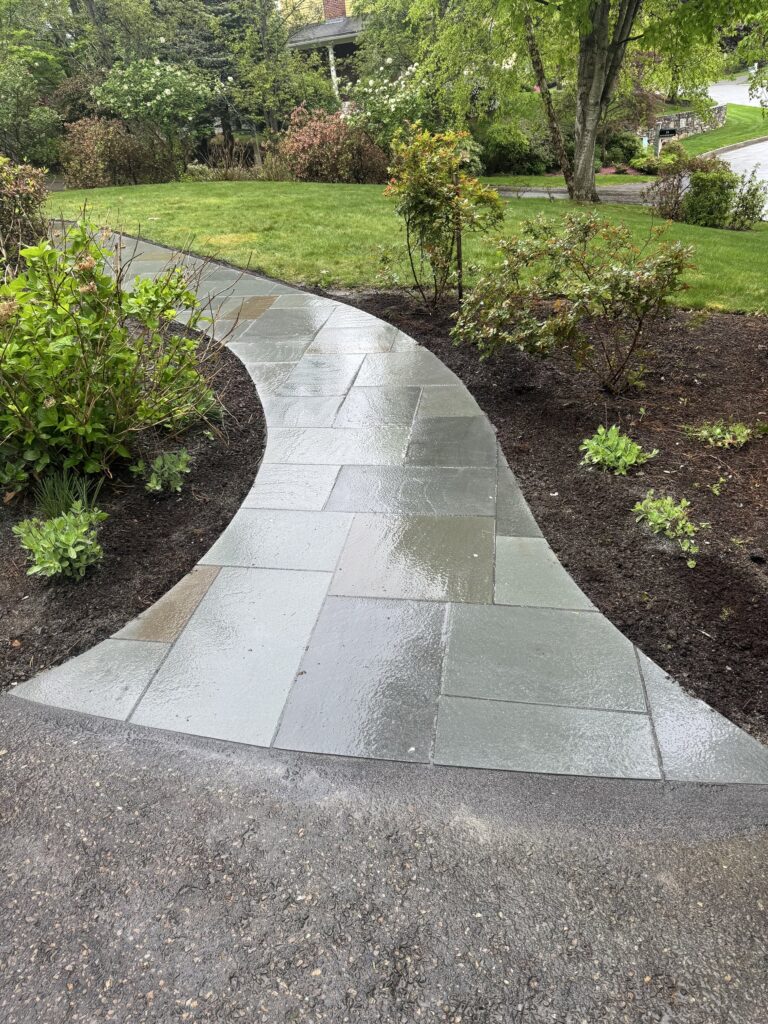
Square footage is the starting point, not the answer. Depth of excavation, how much old material has to come out, access for equipment, the grade of the drive, drainage work needed, and the apron where the drive meets the road all add or subtract cost. A flat, open lot near a South Natick subdivision street costs differently to prep than a tight, sloped drive wedged between two older homes closer to downtown. Natick's mix of clay-heavy soil and old fieldstone fill can also mean extra base work once excavation starts. Proximity to Lake Cochituate and older stormwater setups sometimes calls for added drainage planning too.
Grade, Trees, and What's Actually Under Natick Driveways
A driveway that slopes toward a garage or a house is a drainage design problem before it's a paving one. Water has to be directed off the surface and away from the foundation, not just allowed to run wherever gravity takes it. Natick's older neighborhoods often sit under mature oaks and maples, and roots under or beside a drive will eventually heave a surface that was laid flat over them. Shaded drives also stay damp longer after rain, which matters for how a sealed surface wears over time and how early it may need resealing. Then there's what's underneath: much of Natick's base soil is glacial till, a dense mix of clay, sand, and stone that drains poorly and shifts with freeze-thaw cycles if the excavation and gravel base aren't built to handle it.

Access and Working Around a Natick Lot
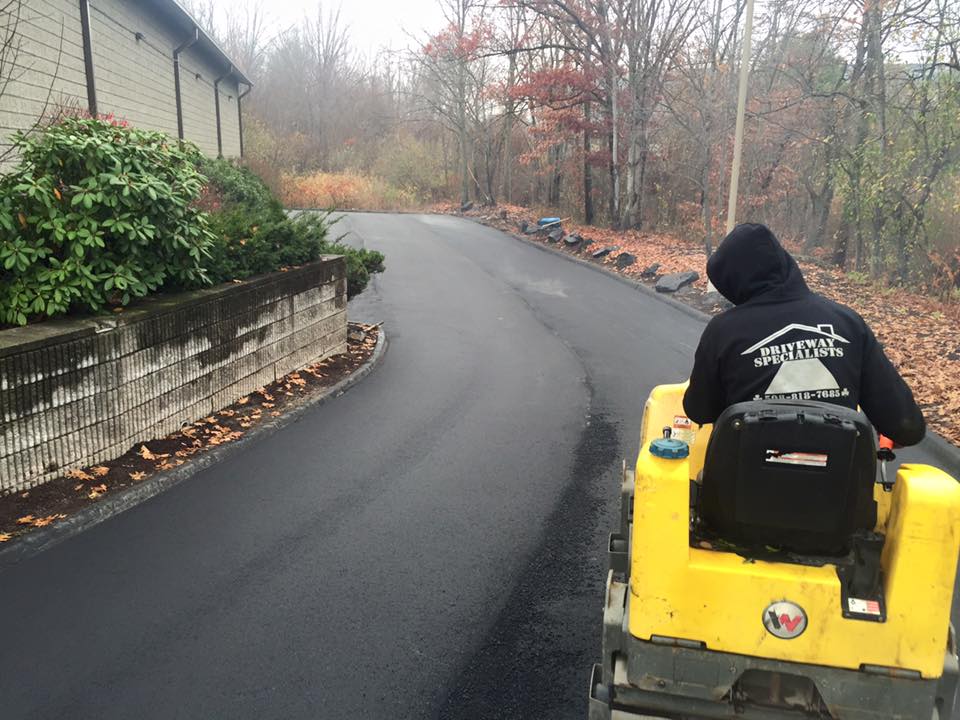
Getting a paver, a roller, and a delivery truck onto a property matters as much as the paving itself. On a tight lot near downtown Natick with on-street parking and narrow setbacks, planning the approach and turning radius is often the hardest part of the job, and crews may need to hand-wheel material in from the street or coordinate a temporary parking permit before work starts. On a more open South Natick subdivision lot, or a larger lake-area property with a longer approach, access is less of a constraint and the work can move faster once equipment is on site.
- Staging area for the paver, roller, and material stockpile
- Truck access for asphalt or base delivery without blocking neighbors
- Protecting existing walkways, irrigation, and landscaping along the route
- Sequencing excavation and paving around tight turning radii
Either way, where equipment stages and how material gets in changes the timeline before the first shovel moves.
What drives the price
Several things set the cost of a driveway, and each one is visible only on site.
- Square footage : The area to be paved, plus any widening, turnaround or parking pad you want added.
- Depth of excavation : How far down the old material has to come out, and how much of the base has to be rebuilt.
- Material removed : The old asphalt has to be hauled away, and the amount depends on what is there.
- Access: A paver, a roller and delivery trucks all need to get in and turn around. Tight Natick frontages can limit what equipment fits, which changes how the work is staged.
- Grade: A steep drive is harder to prepare, harder to compact and harder to drain correctly.
- Drainage: If water needs to be moved off the drive and away from the house, that work is part of the job.
- The apron: On many Natick lots the apron meets the sidewalk with very little room between the street and the house. How that transition is built affects both the drive and the walk, and we look at it closely.
Anyone who gives you a firm figure without having stood on your driveway is guessing. When the guess is wrong, the extra cost shows up later as shortcuts in the base.
Scheduling Around New England Weather
Paving is seasonal in Massachusetts. Asphalt needs the right conditions to compact and cure properly, and that limits the calendar on both ends of the year. Booking early in the season, before the schedule fills, gives more flexibility on timing. Once a date is set, the homeowner’s part is straightforward: move vehicles off the drive, keep off the new surface for the period the crew specifies, and avoid sharp turns or heavy loads in that first season while it fully sets up under regular use. Edges, in particular, need that first season to firm up before they’re ready for routine plow contact or heavy trailer traffic.
Next Step
If a Natick driveway is cracking at the edges, heaving in spots, or simply isn’t there yet on a new build, the next step is a site visit, not a guess over the phone. Call Driveway Specialists at (413) 337-3772 and we’ll walk the property, look at the ground, and tell you straight whether it’s a base rebuild or a surface fix. We’ve been doing this work across Middlesex County since 1988, and we’d rather tell you what the drive actually needs than sell you the wrong job.
FAQs
How do I know if my Natick driveway needs full replacement or just an overlay?
It comes down to the base. If the ground underneath is solid, drains well, and the existing pavement is only failing on the surface, an overlay can work. If there's heaving, broad cracking that follows the ground beneath, or water pooling in low spots, the base itself has failed and an overlay won't fix it. A site visit is the only reliable way to tell, since these signs can look similar from the surface.
Why does the base matter more in some parts of Natick than others?
Soil type and water table vary across town. Lots closer to Lake Cochituate and some of the older, lower-lying streets tend to hold water longer in the ground, which means the base has to be built to actively drain rather than rely on the soil to do it. Newer South Natick subdivision lots and sandier ground elsewhere drain more easily, which simplifies that part of the job.
When can I book driveway paving in Natick?
Asphalt paving in Massachusetts is seasonal because the material needs the right conditions to compact and cure correctly. Booking earlier in the season generally means more flexibility on scheduling. Call ahead of when you need the work done so we can plan around the calendar before it fills up.
What should I do with a new driveway in the first season?
Keep vehicles off it for the period we specify after paving, avoid sharp turns or point-loading from things like trailer jacks, and give the edges a full season before they see regular plow contact or heavy trailer traffic. That first season is when the surface and edges firm up under normal use.
Call us
If your Natick driveway has reached the end of its life, or you are putting one in for the first time, call (413) 337-3772. We will arrange a time to see the site, measure it, and tell you what it needs.