
Driveway Paving in Sudbury, MA
A driveway in Sudbury usually sits at the end of a long run through trees, not off a short flat street apron. When that surface starts to heave, pool water, or break up at the edges, the fix depends on what is happening underneath it, not just what you can see. Driveway Specialists has been pricing and paving drives like this across Middlesex County since 1988, and Sudbury’s mix of wooded lots and winding, tree-lined drives is a large part of that work.
When you call, we set up a site visit rather than quote blind. On a Sudbury lot that means walking the full length of the drive, not just the section near the road. We measure width and length, check the grade from the street down to the garage or house pad, and look at where water currently goes when it rains. On a lot bordering conservation land or wetland buffer, we also note where tree cover sits directly over the drive, because that changes how the surface behaves long after installation, not just during the pour. We also flag any spots where the existing surface has already settled or cracked along a line, since that often points to a drainage issue under the slab rather than a surface defect you can patch and forget.
Asphalt is the part you see, but the base underneath it carries the weight and decides whether the surface stays flat or starts to wave and crack within a few seasons. Sudbury’s glacial soils vary block to block and even along a single long drive, from well-draining sand and gravel to tighter, slower-draining pockets. A base built without accounting for that variation will fail first in the wet spots, usually where runoff collects at a low point or under heavy shade that never fully dries out. Getting the excavation depth and compaction right for the actual soil on your lot, not a generic spec, is where a paving contractor earns the job and where a resurfacing crew that skips straight to new asphalt sets you up to redo the work in a few years.
Root systems add another layer most town drives don’t have to deal with. Mature oaks and maples throwing roots under a drive will lift a thin overlay from below even if the surface looks sound when it’s poured. Part of the site visit is checking for that heave risk along the run, not just at the ends, and planning the base depth or root barrier accordingly rather than paving over a problem that will resurface in a year or two.
Length matters too. A long wooded drive sees more freeze-thaw cycling along its shaded stretches than the sunnier section near the road, so we often plan drainage and base thickness to vary slightly along the run instead of treating the whole drive as one uniform job. Edges bordering lawn or garden beds get attention as well, since loose soil pushing against an unsupported edge is a common reason asphalt starts crumbling at the margins long before the middle shows any wear.
What this adds up to on a Sudbury property:


What Our Clients Say
Full Replacement or Overlay
Not every tired-looking drive needs to be torn out. If the base is still solid, intact, well-compacted, draining the way it should, an overlay can extend the life of the drive for a reasonable cost. But an overlay laid over a broken or saturated base is money spent twice: the new surface will crack and settle wherever the base already has, usually within a season or two. On long Sudbury drives with root pressure and inconsistent soil, we check base condition at multiple points along the length before recommending either option, not just at the section nearest the street.
What Drives the Price
A firm quote over the phone for a Sudbury driveway isn’t really a quote. Price is set by square footage, how deep we need to excavate to reach stable ground, how much old material has to come out, and how the site itself affects the work. A long winding drive through trees takes longer to access with equipment than a short straight run, and grade matters too: a drive that drops toward a garage needs drainage planning built into the base, not added after the fact. The apron where the drive meets the road is its own line item, and on a tight, tree-lined approach, getting paving equipment and material trucks in and turned around without damaging root zones or landscaping takes more care and more time than a wide open lot.

Scheduling Around the Season
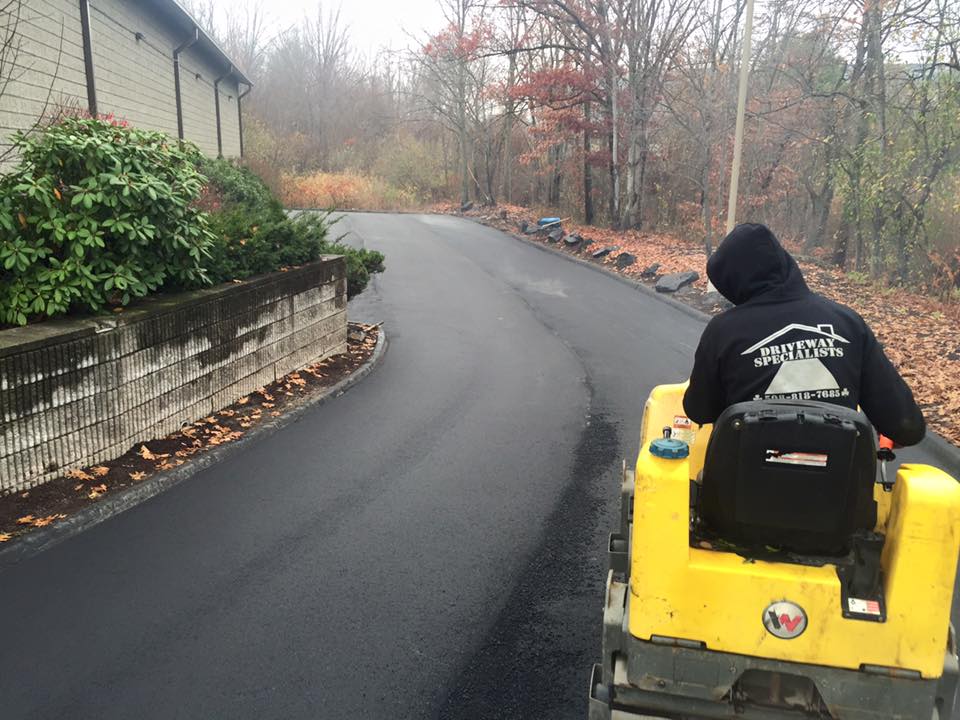
Paving in Massachusetts runs on a seasonal window, and like most contractors in the area we book up fast once temperatures climb and that window fills. The practical advice is to get your site visit scheduled early in spring rather than waiting until the drive is cracked, pooling water, or otherwise unusable. Once a date is set, plan ahead for the install day itself: clear vehicles, trash bins, and basketball hoops from the area, and arrange alternate parking since the surface needs to cure undisturbed. Expect the asphalt to firm up gradually over its first season rather than reaching full hardness on day one, so avoid sharp turning, trailer jacks, or kickstands that can leave marks. Shaded sections under heavy tree cover, common on wooded Sudbury lots, will take longer to fully cure than open stretches in direct sun.
What drives the price
Several things set the cost of a driveway, and each one is visible only on site.
- Square footage : The area to be paved, plus any widening, turnaround or parking pad you want added.
- Depth of excavation : How far down the old material has to come out, and how much of the base has to be rebuilt.
- Material removed : The old asphalt has to be hauled away, and the amount depends on what is there.
- Access: A paver, a roller and delivery trucks all need to get in and turn around. Tight Sudbury frontages can limit what equipment fits, which changes how the work is staged.
- Grade: A steep drive is harder to prepare, harder to compact and harder to drain correctly.
- Drainage: If water needs to be moved off the drive and away from the house, that work is part of the job.
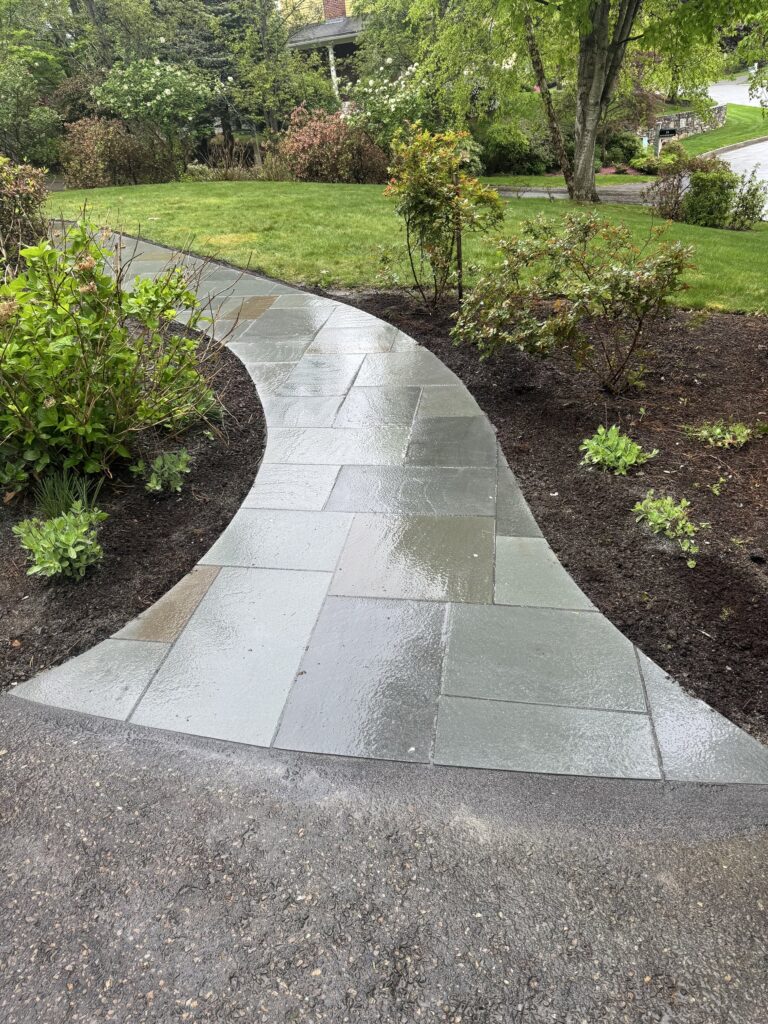
- The apron: On many Sudbury lots the apron meets the sidewalk with very little room between the street and the house. How that transition is built affects both the drive and the walk, and we look at it closely.
Anyone who gives you a firm figure without having stood on your driveway is guessing. When the guess is wrong, the extra cost shows up later as shortcuts in the base.
Getting Started
If your driveway is cracking, heaving from roots, or holding water in low spots, the next step is a site visit, not a guess over the phone. Call Driveway Specialists at (413) 337-3772 to get a visit scheduled and a real assessment of what your Sudbury drive actually needs.
Drainage on a Wooded Lot
Water that has nowhere to go is the most common reason a Sudbury driveway fails early. Heavy tree cover slows evaporation, so moisture sits longer in the base after rain than it would on an open lot nearby in Wayland or Framingham. We grade and build the base to move water off and away rather than trap it.
Working Around Mature Trees
Large oaks and maples near a drive mean roots running under the surface in directions you can’t always see from above. We check for root pressure along the full length of a Sudbury drive during the site visit, not just at the obvious high points, because a root pushing up under shaded, damp asphalt will show up as heave well before it cracks through. Where root activity is heavy, base depth and material choices get adjusted to reduce how fast that pressure reaches the surface, rather than pretending the tree isn’t there.
FAQs
Why does my Sudbury driveway crack faster under the trees than in open sections?
Shaded, tree-covered sections stay damp longer after rain, and that extra moisture works on the base through New England's freeze-thaw cycles. Open, sunlit sections dry out faster and see less of that repeated expansion and contraction, so they tend to hold up longer.
Can you pave around mature trees without harming them?
We account for root zones when planning excavation depth and equipment access, but any paving work near a mature tree carries some risk to roots. We discuss that risk directly during the site visit for lots with trees close to the drive.
Do you need to see the driveway in person before quoting?
Yes. Grade, soil condition, root pressure and drainage all vary along a Sudbury drive, sometimes significantly between the street end and the garage end, so a firm price requires a site visit rather than a phone estimate.
How long before I can drive on a new driveway?
We give you specific timing for your project at the site visit, since it depends on weather, shade cover and the work done. In general, newly paved asphalt needs time off traffic before use and continues to firm up gradually over its first season.
Call us
If your Sudbury driveway has reached the end of its life, or you are putting one in for the first time, call (413) 337-3772. We will arrange a time to see the site, measure it, and tell you what it needs.