
Driveway Paving in Wellesley, MA
A Wellesley driveway rarely fails quietly. On an older lot it shows up as alligator cracking spreading from the garage apron, a surface that’s gone soft and spongy at the edges, or frost heave that’s turned a flat run into a series of small ridges. On a teardown-rebuild lot, there’s often no driveway at all yet, just graded subgrade and a finish deadline tied to the rest of the build. Either way, the question is the same: who do you call, and what do they actually need to see before they can tell you what this costs.
When you call, the first thing that happens is a site visit, not a phone quote. We walk the lot, look at the existing surface or the graded pad, and check how the ground falls toward the street, the garage and any low corners. On the larger, well-kept lots common in Wellesley, that grade reading matters more than the square footage. A long gentle slope toward an attached garage behaves completely differently from a flat pad near the road, and the drainage plan for each is not the same job. We also look at where snow gets plowed or shoveled to, since a pile that sits against an edge all winter will find any weak seam in the base by March.
Wellesley lots vary block to block. Some sit on well-draining glacial sand and hold a compacted base for decades. Others have pockets of heavier, clay-rich soil that hold water against the base through a wet spring and winter freeze-thaw cycle. We check this on the visit because it changes the excavation depth and the base material we spec, not as an afterthought but as the main decision. Mature trees are common on these properties too, and root heave under an old driveway edge is something we look for specifically, since cutting roots without addressing the regrowth just buys a few years.
From there we talk about whether the existing drive can be resurfaced or needs to come out. Resurfacing only makes sense if the base underneath is still sound; if the cracking is structural rather than cosmetic, an overlay just telegraphs the same pattern back through within a season or two. On a lot with high finish expectations, that decision shows on the surface for years, so it’s worth getting right rather than rushed. The same applies to edges and transitions: where the driveway meets a front walk, a stone wall, or a garage threshold, a clean, level tie-in is usually what separates a driveway that reads as finished from one that looks patched in.
A few things typically come up during that first visit, worth thinking through before we arrive:
- Whether drainage needs a trench drain or catch basin, not just a crown and slope
- How close the new edge can run to existing trees without disturbing root plates
- Whether the garage apron needs reinforcement for a heavier vehicle or plow truck
- Timing against landscaping, irrigation lines, or other trades already scheduled on site
None of this is guesswork from the curb. It’s why the visit comes before the number, and why the number tends to hold once the work starts.


What Our Clients Say
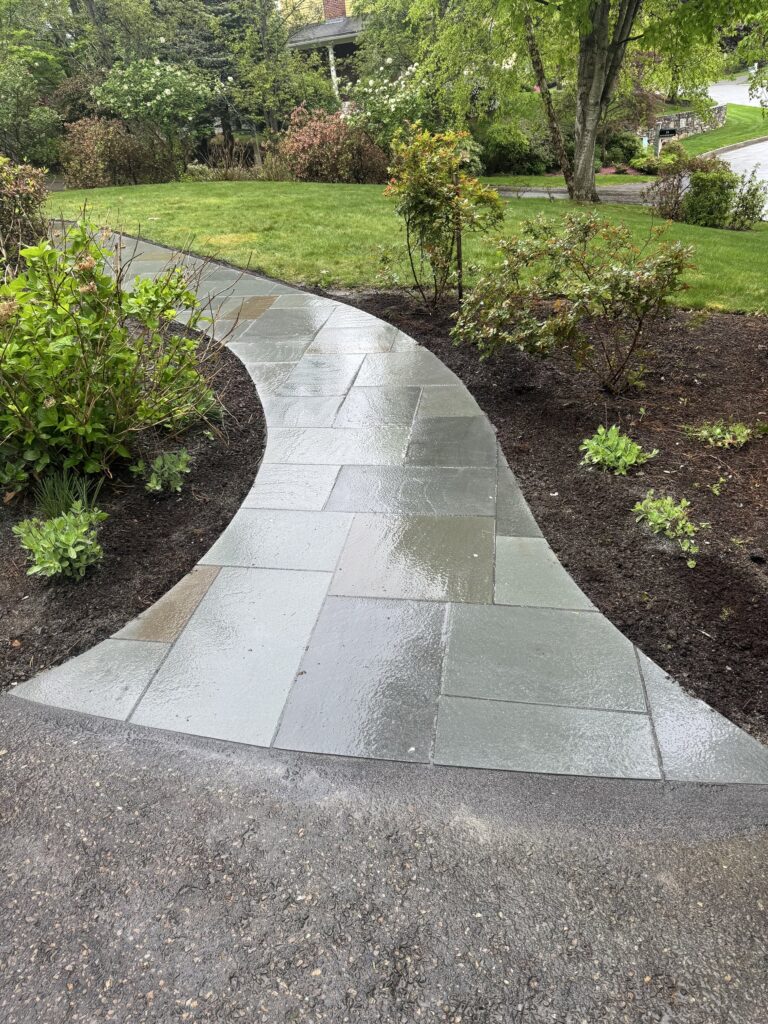
Full Replacement or Overlay
An overlay only works over a base that's still sound, meaning it hasn't shifted, cracked through to the subgrade, or trapped water underneath. If the existing driveway has widespread alligator cracking, pooling, or edges breaking away, the base has already failed, and an overlay just hides it for a season or two before the same cracks telegraph back through the new surface. On Wellesley's older properties, where the original base may be decades old and was never engineered for today's heavier vehicles, we check this on-site rather than assume either way. That inspection looks at drainage, slope, and how the edges have held up over time.
What Actually Drives the Price
Square footage is only the starting number. The real cost drivers are excavation depth, how much material has to come out, how the equipment accesses the site, and the drainage and apron work the grade demands. A driveway on a tight, tree-lined lot with a narrow approach costs more to execute than the same square footage on an open, easy-access pad, because the paver, roller and delivery truck all need room to work and turn. Wellesley's mature landscaping and circular or side-entry drives often mean exactly this kind of constrained access, along with root systems and stone walls that complicate excavation and base work. Soil conditions matter too: heavier clay subgrades common in parts of town need deeper gravel bases to drain properly and avoid frost heave come winter.


Scheduling Around New England Weather
Paving in Massachusetts runs on a seasonal window, and asphalt won’t compact and cure properly outside it. That means spring through fall books up, and a driveway tied to a new build’s finish schedule should get on the calendar as early as possible rather than left until the week it’s needed. We’ll give you a realistic sense of timing once we’ve seen the site and scope, rather than a date that doesn’t hold.
Once the new surface is down, keep vehicles off it for the period we specify and expect the asphalt to firm up further over its first season, especially through its first summer. It will look and feel slightly different a year in than it does the day it’s installed, and that’s normal, not a defect.
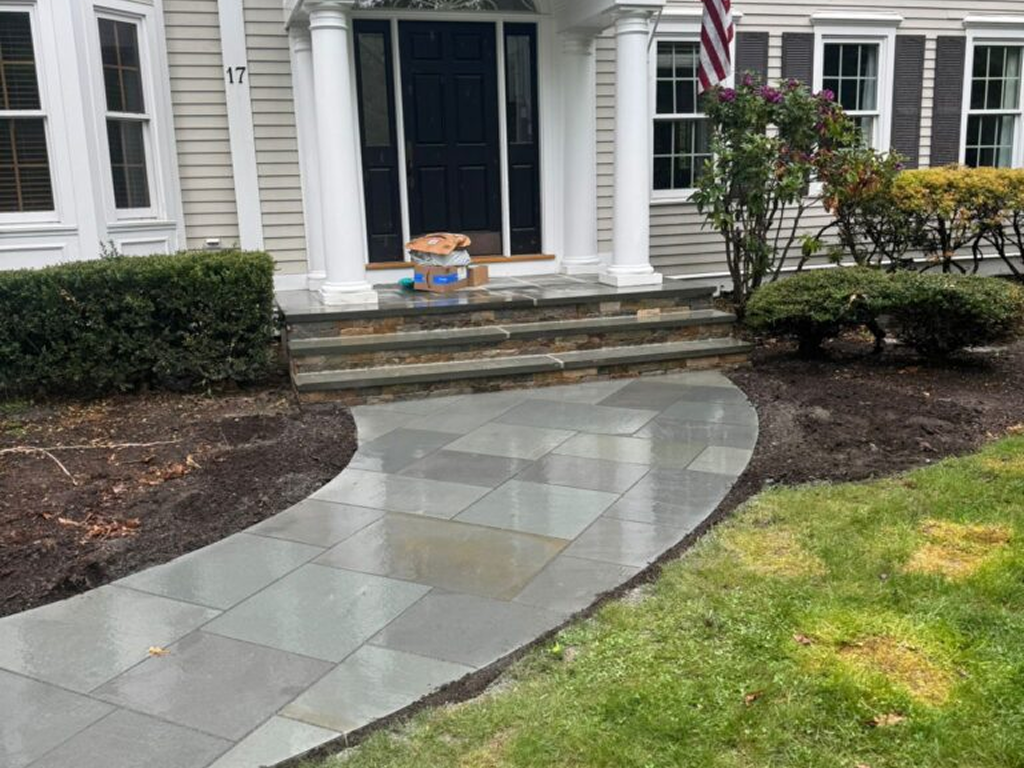
What drives the price
Several things set the cost of a driveway, and each one is visible only on site.
- Square footage : The area to be paved, plus any widening, turnaround or parking pad you want added.
- Depth of excavation : How far down the old material has to come out, and how much of the base has to be rebuilt.
- Material removed : The old asphalt has to be hauled away, and the amount depends on what is there.
- Access: A paver, a roller and delivery trucks all need to get in and turn around. Tight Wellesley frontages can limit what equipment fits, which changes how the work is staged.
- Grade: A steep drive is harder to prepare, harder to compact and harder to drain correctly.
- Drainage: If water needs to be moved off the drive and away from the house, that work is part of the job.
- The apron: On many Wellesley lots the apron meets the sidewalk with very little room between the street and the house. How that transition is built affects both the drive and the walk, and we look at it closely.
Anyone who gives you a firm figure without having stood on your driveway is guessing. When the guess is wrong, the extra cost shows up later as shortcuts in the base.
Getting the Base Right
Everything about how long a Wellesley driveway lasts comes down to what’s under it, not the asphalt on top. A compacted gravel base that’s deep enough and properly drained will carry the surface through repeated freeze-thaw cycles without heaving. A thin or poorly compacted base will crack within a few winters no matter how good the asphalt is. This is where the real cost of the job sits, and it’s the part that’s invisible once the driveway is finished, which is exactly why it has to be done right the first time.
Protecting the Finish
On a property with a high finish standard, the edge detail and apron transition matter as much as the surface itself. A clean, properly backed edge resists plow damage through winter and keeps the drive line sharp against lawn or planting beds. Where the drive meets the street, we account for who’s responsible for that section, since a private way and a town-accepted road aren’t treated the same. Getting this right at installation avoids a patched, uneven look creeping in after the first winter.
Next Step
If your driveway has reached the point where patching no longer makes sense, or you’ve got a new build with graded ground and no surface yet, the next step is a site visit, not a guess over the phone. We’ve been doing this work across Norfolk and Middlesex counties, including Wellesley, since 1988. Call (413) 337-3772 to set up a time to walk the site.
FAQs
How long does a driveway paving job take in Wellesley?
It depends on whether it's a full replacement or an overlay, and how much excavation and base work the site needs. We'll give you a realistic timeline once we've seen the ground and scope, rather than a generic figure that doesn't account for your lot.
Can my existing driveway just be resurfaced instead of replaced?
Only if the base underneath is still sound. If there's widespread cracking, pooling water, or broken edges, the base has already failed and an overlay will just crack again within a season or two. We check this on the site visit before recommending either option.
Why does the quote depend on a site visit instead of just square footage?
Square footage alone doesn't tell us excavation depth, access constraints, grade, or drainage needs, all of which affect labor and material far more than area does. A firm quote without a site visit is a guess, not a price.
What time of year can driveway paving happen in Massachusetts?
Asphalt needs to be installed and compacted within a seasonal window, so paving runs from spring through fall. Jobs tied to a new build or a specific deadline should be scheduled as early as possible since the season books up.
Will my new driveway look finished right away?
The surface will be fully usable once we clear you to drive on it, but asphalt continues to firm up over its first season, particularly through the first summer. Slight changes in texture or sheen in that first year are normal.
Call us
If your Wellesley driveway has reached the end of its life, or you are putting one in for the first time, call (413) 337-3772. We will arrange a time to see the site, measure it, and tell you what it needs.