
Private Driveway Paving in Westborough; MA
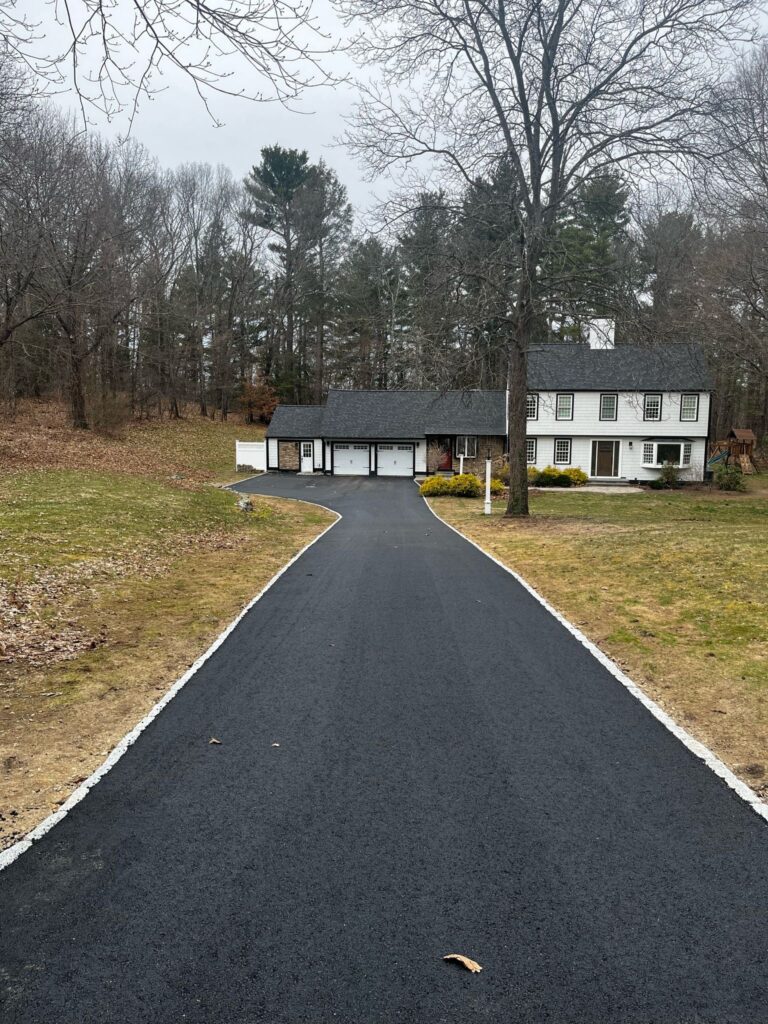
A drive that runs a few hundred feet back through trees to a Westborough house off the corridor, or a shared approach serving two or three homes on a private way, is a different job from a standard driveway. If it has gone soft at the low end, developed ruts after every storm, or was cut in once and never built up properly, paving it isn’t a matter of resurfacing a slab near the garage. It’s closer to building a short private road, and it needs to be planned like one from the base up.
Length changes almost everything about the job. Over a few hundred feet, a drive needs a real crown and consistent pitch to shed water off both sides rather than letting it run down the centerline and undercut the base. Water has to go somewhere specific – a ditch line, a culvert under a crossing point, daylight into woods that can actually absorb it – not just wherever the grade happens to send it. A turnaround at the house end, if there isn’t one already, is worth planning into the work rather than treating as an afterthought once the paving crew is already on site. The base itself matters more the longer the run gets: a thin gravel layer that happens to hold up under a car on a fifty-foot drive will pump and fail under repeated truck and trailer loads over a quarter mile, especially once Westborough’s spring thaw works through it.
Shared drives and private ways
When a drive serves more than one household, the surface itself usually isn’t owned or maintained by the town. That means cost-splitting, scope, and timing are between the abutters, not set by anyone else. The useful step, before any crew shows up, is getting agreement in writing on a few specific points:
- Who pays what share of the base work versus the surface paving
- What happens if one owner wants a wider or thicker build than the others
- Who’s responsible for ongoing maintenance once the job is done
- What happens if someone simply won’t contribute
None of that is paving work, but skipping it is the most common reason a shared-drive project stalls halfway through, sometimes with one section finished and another left as the same rutted gravel it started as.
Access along the drive matters for more than convenience. Fire apparatus, oil delivery trucks, ambulances and moving vans all need enough width and turning radius to get down a long wooded approach, and enough overhead clearance under low branches. On a short driveway this is rarely an issue. On a quarter-mile run through trees, it’s a safety question worth settling before the surface goes down, because correcting it afterward usually means tearing back up what was just built, culvert and all.


What Our Clients Say
Why a long or steep drive is a different job
Length and slope turn drainage from a detail into the main design problem. Water on a short, flat apron sits and soaks in. Water on a hillside drive picks up speed, carries fines out of the surface, and cuts channels along the edges. By the bottom it has gathered into a stream.
That is why the work starts with where the water goes, not with the surface:
- Crown and pitch : Crown and pitch. The drive needs a shape that sheds water sideways before it can build up speed down the length of it.
- Where water is sent : Moving it off the drive is not enough. It has to land somewhere that will not wash out a neighbour's lawn, undercut a retaining wall, or run across the public sidewalk at the bottom.
- Culverts and crossings: Where the drive crosses a low spot or a drainage path, water needs a way under it. A drive without one acts as a dam and fails at that point first.
- Turnarounds: A drive with no place to turn means vehicles reversing the whole length, which wears the surface and is a real hazard on a slope.
Frost makes every one of these worse. Water left in the base freezes, lifts the surface, and opens cracks, and the next thaw sends more water in. On a steep drive, ice is also a safety question. Where water sheets across the surface in winter, it freezes in the same place every time.
Shared drives and private ways
If you share a drive in Westborough, the paving is the easy part. The hard part is agreeing on it. Most failed shared drives are not neglected out of carelessness. They are neglected because nobody is sure who is responsible.
Before anyone prices anything, settle these:
- Who owns the surface: Ownership can differ from use. Your deed, and your neighbour's, usually says whether the drive is owned jointly, owned by one lot with an easement for the others, or split down the middle. It is worth reading before you collect a cheque from anyone.
- How the cost is split: Equal shares is the simplest. Splitting by use or frontage can feel fairer when one household drives it daily and another rarely does. There is no single right answer, but there must be one answer, agreed before the work starts.
- Agreement in writing: A short note signed by everyone, covering scope, share of cost and who pays when, prevents most disputes. It does not need to be formal. It needs to exist.
- When one neighbour will not pay: This is the common sticking point. If the drive crosses their land or they have a right to use it, you cannot simply leave them out, because the surface is continuous. Sometimes the people who want the work pay for it and accept the cost. If it comes to more than that, a lawyer is the right next call, not the contractor. We will tell you plainly which side of that line you are on.
We can write up the scope in a way that makes it easy to share and discuss with neighbours, with the work broken into parts so people can see what each portion covers. Where a drive meets the public sidewalk, on the tight frontages common in Westborough, the last stretch is a separate question. The apron at that point may not be yours to alter on your own. Check before work starts.
Access for everyone who has to reach the house
A steep, narrow, wooded drive is a safety issue as well as a paving one. The vehicles that matter most are the ones you hope you never need:
- Fire apparatus
- Ambulances
- Oil and propane delivery
- Moving and construction trucks
Each needs width to pass, room to turn, and clear space overhead. On a hillside drive, branches that were fine for a car are a problem for a truck. Tight bends that a car takes without thought can stop a larger vehicle. So we look at the drive the way a delivery driver would, and flag anything that would stop a truck. Sometimes the answer is widening a bend or cutting back growth. Sometimes it is a turnout, so a vehicle can pull aside.
Choosing a surface for a long drive
Full-depth asphalt is not automatically the right answer. It is a good surface where the ground is stable and the water is under control. It is a poor one where neither is true.
Asphalt
Right where the subgrade is stable, the run is well-drained and the drive gets steady traffic. On soft or wet ground it will crack and rut faster than the cost justifies.
Tar and chip
A cheaper, more forgiving surface for a long wooded run where perfect drainage isn't realistic. It flexes with minor ground movement instead of cracking, and repairs are simpler patch by patch.
Stabilised gravel
Often the honest answer for a quarter-mile approach through trees with real grade changes. It handles water and root movement better than a rigid surface, at the cost of more regular upkeep.
The right choice follows the ground. Hillside soil that holds a lot of water, a drive that takes traffic from two households, and a slope that sheds loose stone all point in different directions. We walk it with you and say which we would choose, and why.
Staging a long job
A drive that serves a household is hard to close. Getting the work done without trapping anyone is part of the plan.
- Material. On a narrow lot there may be nowhere to stage it, which affects how and when deliveries come.
- Access. On a shared drive, work is often done in sections so people can come and go. You will know in advance which section is closed and when.
- Disruption. A long job means a few days of machinery, noise and limited parking. We say that at the start and plan around it, instead of promising it will be painless.
Anyone with a medical need, a delivery schedule or a vehicle that has to leave at a set time should tell us early. It changes the order of work.
Frequently Asked Questions
Who pays for paving a shared private drive in Westborough?
Usually the abutters split the cost based on an agreement among themselves, since there's no town authority over a private way. Get that agreement in writing before work starts, including what happens if one household wants a higher spec than the others.
Does a long private drive need a different base than a short one?
The base principle is the same, but a long run has more places for water to collect and more chances for the crown to disappear over distance, so grading and drainage planning matter more than on a short driveway.
Can a fire truck or oil delivery truck get down our drive?
That depends on width, turning radius at any bends, and overhead clearance through trees. It's worth checking before paving, since fixing access after the surface is down means tearing some of it back up.
Is asphalt always the best surface for a long private drive?
No. Asphalt suits stable, well-drained ground with steady traffic. On a long shaded run with soft spots or real grade change, tar and chip or stabilised gravel often hold up better and cost less to maintain.
Next step
Tell us where the drive is, who uses it, and what it does in a hard rain. We will look at it on site, before we say anything about surfaces, and talk it through with you and your neighbours if it is shared.