
Asphalt Repair in Natick, MA
You are standing over a pothole that keeps coming back, or a patch of alligator cracking by the garage apron, or a low spot that holds water after every rain. You don’t want a new driveway. You want to know if this specific piece of asphalt can be fixed, and what that would actually mean.
That’s what this page is for.
Reading the damage
Not all cracking means the same thing, and the pattern tells you what’s happening underneath before anyone cuts into it.
Hairline cracks running in one direction are usually surface aging – the binder drying out and losing flexibility. They let water in but the base underneath is still sound. Alligator cracking, the kind that looks like scales or a dry lakebed, is different. That’s a base failure. The asphalt is flexing under load because what’s supporting it has broken down, and the surface is cracking in a web pattern because it has nowhere else to go.
Edge failure – crumbling along the sides of the driveway, especially where there’s no curb or where a plow blade catches the lip – is its own category. It’s almost always a support problem, not a surface one. The edge of a driveway has less confinement than the middle, so it’s the first place a weak base shows itself.
Sinking is a base or drainage issue: material has washed out or compacted unevenly underneath, and the surface has simply followed it down. Heaving is close to the opposite – something is pushing up from below, usually frost or a root, and the asphalt is cracking because it’s being lifted rather than settling.
A contractor who looks at your driveway and tells you three of these four things are present, and what each one means for the next few years, is worth more than one who walks up and says the word “replacement” before touching the surface.
Why Natick driveways show these patterns
Natick’s freeze-thaw swings do real work on a driveway base over a winter. Water gets into a crack, freezes, expands, and widens that crack a little more. Do that twenty or thirty times between November and March and a hairline crack from October can be a real problem by April. That’s why spring is when most of these calls come in – the damage was building all winter and finally becomes visible, or a pothole opens up all at once after a thaw.
Older sections of town also have driveways poured decades ago over bases that wouldn’t meet current standards, which is part of why edge crumbling and base failure show up more here than in newer developments with properly compacted gravel underneath.


What Our Clients Say

How to read the damage
Asphalt rarely fails for the reason it appears to. The surface shows a symptom, and the cause is usually underneath.
Repair or replace
Patching works when the base underneath is still solid and the damage is localized.
Infrared patching reheats and blends the existing asphalt rather than cutting a visible patch into it, which matters most on a Natick driveway that's otherwise in good shape apart from one pothole, crack, or sunken trouble spot needing a seamless repair.
Saw-cut and replace removes a defined section down to sound material and rebuilds it clean. It’s the right call where the damage has a clear edge – a sunken section, a cracked apron corner.
Crack filling is maintenance, not structural repair. It keeps water out of hairline cracks before Natick's freeze-thaw cycles turn them into potholes or alligatoring.
Edge rebuilding reconstructs the base and support at the perimeter where confinement is weakest – often where plow blades have been catching the lip for seasons.
Why Natick driveways fail this way
Natick covers a lot of different ground in a small area, and that’s part of why the failure patterns vary so much from one street to the next. The dense older neighborhoods near the center often have driveways poured decades ago over whatever base was standard at the time, tying into drainage systems that were never built for today’s runoff volumes. South Natick and the lakeside lots around Lake Cochituate sit on different soil again, closer to the water table, where moisture under the base doesn’t drain away as fast and freeze-thaw cycles have more to work with each winter. The newer subdivisions tend to have better-built bases to start, but mature trees throughout town – oaks and maples that predate most of the pavement around them – push roots under edges and aprons everywhere, old streets and new developments alike. Whatever block of Natick you’re on, the mechanism is usually water finding a way into the base, then freeze-thaw working on whatever gap or weakness it finds. That’s why the same crack pattern shows up again every spring if the underlying cause isn’t addressed.

What the repairs are
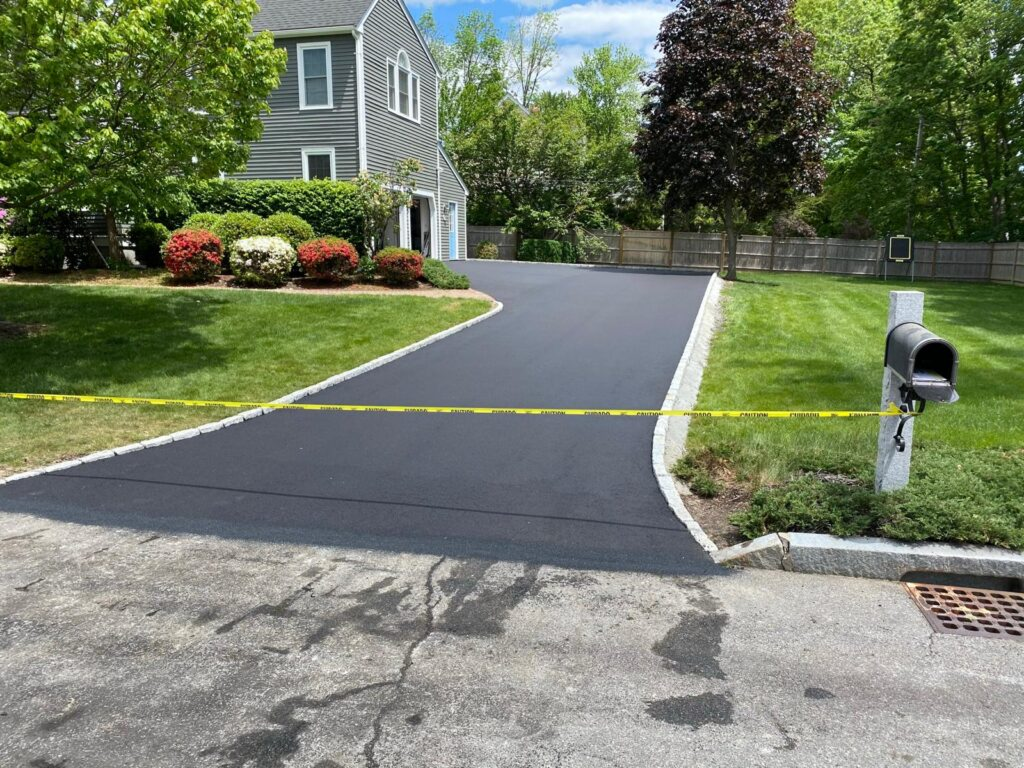
On a sloped Natick drive, water that isn't shedding properly runs toward the low point – often right at the garage – and sits there weakening the base until the asphalt sinks, cracks, and needs timely repair before winter freeze-thaw cycles make it worse.
Root heave from a mature tree near the edge of the driveway shows up as a slow lift, often years after the tree was planted or even removed.
A heavier vehicle than the driveway was built for – a delivery truck, an RV, a dumpster – concentrates weight on a small area and can crack an otherwise sound surface.
Timing matters more than it seems
A crack fixed in October is a small job. Left through a Natick winter, water seeps in, freezes, and expands – turning a simple seal into a full section replacement come spring.
Next step
If you’re dealing with a specific failure on a Natick driveway and want a straight answer—patch, section replacement, or something bigger—call Driveway Specialists at (413) 337-3772. We’ve worked across Middlesex County since 1988 and tell you what we actually see.
Why drives fail in Natick
Natick's ground is unforgiving in a few specific ways.
Steep hillside lots mean water arrives with speed. A sloped drive carries runoff downhill, and where that water meets a low corner, a garage door or the seam of an old patch, it goes down instead of away. Over years that washes out fine material from under the asphalt and leaves the hollows that later sink. On a hillside, drainage decides how long the work lasts.
Shared drives on two-family properties take more traffic than a single-family drive was built for. More vehicles, more turning, more weight on the same few feet. That is exactly where alligator cracking appears first, and where edges break down from vehicles clipping the sides.
Tight frontages put the apron directly against the sidewalk. Plows and shoveling push snow and meltwater straight onto that strip, and the edge there takes constant punishment. It is also the part of the drive most likely to involve the town, so if the damage reaches the apron or the sidewalk line, we will tell you before work begins what is yours to fix and what isn't.
And in every case, frost is the engine behind it. Water enters a small crack, freezes, expands and pries the crack wider. It thaws and drains into the opening, and the cycle repeats all winter. A hairline crack in October can be a pothole by March.

Why timing matters
A crack that is filled this fall is a small job. The same crack left through a winter lets water into the base, and the cost of the repair rises with every freeze. A pothole gets larger as vehicles break its edges away. An edge failure keeps retreating.
Spring is when the damage that has been hiding becomes obvious, and when everyone calls at once. The cheapest repairs happen before that, while the problem is still the size of a hand.
Asphalt repair questions in Natick
Can a pothole be fixed without replacing the whole driveway?
Usually, yes, if the surrounding base is still sound. A pothole is a localized failure – it's cut out and rebuilt as a patch. It only becomes a replacement job if the same pattern is showing up across large parts of the driveway, which points to a base problem that's bigger than one hole.
How do I know if it's a surface crack or a base problem?
Look at the pattern. A single hairline crack or a few parallel lines usually means surface aging. Cracking that forms a web or scale pattern, known as alligator cracking, means the base underneath has already failed and is letting the surface flex.
Why does the edge of my driveway crumble before the middle does?
The edge has less material around it holding it in place, so it's the first area to show weakness if the base wasn't built with enough support there. Plow blades catching an unprotected edge each winter speeds this up.
Is crack filling the same as a repair?
Not quite. Crack filling is maintenance – it keeps water from getting into the base through small cracks. It's worth doing early, but it doesn't fix a section that has already sunk or failed structurally.
Does a sunken spot near the garage mean I need a whole new driveway?
Not necessarily. A sunken section by the garage is often a localized drainage and base issue where water collects at the low point. That section can usually be cut out and rebuilt without touching the rest of the driveway, as long as the surrounding base is holding up.
Next step
Call us at (413) 337-3772. Tell us what you are looking at and where on the drive it is. We will come out, look at the damage and the ground around it, and tell you honestly whether it can be repaired and what that involves.