
Patios in Brookline, MA
Most Brookline lots were never built with a backyard patio in mind. The Victorians and prewar two- and three-families along streets near Coolidge Corner, Washington Square, and the Brookline Village side were laid out for a house and a narrow strip of yard, not outdoor living. If you own one of these properties, the question isn’t whether a patio will fit – it’s how to fit one without fighting the grading, the shade, and the tight access that comes with a dense, old streetscape.
This is hardscape work, not driveway work. A patio succeeds or fails on what happens underneath it and where the water goes once it rains, not on how it looks the day it’s finished. Done right, a stone or paver patio on a Brookline lot holds flat through winter after winter of freeze-thaw. Done wrong, it heaves at the joints, pools water against the foundation, and needs redoing inside a few seasons.
What’s actually under a good patio
Every patio surface – stone, paver, or poured – sits on a prepared base, and that base is what determines whether the surface stays flat. The process is excavation to a consistent depth, a compacted gravel base, a bedding layer, and edge restraint to keep the whole assembly from creeping outward over time. Skip any one of these steps and Massachusetts frost will find the weak point. Ground freezes, lifts whatever’s loose, and thaws unevenly – that’s what pushes a poorly based patio into waves and gaps rather than a tight, even surface.
On Brookline’s older lots, this base work often has to happen in a confined space – behind a house, beside a driveway, between two buildings with barely a few feet of clearance. That changes how material comes in and how compaction equipment gets used, but it doesn’t change what the base needs to do. A patio built on a shortcut base will fail whether the lot is a half-acre in Weston or a tight Brookline backyard; it just fails faster here, because there’s less room for water to spread out and more surrounding structure for it to affect.
Drainage deserves its own attention on these lots. Many Brookline backyards slope gently toward the house rather than away from it, a quirk of how these properties were originally graded decades ago. A patio installed without correcting that pitch just gives runoff a hard surface to ride toward your foundation instead of soil to soak into. Getting the slope right – typically a gentle fall away from the house of a small percentage – along with planning for where water exits the patio area, whether toward a lawn, a drain, or the street side, matters as much as the material on top. This is also where mature trees come into play: root systems common to the older shade trees on these lots can shift a base over time if a patio is built too close without accounting for root flare and future growth.


What Our Clients Say
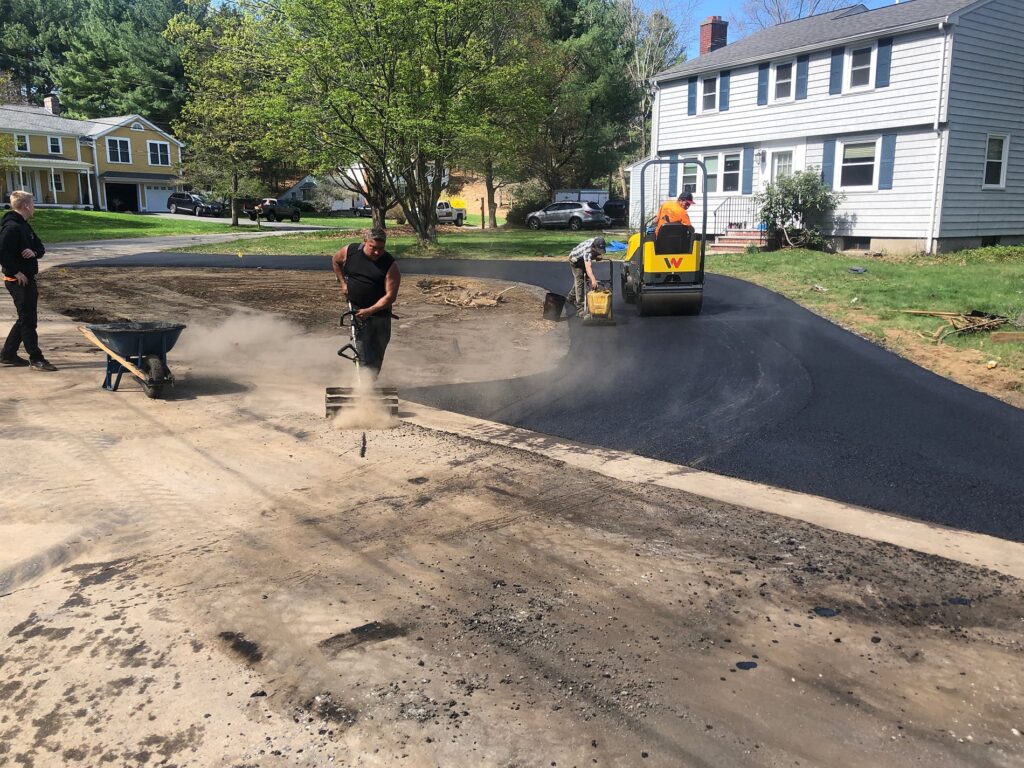
What happens below the surface
A patio is a thin finished layer sitting on a structure you never see. That structure decides whether the surface is flat in ten years or wavy in two.
Material trade-offs
Concrete pavers, natural stone, and poured concrete age and repair differently. No single material suits every Brookline yard – the right pick depends on budget, your home’s look, and how much hand-matching you’re willing to pay for later.
Pavers: even wear, easy fixes
Interlocking pavers handle Brookline's freeze-thaw cycles well because each unit can move slightly without cracking.
Natural stone: character, higher cost
Bluestone or fieldstone suits an older Brookline Victorian or Colonial far better than a uniform paver pattern, echoing the stone walls and foundations nearby.
Poured concrete: simplest, least forgiving
A poured slab is the plainest option and the hardest to repair piecemeal.
Why drainage comes first
Every hard surface sheds water instead of absorbing it. Before any material gets chosen, the patio has to be pitched away from the foundation, or that water ends up in the basement instead of the yard.
Grading on a sloped lot
Brookline's hillier streets near the reservoir and south side mean some yards fall toward the house, not away from it.
Materials and the trade-offs
Tying into an existing driveway
Where a patio meets a paved driveway or a stone path, the transition has to be planned, not patched. A clean edge restraint keeps the two surfaces from drifting apart as each settles differently.
Matching an older house
A Victorian or prewar Brookline house usually has brick, granite, or clapboard detail worth matching.
Working around mature trees
Brookline's older neighborhoods have real tree canopy.
Access on a narrow lot
Many Brookline properties have no side yard wide enough for standard equipment.
Street parking and the work zone
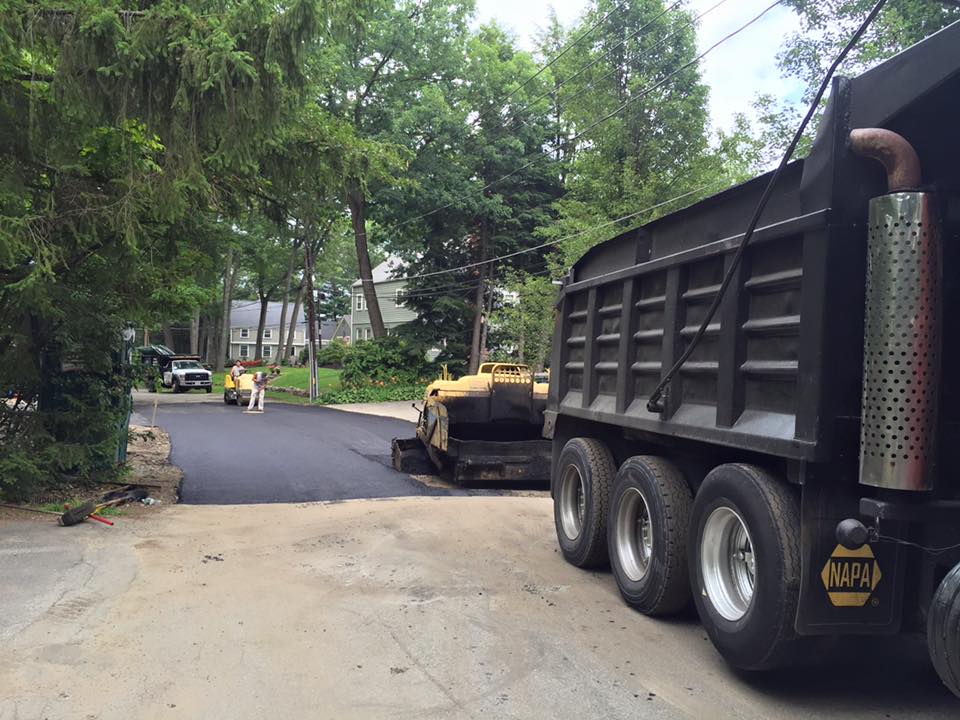
With on-street parking tight in most Brookline neighborhoods, staging material and equipment takes planning before work starts, not improvising once a delivery truck is already on the block.
Historic district considerations
Parts of Brookline fall under local historic district review, which can affect what’s visible from the street – retaining walls, fencing, front walkways, and sometimes paving tied to a front approach or driveway apron. A rear patio set well back from the street typically has far more latitude than anything facing the road or visible from a public way, but it’s worth confirming before design work goes too far, since review timelines can shift a project schedule more than the actual construction does. Material choices and sightlines matter too – some committees care about what’s seen from the sidewalk, not what’s installed behind the house.
Starting the conversation
A patio on a Brookline lot is a planning problem before it’s a materials problem – what the grade does, where water goes, how equipment gets in, and what the house next to it looks like. Triple-decker lots and additions squeezed onto older subdivisions mean many backyards here are narrower and more sloped than they first appear, with retaining walls, mature trees, or a neighbor’s fence a few feet from where the patio edge needs to land. Those answers are different on every street in town, which is why a walk-through of the actual yard matters more than a catalog of paver colors.
Where this suits Brookline properties
Tight rear yards
Narrow Brookline lots with limited side access suit a smaller, carefully planned patio over a sprawling layout, since equipment and material movement are constrained from the start.
Shaded, tree-covered lots
Properties with mature oaks and maples benefit from a base designed around root growth, keeping the surface stable years after the trees keep growing.
Sloped backyards
Lots that fall toward the house need regrading as part of the patio work, directing water away from the foundation rather than masking the problem with surface material alone.
Questions about patios in Brookline
Does a Brookline patio need historic district approval?
It depends on location. Patios set back from the street, especially in rear yards, usually fall outside historic review, but anything visible from the front of the property is worth checking before design work is finalized.
Can a patio go in on a lot with almost no side access?
Yes. Many Brookline properties require material to be moved by hand or with smaller equipment rather than standard machinery. It changes the timeline, not whether the work can be done.
Why does my existing patio have waves or gaps between stones?
That's almost always a base problem, not a surface problem. Without proper excavation, compaction, and edge restraint, New England frost heave pushes the stones unevenly over successive winters.
Should a new patio match my driveway material?
Not necessarily. What matters more is a clean, planned transition between the two surfaces so they don't settle at different rates and separate at the joint over time.
Next step
Tell us what you have: the slope, the house, how the space gets used. We will look at the lot and talk through what will work on it. Call Driveway Specialists at (413) 337-3772. We are family-run and have been working in Massachusetts since 1988.