
Patios in Canton, MA
A lot of Canton properties sit on ground that was never flat to begin with. Post-war subdivisions off the main roads and newer builds closer to the Blue Hills both deal with the same reality: the land falls, often toward the house, and whatever you build on it has to manage water rather than ignore it. A patio here is not just a flat space for a table and chairs. It’s part of how the property sheds water, and if that part is wrong, everything else about the patio is beside the point.
The work that actually determines whether a patio lasts happens before any stone goes down. Excavation to a workable depth, a compacted base layer, bedding material to set the units level, and edge restraint around the perimeter to keep everything locked in place. Skip any one of those steps and freeze-thaw cycling finds it. Massachusetts ground moves every winter. A base that’s compacted properly moves as a unit and comes back flat. A shortcut base lets individual pavers heave, settle unevenly, and open gaps that get worse every winter after. The depth of that base matters too. A patio built on four inches of compacted base behaves very differently from one built on six, especially on the clay-heavy soil found in parts of Canton that holds water longer than sandier ground does.
Material choice is a trade-off, not a style decision. Concrete pavers are the most forgiving option for repair, since a single unit can be lifted and reset without disturbing the rest of the patio, and they come in enough finishes to sit well against most Canton house styles, from colonials near the center to newer construction further out. Natural stone, like bluestone or fieldstone, ages better visually and suits older homes, but it costs more and a cracked piece is harder to match later since quarried stone varies batch to batch. Poured concrete is the cheapest option up front but the least forgiving of movement. On ground that’s prone to any settling, a cracked slab is a full repair, not a single-unit fix. None of these is the right answer for every yard. The right one depends on the house, the budget, and how much the ground under the patio is likely to move.
Drainage is the part that gets skipped when people focus only on the surface material. Once you put a hard, impermeable surface on the ground, rain that used to soak in now runs somewhere. On a lot that falls toward the house, the patio has to be pitched away from the foundation, full stop. That’s not a finishing touch, it’s the reason the patio doesn’t end up causing a basement problem a year after it’s finished. Depending on the grade, that might mean a slight slope built into the base, a drain channel along one edge, or tying the patio’s runoff into an existing drainage path on the property rather than letting it sheet across the lawn toward a neighbor’s yard.
A few things worth asking about before work starts:


What Our Clients Say
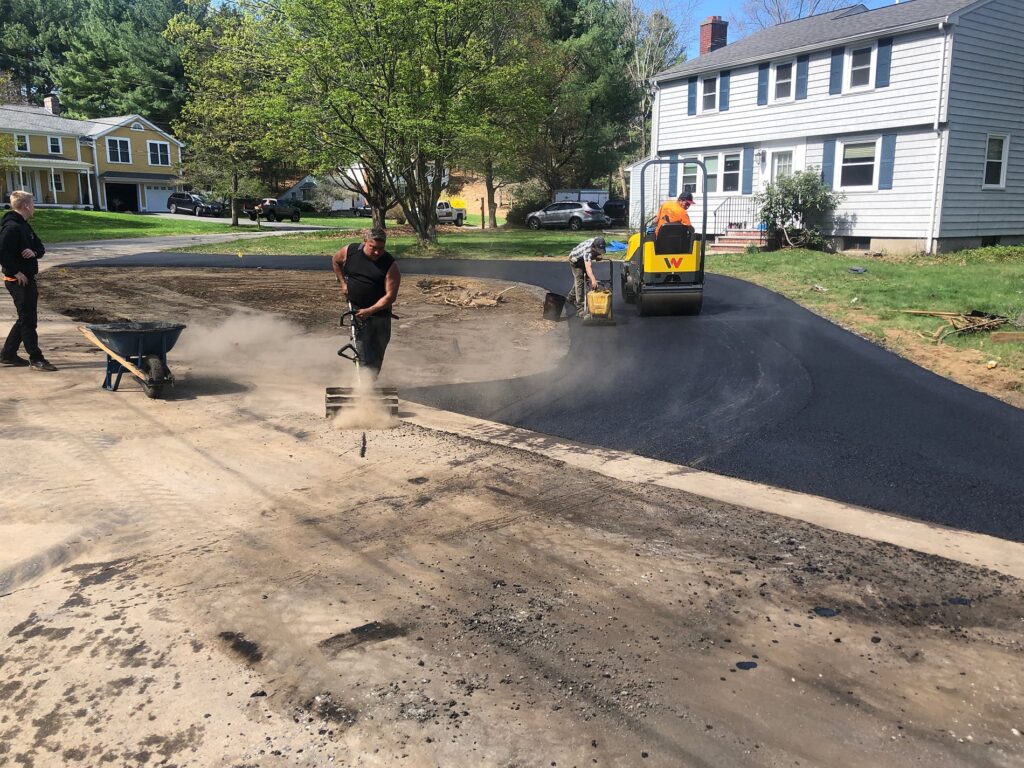
What happens below the surface
A patio is a thin finished layer sitting on a structure you never see. That structure decides whether the surface is flat in ten years or wavy in two.
A patio rarely stands alone. It usually meets a back door, a set of steps, maybe a walkway or an existing wall. Tying the new grade and material into what’s already there is where the planning actually happens.
On a sloped Canton lot, a patio built level with the yard around it can leave a low edge where water collects. Stepping the patio or adding a short wall keeps the surface usable.
Mature trees are common on older Canton lots. Roots near a patio edge can push pavers over several seasons, so base depth and setback from large trees matter more than they first appear to.
Matching a new patio to a Canton home means studying existing stone, brick, and trim before choosing a paver color or pattern, not after installation. We also factor in drainage and grading so the patio drains properly and ages well.
Where a patio meets the driveway or a walkway, the transition between surfaces needs a clean edge detail, or the two will settle at different rates over time.
Access matters on tighter Canton streets. Getting a compactor and material onto a backyard site sometimes shapes the build sequence before design even starts.
Materials and the trade-offs
A Canton patio built near a foundation wall needs the grade checked against the house's own drainage, including where downspouts discharge, before the base goes in.
Fire pits and seat walls add weight and use in one spot.
Some Canton yards have an existing retaining wall from a prior project. A new patio built against it needs its drainage checked separately, not assumed to match.
Newer Canton construction often has engineered grading from the original build. That’s a good starting point for a patio, but it still gets verified rather than assumed to be correct for a hard surface.
Edge restraint and the New England winter
Edge restraint keeps pavers from spreading as Canton's freeze-thaw cycles push and pull the ground beneath them.
Starting a patio project in Canton
The useful first step on a Canton property is walking the site and reading the grade: where water currently runs, where it pools, and how the proposed patio location sits relative to the house and any slope toward the Blue Hills side of town. That tells us the base depth, the drainage plan, and whether a wall or step is needed before material selection even comes up. From there it’s a question of matching material to the house and the budget honestly, including what each option costs to repair years down the line, not just what it costs to install now. If you’re planning a patio on a Canton lot with any grade to it, the right move is to get the site looked at before committing to a material or a layout. Call (413) 337-3772 to talk through the site and get a plan that accounts for the ground you’re actually building on, not a generic layout dropped onto it.
Where this suits Canton properties
Blue Hills-side slopes
Lots that fall toward the Blue Hills need a patio tied into a drainage plan before anything else, since water will find the house foundation if the grade is left to chance.
Post-war subdivision yards
Many Canton yards from the 1950s and 60s have settled, uneven ground and older plantings. A patio here means regrading around what already works rather than starting flat.
Newer construction lots
Newer Canton builds often have engineered grading already in place. That makes tying a patio into existing drainage more straightforward, but it still has to be checked, not assumed.
Questions about patios in Canton
How is a patio different from a driveway in terms of what's needed underneath?
A patio carries foot traffic and furniture, not vehicle loads, so the base doesn't need the depth or compaction a driveway does. But it still needs excavation, a compacted base, and proper edge restraint, because frost heave doesn't care what's walking on the surface above it.
Can a patio go in on a sloped Canton lot without a retaining wall?
Sometimes. It depends on how much the ground falls across the patio area. A small grade change can often be handled by stepping the patio or adjusting the base depth. A steeper drop usually needs a low wall to hold the level and keep water moving where you want it.
What happens if a patio isn't pitched away from the house?
Water sits against the foundation instead of running off, which is exactly the problem a patio should solve rather than create. On Canton's sloping lots this is the first thing we check before any material gets chosen.
Do you match a new patio to an older Canton house?
We look at the existing stone, the entry, and any walls already on the property, and choose a material and pattern that sits with the house rather than against it. Some houses suit fieldstone-style pavers, others suit a cleaner cut edge.
How does frost affect a finished patio over time?
Freeze-thaw cycles move whatever sits in and under the base. If compaction and edge restraint are done properly at installation, the surface moves as one piece and stays flat. If they're not, individual pavers lift and settle unevenly over a few winters.
Next step
Tell us what you have: the slope, the house, how the space gets used. We will look at the lot and talk through what will work on it. Call Driveway Specialists at (413) 337-3772. We are family-run and have been working in Massachusetts since 1988.