
Patios in Maynard, MA
Maynard’s older neighborhoods weren’t built with big yards in mind. The mill-town lots are narrow, the houses sit close to the street and close to each other, and the driveway is often just wide enough for one car. If you’re trying to add outdoor living space on a lot like that, you’re not thinking about a driveway at all. You’re thinking about what to do with the strip of ground beside the back door, or the side yard between your house and the fence line, or the small patch out front that’s currently just grass and a path to the porch.
A patio is the answer to that problem in a way a driveway extension never is. It doesn’t need to connect to a road. It doesn’t need to handle a vehicle’s weight. It needs to sit flat, drain correctly, and hold up through a Massachusetts winter without heaving or gapping. On a tight lot, getting those three things right matters more than the material you pick, because there’s so little margin for error in how water moves once you’ve covered part of the yard in stone or pavers.
What’s actually underneath a patio that lasts
The visible surface, whether it’s pavers, natural stone, or poured concrete, is the last thing installed and the least important part of why a patio holds up. Underneath, the work is excavation to a consistent depth, a compacted gravel base, a bedding layer, and edge restraint around the perimeter. Frost in New England pushes against anything built on soft or inconsistent ground. A patio built on a properly compacted base moves with the frost as a single unit. One built on topsoil or a shallow scrape of sand shifts unevenly, and that’s when you get the waviness, the sunken corner, the paver that rocks underfoot.
On Maynard’s smaller lots, excavation itself is often the constraint, not the design. There’s less room to stage material, less room for equipment to maneuver, and sometimes a patio needs to be hand-built in sections because a skid steer simply can’t get into the space. That changes the timeline and the approach, but it doesn’t change the base requirements. The ground underneath still has to be excavated and compacted correctly, whether it’s done by machine or by hand.


What Our Clients Say
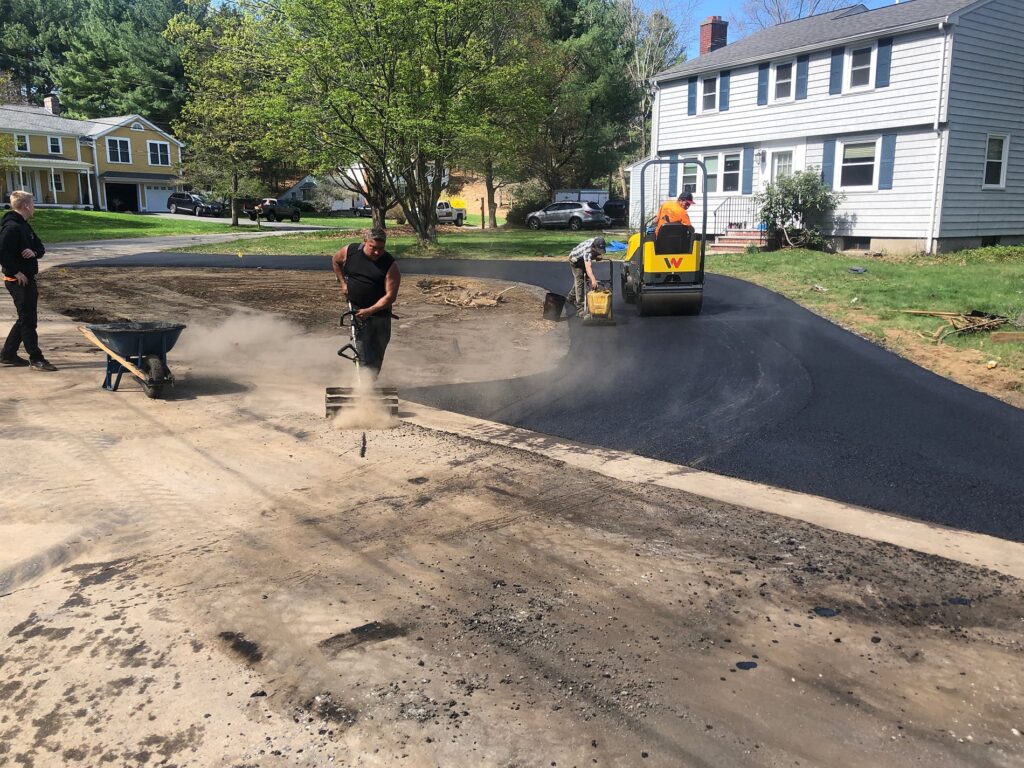
What happens below the surface
A patio is a thin finished layer sitting on a structure you never see. That structure decides whether the surface is flat in ten years or wavy in two.
Materials age differently, and Maynard’s freeze-thaw winters test both. Pavers can be lifted and reset individually if one settles or heaves. Poured concrete can’t be spot-repaired the same way; a crack usually means a visible patch or full section replacement.
Natural stone, like bluestone or granite, costs more up front and has no uniform pattern to repeat, which reads as a more established, less assembled look over time.
Concrete pavers remain the most budget-flexible patio option for Maynard homeowners, offering a uniform, manufactured look that some prefer and others avoid.
None of these materials handle freeze-thaw cycling by themselves. The base underneath does that work, and Maynard's clay-heavy soil makes proper excavation and compaction essential.
Water has to go somewhere once a hard surface replaces lawn. On a tight Maynard lot, that usually means pitching the patio toward the street side or a drainage swale, never toward the house or a neighbor’s foundation.
Grade changes of even an inch across a small patio can be the difference between water draining cleanly and water pooling against a sill or a fence post after every storm.
Materials and the trade-offs
A patio built right against an older foundation needs extra care. Many Maynard homes have foundations that predate modern waterproofing, so keeping water moving away from that wall is a real design priority, not a formality.
Tying a new Maynard patio into an existing walkway, porch step, or low wall means matching elevations carefully.
Older Maynard homes often have brick, stone, or clapboard details worth echoing in a new patio. A bluestone surface or a brick-pattern paver can sit naturally next to a house built decades before either material was installed as hardscape.
Mature trees are common on Maynard's older lots, and nearby roots are a long-term consideration for any patio.
Shade from mature trees also keeps a Maynard patio surface damp longer after rain, which affects material choice. Textured pavers and natural stone handle that better underfoot than smooth, sealed concrete, resisting algae and staying safer in wet, shaded yards.
Where this fits on a Maynard property
Maynard’s housing stock runs toward smaller colonials, capes, and mill-worker cottages built close together, often on lots where the backyard is the only real private outdoor space available. A patio makes sense here specifically because it doesn’t compete with the driveway for room and doesn’t require the kind of open, level acreage that a bigger hardscape project would need. A side-yard patio connecting a kitchen door to a small seating area is a common fit. So is a compact rear patio replacing a patch of lawn that doesn’t get enough sun to grow well under mature trees anyway, which describes a lot of yards in Maynard’s older neighborhoods near the Assabet River.
Starting the conversation
A patio project on a tight Maynard lot starts with looking at the actual ground: where water already moves during a storm, how close the nearest foundation or property line sits, how much slope the yard carries, and what access exists for materials, a small excavator, and spoil removal through a narrow side yard or shared driveway. That assessment shapes the design more than any catalog of paver patterns does. Soil type matters too — Maynard’s mix of clay-heavy and ledge-prone lots behaves differently under a patio base than sandy, well-drained ground, which affects how deep we excavate and compact.
- Drainage patterns and downspout tie-ins
- Setback and property-line clearances
- Equipment access and staging space
- Existing grade, slope, and soil conditions
We walk through each of these before talking materials or layout, because a plan that ignores any one of them tends to cause problems after the first hard rain. If you’re working with a small yard in Maynard and want to know what’s realistic for the space you actually have, call Driveway Specialists at (413) 337-3772 and we’ll walk the site with you.

Where this suits Maynard properties
Mill-town cottages on tight lots
Maynard's older homes often sit close to the street with little side yard. A small patio off the back or side door turns that narrow strip into usable space without competing with the house for room.
Short, narrow driveways
Where the drive is too tight to widen, a patio or walkway alongside it adds outdoor space without touching the paved surface itself, and separates foot traffic from car traffic on a small lot.
Homes set close to the property line
Dense lot layouts mean drainage has to be planned carefully so water moves toward the street or a side yard, not onto a neighbor's foundation a few feet away.
Questions about patios in Maynard
Can a patio fit on a small Maynard lot?
Most of Maynard's lots are small by design, from the town's mill-era layout. A patio doesn't need much room to work; a modest paved area off a back door or side entry is often more usable than an equivalent stretch of lawn, especially where the yard is narrow or shaded.
Will a new patio cause water problems next door?
Only if the grading is wrong. On tight lots where houses sit close together, pitching the patio surface away from both your foundation and the neighboring property is the main design constraint, more than style or material choice.
Does the patio need to match the driveway?
No. A patio and a driveway do different jobs and can use different materials. What matters more is that the patio reads as part of the house, matching brick, foundation stone, or an existing walkway rather than the pavement out front.
What happens to a patio over a Maynard winter?
Frost pushes and pulls on anything built on unprepared ground. A patio built on a proper excavated and compacted base moves as one unit with the freeze-thaw cycle instead of lifting unevenly, which is what causes shifting pavers and gapped joints after a few winters.
Next step
Tell us what you have: the slope, the house, how the space gets used. We will look at the lot and talk through what will work on it. Call Driveway Specialists at (413) 337-3772. We are family-run and have been working in Massachusetts since 1988.