
Patios in Wrentham, MA
Most Wrentham properties share a few things: a long drive back from the road, mature trees on at least part of the lot, and often some distance from a pond or lake frontage. A patio here is rarely an afterthought tacked onto a small backyard. It is usually the main outdoor living space on a property where the house itself sits well back from the street, and it has to work with the woods, the grade, and the age of the house rather than against them.
That changes how the job gets built. A patio going in behind a set-back colonial on a wooded half-acre or more needs excavation, base, and drainage planning specific to that lot; a flat suburban backyard does not have the same root systems, slope, or distance from the house to the nearest low point.
What happens below the surface
The visible stone or paver surface is the smallest part of the job. Underneath it is excavation to the right depth, a compacted base layer, bedding material, and an edge restraint that holds the whole thing together. Massachusetts frost moves the ground every winter. A patio with a thin or poorly compacted base heaves unevenly as the ground freezes and thaws, and by the second or third winter the joints open and the surface goes wavy. A patio built on a properly compacted base moves together, if it moves at all, and stays flat.
Edge restraint matters just as much on a wooded lot as a plain one. Without a solid edge, paver fields creep outward over a few seasons, especially where the ground is soft from shade and leaf litter rather than full sun and turf.
Material trade-offs
Natural stone, concrete pavers, and poured concrete each behave differently through a New England winter. Natural stone costs more up front and ages unevenly in a way that often looks better with time, but individual stones can be harder to source for a repair years later. Concrete pavers are more uniform, generally less expensive, and because they are a system of individual units, a cracked or heaved paver can be lifted and replaced without redoing the whole patio. Poured concrete is the least flexible of the three: it is a single slab, so if frost cracks it or a tree root lifts a section, the fix usually means cutting and replacing that whole section rather than swapping a unit. None of these is the right answer everywhere. A wooded lot with root activity nearby favors pavers precisely because of that repairability.


What Our Clients Say
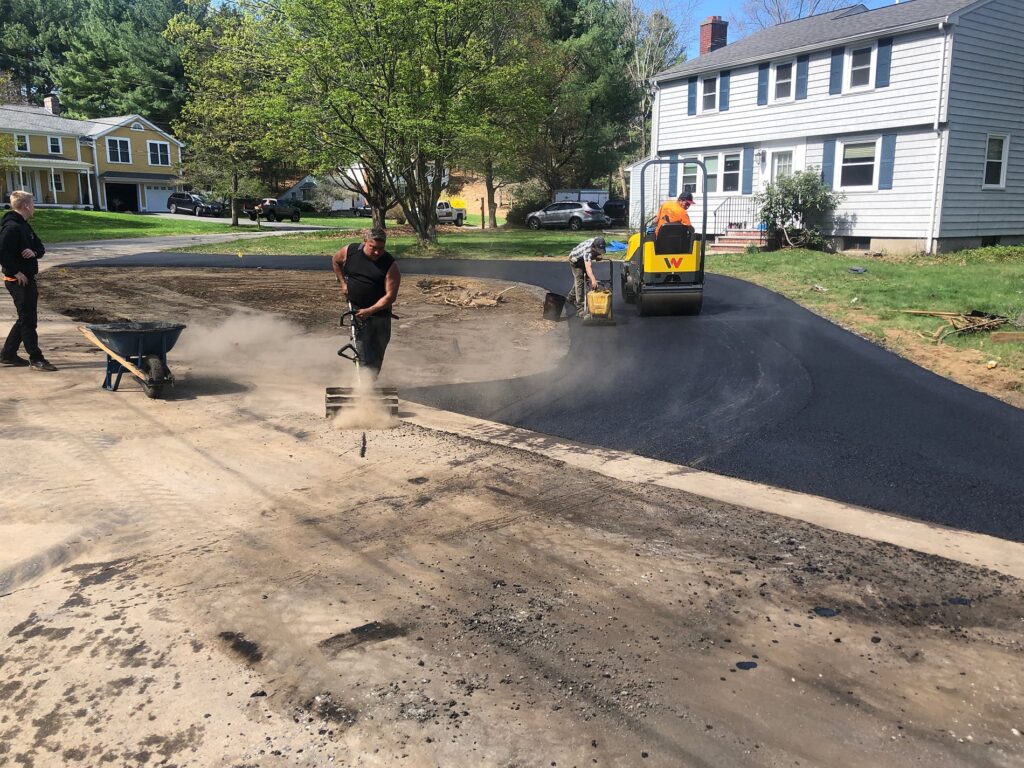
What happens below the surface
A patio is a thin finished layer sitting on a structure you never see. That structure decides whether the surface is flat in ten years or wavy in two.
Water has to go somewhere.
Grade control matters more on Wrentham's sloped, wooded lots.
A patio near a well or septic field needs drainage planned around those systems, not just around the house. That’s common on larger Wrentham lots.
Where a Wrentham patio sits at the low end of a sloped yard, a discreet drain or gravel trench carries overflow safely away during heavy rain, protecting pavers, bedding sand, and nearby foundations from erosion, pooling, and the frost heave that New England winters bring.
Tying a new Wrentham patio into an existing stone wall or planting bed means matching joint width, coursing, and stone tone carefully, so the new paving reads as original work rather than something stapled on as an afterthought.
Where a Wrentham patio meets the back door or an existing walkway, the transition in height, material, and drainage has to be deliberate, not an afterthought.
Materials and the trade-offs
On older Wrentham homes, a patio built with irregular stone in a traditional running pattern tends to look original to the property, while uniform, bright pavers usually look bolted on.
Matching mortar color and stone tone to existing foundation stone or an old stone wall keeps a new patio from reading as a recent addition.
On a Wrentham lot with mature oaks or maples near the planned patio, the layout shifts slightly to avoid major roots rather than cutting through them, protecting tree health while keeping the base stable, properly sloped for drainage, and built to last through New England winters.
Shaded Wrentham patios under heavy tree cover stay damp longer after rain, encouraging moss and algae growth.
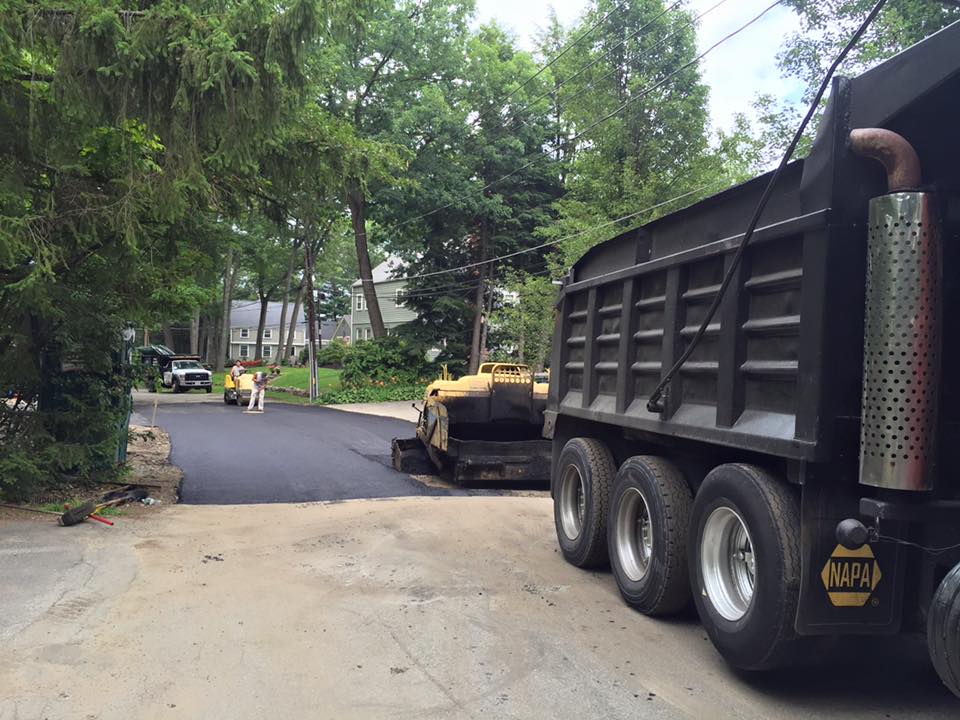
A long, wooded driveway means equipment access has to be planned before excavation starts, not worked out on the day.
Fitting the patio to what's already there
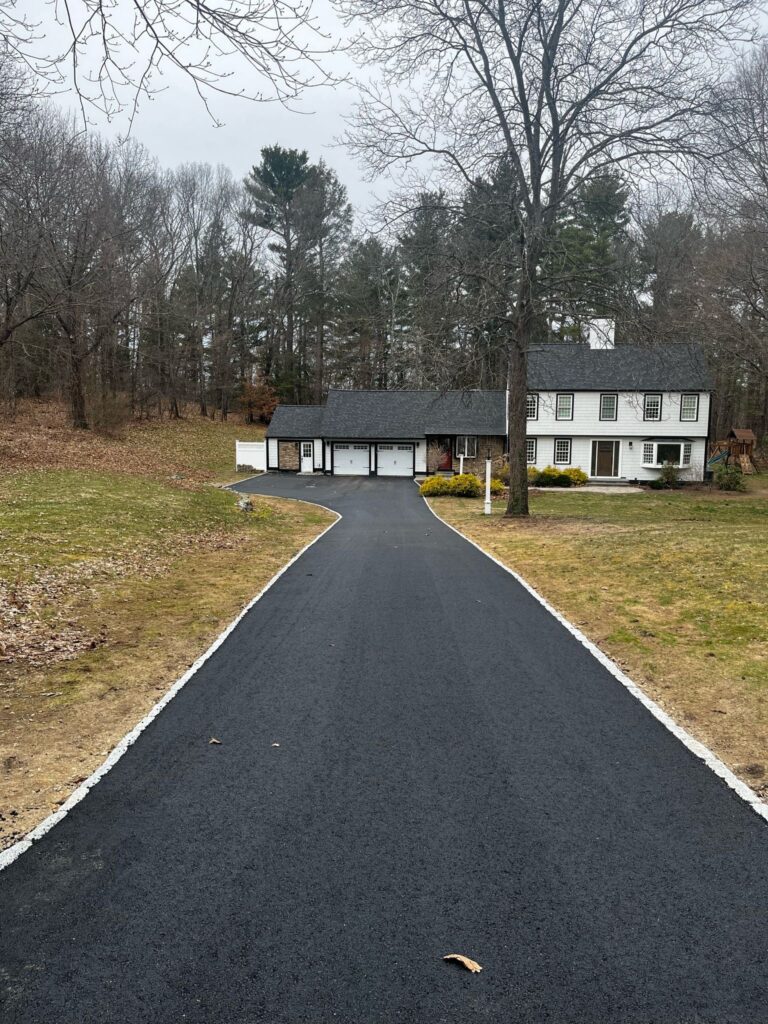
Few patios in Wrentham go into a blank yard. There is usually a driveway already in place, an entry walk, maybe an existing stone wall or a planting bed that has been there for years. The new patio has to sit against all of that without looking like a separate project dropped on top.
That means matching stone tone or paver color to what already exists where possible, keeping joint widths consistent with any nearby walkway, and thinking about sightlines from the house and the drive. On a property with a long approach, the first clear view of the patio is often from partway down the driveway rather than the back door, so the layout gets planned with that in mind.
Getting started
A patio on a Wrentham property is as much about the ground it sits on as the stone or pavers on top. Lot size, slope, tree cover, and proximity to a pond or well all shape the right approach before any material gets chosen. Many Wrentham lots carry heavier clay soils and seasonal wet spots near low-lying yards, which means drainage planning and a properly compacted base matter more here than the surface layer itself. A site visit is the fastest way to see what the lot actually needs: where water naturally moves, how close roots run under a proposed footprint, and whether the grade needs correcting before any base goes down.
Getting started usually involves:
- Walking the site to check slope, drainage, and tree root interference
- Discussing material options suited to the home’s age and style
- Reviewing base depth and compaction needed for the specific soil
- Rough sizing and layout against how the space will actually be used
Call Driveway Specialists at (413) 337-3772 to talk through a Wrentham patio project, from layout through the base work that decides how well it holds up through winters and years ahead.
Where this suits Wrentham properties
Lakeside frontage lots
Properties near Lake Pearl and Wrentham's ponds need patios set back with grading that keeps runoff away from the shoreline and out of the house foundation.
Long wooded drives
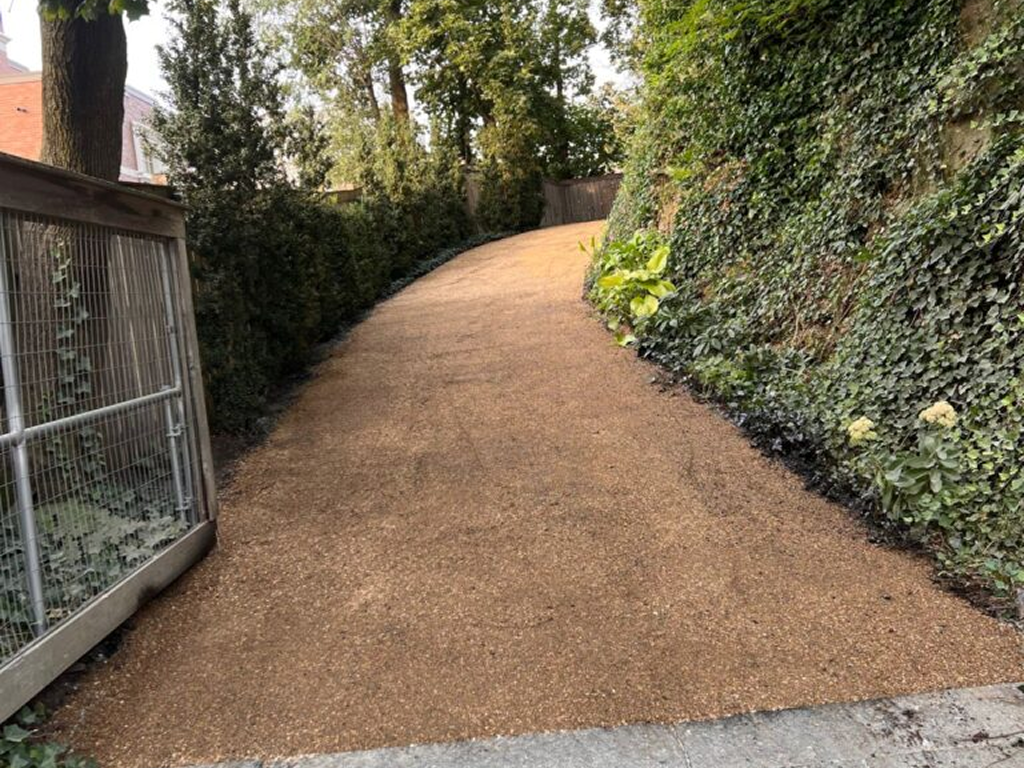
A patio at the end of a long drive becomes the main outdoor space when the front yard is mostly trees. Root-aware excavation keeps mature trees healthy nearby.
Older homes set back
Set-back colonials and farmhouses common in Wrentham call for a patio material and edge style that reads as original to the property, not added on.
Questions about patios in Wrentham
What is the difference between a patio and a paved driveway project?
A driveway is engineered for vehicle load and daily wear. A patio is built for foot traffic, furniture, and standing water management, which means a different base depth, different jointing, and more flexibility in material choice since it is not carrying a car.
Can a patio be built near mature trees without harming them?
Yes, with care. Excavation depth and the line of the patio edge are adjusted to avoid major roots, and in some cases the patio is set slightly away from the trunk rather than cutting straight through the root zone.
How does a patio handle a sloped, wooded lot like many in Wrentham?
The patio itself is built level, but the base and perimeter grading are shaped to carry water around and away from the slab rather than letting it pool against the house or run toward a foundation.
Will a new patio match an older farmhouse or colonial?
Material and edge choice do most of the work. Irregular natural stone or a muted paver in a traditional pattern reads as original to an older house, where a bright, uniform paver usually does not.
How long does a typical patio installation take?
It depends on size, access, and how much excavation and grading the site needs. A wooded or sloped Wrentham lot with limited equipment access generally takes longer than a flat, open yard.
Next step
Tell us what you have: the slope, the house, how the space gets used. We will look at the lot and talk through what will work on it. Call Driveway Specialists at (413) 337-3772. We are family-run and have been working in Massachusetts since 1988.