
Retaining Walls in Bellingham, MA
Bellingham has two kinds of lots that both end up needing a wall. The newer subdivisions off the main roads sit on larger parcels with wide drives and graded yards that often step down from the house pad toward the street or a back corner. The older homes toward the Rhode Island line sit on rural roads with less uniform grading, where the ground was never cut flat to begin with. Both situations create the same problem: a slope that’s wasting usable yard, eroding at the edges, or pushing water somewhere it shouldn’t go. A retaining wall solves that by holding the grade where you want it instead of where it naturally wants to settle.
This is different work from fixing a cracked driveway. You’re not repairing a failure, you’re building something new to create usable, stable ground. That changes how we think about the job. It’s as much about how the wall reads against your house and landscaping as it is about function, and the two aren’t separate decisions. A wall that holds soil but looks out of place, or drains badly and heaves apart in three winters, has failed at the actual job even if it’s still standing.
What holds it up isn’t what you see
The visible face of a wall is the smallest part of the work. What decides whether it stays flat or starts leaning is everything behind it: how deep the base is excavated, what the base material is, how well it’s compacted, and whether water has somewhere to go once it hits the back of the wall. Massachusetts frost is the reason this matters so much. Water sitting behind a wall freezes, expands, and pushes. A wall with no drainage path takes that push every winter until something gives, usually a bulge partway up the face or a section that starts to lean outward from the top. A wall with proper backfill and a drainage path behind it moves the water down and away before it has the chance to freeze against the structure.
Compaction matters just as much as drainage. Loose base settles unevenly under the weight of the wall and the soil behind it, and an unevenly settled wall goes wavy along its length even when the materials themselves are sound. Getting this right the first time is cheaper than it sounds, and almost impossible to fix later without taking the wall apart.


What Our Clients Say
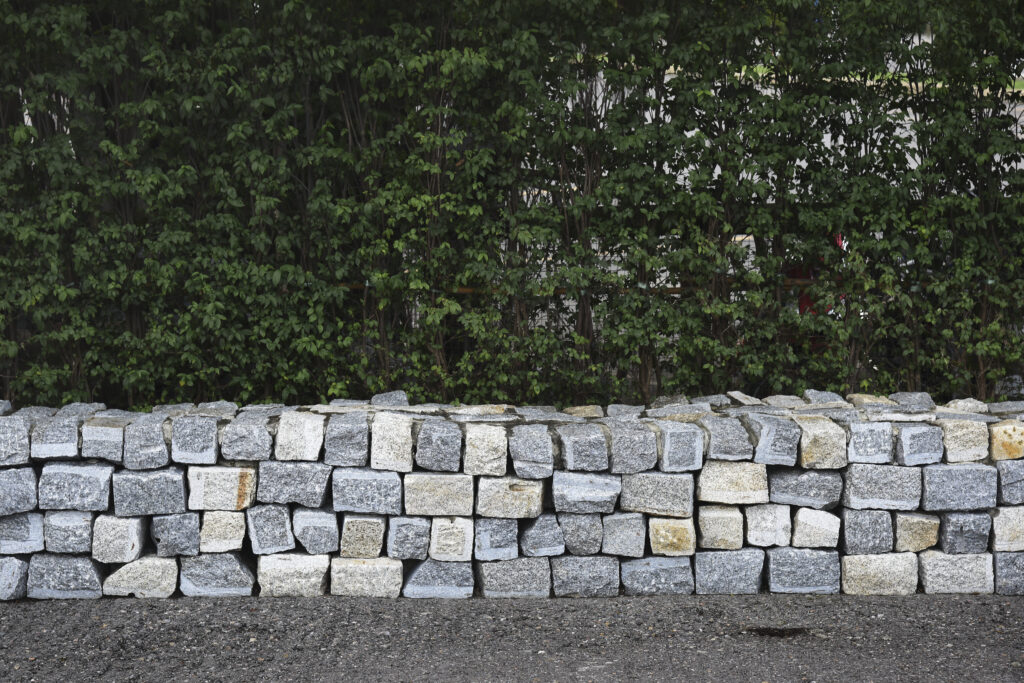
What holds a wall up is underground
The part you see is the smaller part of the job. Below it, the work runs in a fixed order.
Drainage behind the wall

Choosing the material

Questions we get asked
Does a retaining wall in Bellingham need an engineer?
Taller walls, or walls holding back a slope near a structure or driveway, often need an engineered design rather than a standard gravity build. Shorter garden and grade walls usually don't. We'll tell you honestly which category your project falls into before any work starts.
What wall material holds up best to Massachusetts winters?
Segmental concrete block and natural stone both perform well if the drainage and base behind them are done correctly. Timber walls are the most affordable upfront but degrade faster and are harder to repair in sections once they start to fail.
Can a retaining wall help with a wet yard in Bellingham?
It can, if it's designed with drainage in mind rather than just as a soil-holding structure. A wall built with a gravel backfill and an outlet gives water somewhere to go instead of pooling against the foundation or low points in the yard.
How does a new wall tie into an older Bellingham home?
Material and cap choice do most of the work. A stone or block color and profile that echoes the house's age and trim, rather than contrasting with it, usually reads as original to the property instead of added on.
Next step
Call us and we will come look at the slope, the access and the water. We will tell you what the wall needs and what it will cost to do properly.