
Cobblestone Aprons and Edging in Framingham, MA
Framingham properties cover a lot of ground, and the right apron or edging detail changes depending on which part of town you’re in. On the dense two-family streets north of downtown, a cobblestone apron is often the only hardscape move that fits: a narrow band between sidewalk and drive where the transition has to look finished and hold up to tight turning from cars parked nose-in off the street. In the post-war subdivisions through the middle of town, it’s usually about framing an existing asphalt or paver drive that looks unfinished without a defined edge, especially on corner lots where the drive is visible from two directions. On the larger lots south, cobblestone edging does more work along borders, planting beds and the sweep where a driveway meets a front walk, often tying into stone walls or plantings already on the property.
This is not a repair job and it’s not about fixing a failing surface. It’s about the transition points on your property: where the street meets the drive, where the drive meets the walk, where a lawn meets a bed. Cobblestone, whether reclaimed granite or a manufactured concrete unit cut to look like it, is the material most homeowners reach for because it reads as permanent and traditional in a way poured concrete or plain asphalt edging doesn’t. Reclaimed granite costs more and takes longer to source, but it carries a weight and texture that a manufactured unit, however good the casting, doesn’t quite match on an older colonial or a period-appropriate rebuild. On newer construction, a clean manufactured cobble is often the better fit anyway, since it doesn’t fight with the rest of the house.
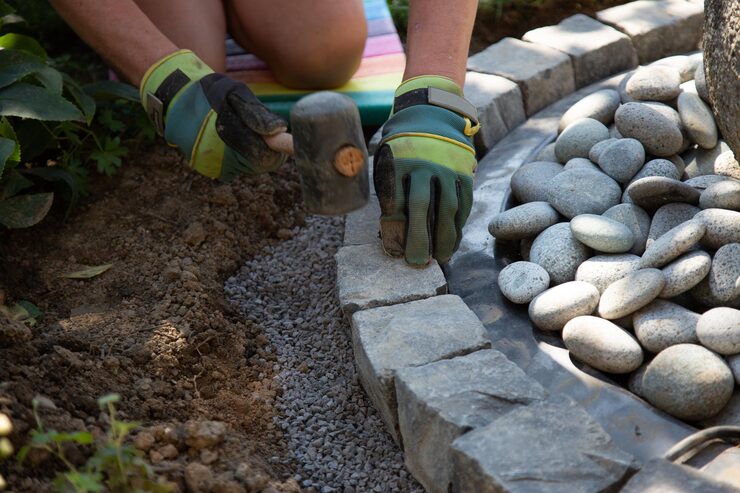
None of that look matters if the installation underneath is wrong. A cobblestone apron carries real weight and turning load, not just foot traffic, so it needs excavation to a stable subgrade, a compacted base deep enough to spread that load, and a bedding layer the stones sit into. The piece most installers skip, or do badly, is edge restraint. Without a buried restraint on both sides of the run, the stones migrate outward under traffic and frost, and within a couple of seasons the crisp line you paid for is gone, replaced by gaps that catch mulch, gravel and plow blades alike.
In Massachusetts, frost is the real test. Ground freezes, heaves, and drops back down unevenly across a run of stone. A base built to drain, rather than hold water that then freezes and lifts the unit above it, is what keeps an apron flat instead of wavy. This matters more on the shaded, tree-lined streets common across Framingham, where soil stays damp longer into the season and freeze-thaw cycling runs harder than it does on an open, sunny lot. Drainage planning also has to account for how water actually moves across your specific lot, not a generic grade:
- Where runoff from the roof and drive naturally collects along the apron or edging line
- How snowplow passes and shoveling will treat the stone edge over a full winter
- Whether tree roots nearby are likely to disturb the base within a few years


What Our Clients Say
What the work involves below the surface
The stone is the last and smallest part of the job. A cobblestone apron stays flat or goes wavy depending on what is underneath it.
Reclaimed granite cobblestone costs more upfront, ages with a worn, irregular character, and can be reset stone by stone if one shifts. Manufactured concrete costs less, ages uniformly, but a cracked unit usually means replacing the whole section.
Every hard surface sheds water instead of absorbing it. In Framingham, a cobblestone apron or edging run has to carry that water away from the foundation and off the drive, not pool it at the garage threshold or front walk.
Grade is set before a single stone goes down. Get the pitch wrong and water finds the lowest point, usually right where you don’t want standing water in January.
New cobblestone has to read as deliberate next to what’s already there: the driveway surface, an existing walkway, a retaining wall, or foundation plantings it now borders.
On an older Colonial or Cape common across Framingham, a granite-look edge often suits the house better than a sharp, modern concrete line would.
Materials and the trade-offs
Matching the house and the street
Framingham’s housing stock spans a wide range of ages and styles, often block by block. A cobblestone apron that works outside a 1920s two-family near the center can look wrong outside a 1990s colonial a mile away, and the reverse is just as true. Stone size, joint width, and whether the units are tumbled or sharp-edged all signal age, and matching that to the house is as much a part of the job as the base work underneath. We also look at what borders the new work: an existing concrete walk, a stone retaining wall, a planting bed edge. The goal is a run that looks like it belongs, not an add-on.

Street-to-drive aprons
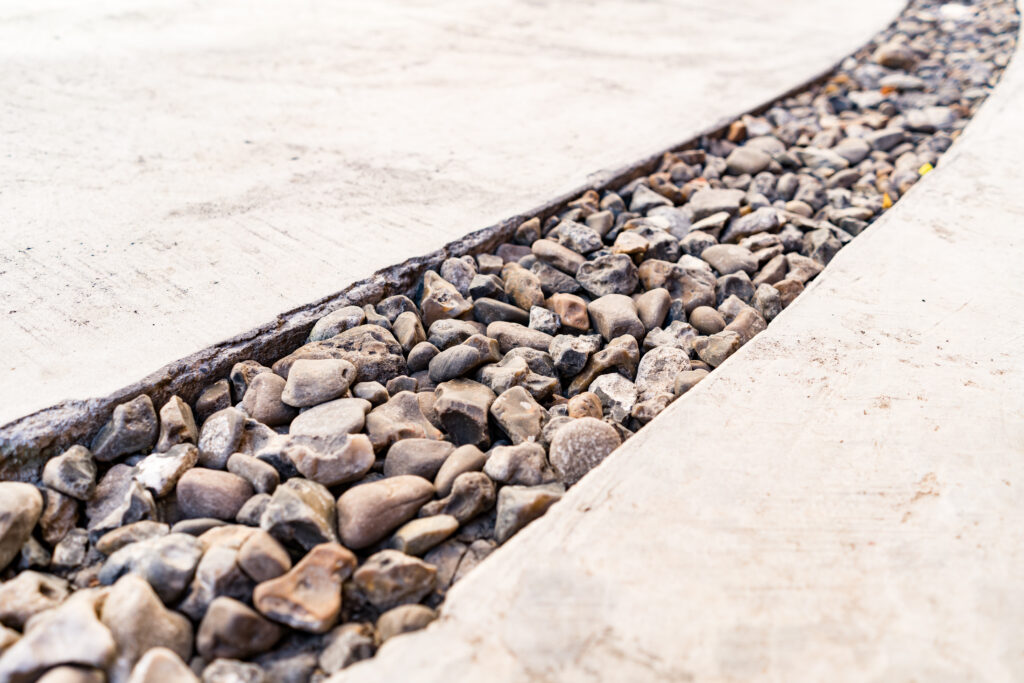
An apron sits at the point where your driveway meets the road, and in Framingham that road could be a town-accepted street or a private way, which changes who has say over the curb cut and the apron’s edge. On the narrower, denser streets north of downtown, the apron is often the single most visible hardscape feature on the whole property, framed tight between sidewalk and garage. That’s exactly the spot where cobblestone earns its keep: a defined, durable border on a strip too small for much else. The base work matters more here, not less, because turning traffic concentrates stress right at that transition.
Further out, where lots open up and setbacks grow, an apron has room to breathe and can run wider, sometimes stepping out to meet a circular or horseshoe drive. The principle underneath doesn’t change: excavate to stable ground, build a compacted base that drains, bed the stone properly, and restrain both edges so the run holds its line through freeze-thaw instead of spreading.
Edging for walks, beds and borders
Away from the driveway, cobblestone edging does different work: framing a front walk, defining a planting bed, or stepping down a slope on the larger lots south of town. These runs carry less load than an apron, but they still need a real base and buried restraint, because frost heave doesn’t care whether the stone is under a car or under a hosta bed. A shallow, mortar-only edge set on topsoil looks fine the first spring and then tilts, separates, or walks itself out of line by the second winter, usually right where a sprinkler head or downspout keeps the soil wet.
Where a property already has mature plantings or an older brick or bluestone walk, we set the cobblestone to match the existing joint pattern and stone tone rather than introduce a second competing material. Where it’s starting from scratch, the stone choice gets driven by the house era and by how much upkeep the owner actually wants to take on over time.
Where this suits Framingham properties
Dense two-family streets
Narrow frontages near the center of town where a tight, well-defined apron is the only hardscape move that fits, and turning traffic puts real stress on the edge.
Post-war subdivisions
Mid-century lots where an existing asphalt or paver drive often needs a defined cobblestone border to look finished and to stop the surface edge from eroding.
Larger lots to the south
More open properties where cobblestone edging frames walks, beds and slopes, with room for wider runs and more decorative border work.
So tar and chip suits a longer, gentler Framingham drive with some room around it. It is a poor match for a short, steep or shared one, or one that opens straight onto the walk.
Questions we hear
Is a cobblestone apron the same thing as fixing a driveway?
No. An apron or edging project addresses the transition points and borders on your property, not the condition of the driveway surface itself. If your asphalt or pavement is failing, that's a separate repair conversation.
Can cobblestone edging be added to an existing driveway without redoing the whole drive?
Usually yes. Edging is installed along the perimeter of the existing surface, so the drive itself doesn't need to be torn out, as long as the base beneath the new edge is properly excavated and compacted.
Does the apron at the street need town approval in Framingham?
That depends on whether you're on a town-accepted road or a private way. Work at a curb cut on an accepted street involves the town; on a private way, it's between the owners.
How does New England winter affect cobblestone edging?
Freeze-thaw cycling is the main threat. Ground that freezes and heaves unevenly will shift stone that isn't set on a proper compacted base with buried edge restraint, which is why that underground work matters more than the stone itself.
Can a damaged section of cobblestone be fixed without redoing the whole run?
With natural granite cobblestone, individual stones can often be reset or replaced in place. Manufactured concrete units are more likely to need a full section replaced if one is cracked or badly shifted.
Next step
Call us at (413) 337-3772. Tell us about the lot, the slope and what you want the frontage to look like. We have been working in this area since 1988, and we will tell you plainly what suits your property.