
Cobblestone Aprons and Edging in Lincoln, MA
A long drive winding through trees to a house that sits well back from the road is normal in Lincoln. The point where that drive meets the street is often the only part of the property a passerby ever sees, and it’s also the part that takes the worst punishment: plow blades, runoff, road salt, and frost pushing up from underneath every winter. A cobblestone apron at that transition, with proper edging along the drive itself, is a way to make that point hold its shape and look like it belongs on a wooded lot rather than a suburban one.
This is hardscape work, not a driveway repair job. Nobody needs a cobblestone apron. People choose one because the stock asphalt-to-road transition looks wrong against a stone wall, a gravel edge, or an older farmhouse, and because a loose, spreading edge is an ongoing maintenance headache on a property this size.
What’s happening below the stone
Cobblestones that stay flat and tight for years, and ones that heave and separate after two winters, are built the same way on top. The difference is underneath. Massachusetts frost pushes and drops the ground every freeze-thaw cycle, and anything set directly on native soil moves with it. That means excavating below frost influence, laying a compacted gravel base that drains instead of holding water, bedding the stones in a layer that lets them sit tight against each other, and running a solid edge restraint along both sides so the whole assembly can’t creep outward under its own weight or a plow blade.
Skip any one of those steps and the apron still looks fine the first season. By the third, individual stones rock underfoot, gaps open, and the edge line wanders. Reclaimed granite cobbles, which many Lincoln homeowners prefer for the weathered look that matches an older stone wall or a fieldstone foundation, are heavier and more irregular than new-cut block, so the base work underneath has to be even more exacting to keep the coursing tight.
Where water goes
A hard surface doesn’t absorb anything, so once you pave a transition, the water that used to soak into the ground has to go somewhere else. On a Lincoln lot that usually means pitching the apron gently away from the garage or the house and letting it shed toward the existing grade or a drainage swale, not toward a foundation or a neighboring tree’s root zone. Getting this wrong is the single most common reason a brand-new apron develops a standing puddle or a slick ice patch by the following winter.


What Our Clients Say

What the work involves below the surface
The stone is the last and smallest part of the job. A cobblestone apron stays flat or goes wavy depending on what is underneath it.
On a long Lincoln drive bordered by conservation-adjacent woods, tree roots, leaf litter and deep shade change how edging is built and how quickly moss and algae take hold, so we choose a cobblestone apron base and finish built to shed damp and resist root movement.
Granite cobbles read as permanent and age well against Lincoln's stone walls and brick frontages. Concrete pavers cost less up front but show wear sooner in damp, shaded settings.
A steel or granite edge restraint holds a gravel drive's margin tight, stopping loose stone from migrating onto the apron every time a plow passes.
Matching new stonework to an existing Lincoln wall or an older farmhouse’s fieldstone means choosing a cobble color, size, and laying pattern that sits quietly rather than competing, while still framing the driveway edge with a crisp, durable, well-defined border.
Where a Lincoln driveway apron meets a town-accepted road, the curb cut and immediate transition fall under the town’s jurisdiction; everything behind that line is yours to design, from cobblestone pattern and edging style to border width and overall finish.
Materials and the trade-offs
Materials and the trade-offs
Granite cobblestone is the traditional choice for this kind of property. It’s heavier and costs more to source and set than a concrete paver, but it doesn’t fade, chips rather than crumbles, and individual stones can be lifted and reset decades later if a root or frost heave pushes one out of line. Concrete pavers cost less initially and come in more shapes, but the surface finish wears thinner over time, especially where shade keeps the stone damp through most of the year.
Reclaimed granite, when it’s available, splits the difference: it already has the worn, settled look a new quarried cobble takes years to develop, which matters on a property where the house itself may be a century old. Whichever material is chosen, the edge restraint matters as much as the stone. A loose or shallow edge lets the whole field spread sideways under frost and vehicle weight, no matter how good the stone itself is.


Tying into what's already there
Most of this work on Lincoln lots isn’t a stand-alone project. It has to read as part of a drive, an entry, a stone wall, or existing plantings that were put in years or decades ago. That means matching mortar color if there’s existing masonry nearby, picking a cobble size that doesn’t look undersized or oversized next to an existing wall cap, and deciding how the apron edge meets a gravel or asphalt drive surface without a visible seam that catches a plow blade or a snow shovel.
On a wooded lot this also means working around root zones without cutting through them, since a mature oak or maple’s roots often extend well past the canopy and a severed root can kill a tree slowly over several seasons. Planning the excavation path before any digging starts avoids that problem.
Where this fits on a Lincoln property
Long private drives through wooded or conservation-adjacent land are the most common reason this work comes up in Lincoln. A street-end apron is the one piece of hardscape a passing car actually sees, which is why owners want it to look intentional rather than like a patch of asphalt dropped at the road. Cobblestone aprons and edging also do practical work at that transition point: they define where town-maintained road ends and private drive begins, which matters on the older, narrower lanes common around Lincoln Center and the conservation land trails. The same logic extends to Weston and Carlisle properties with similar frontage, where the drive itself is set well back and shaded most of the day, so stonework at the entrance carries more visual weight than anywhere else on the property.
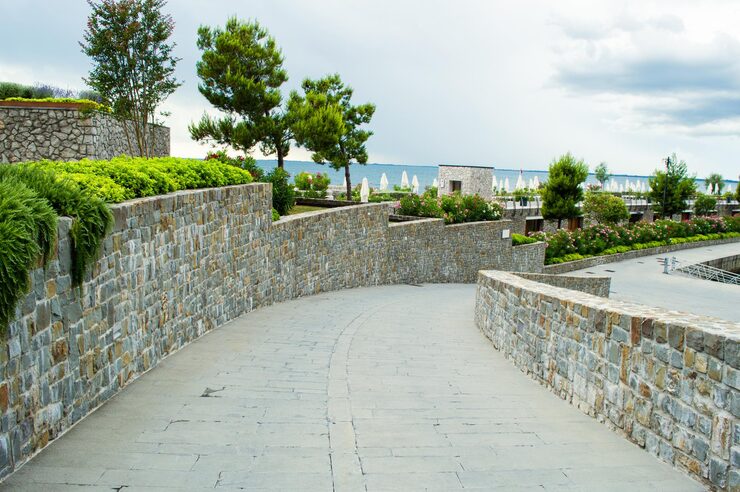
Where this suits Lincoln properties
Long woodland drives
A drive that disappears into trees needs an apron detail that looks deliberate from the road, not like leftover asphalt patched against gravel or stone.
Conservation-adjacent lots
Where setbacks and tree cover limit what can change near the street, a cobblestone transition keeps the entrance low-key while still solving the drainage and edge problem.
Older stone-wall properties
Houses with existing fieldstone walls or granite posts call for a cobble size and color that sits alongside that stonework instead of looking newly dropped in.
So tar and chip suits a longer, gentler Lincoln drive with some room around it. It is a poor match for a short, steep or shared one, or one that opens straight onto the walk.
Questions we hear
How is a cobblestone apron different from paving a driveway?
A driveway surface carries the full weight and traffic of the drive itself. An apron is the transition at the street, usually a shorter run of stone set for looks and durability where the drive meets the road, built on the same excavation and base principles but on a much smaller footprint.
Will tree roots near the road cause problems?
They can if the excavation path isn't planned around them. On wooded Lincoln lots we map the likely root zone of nearby mature trees before digging, so the apron goes in without cutting roots that could weaken or kill the tree over time.
Can edging be added to an existing gravel drive without redoing the whole drive?
Yes. Edge restraint can be installed along the margins of an existing gravel drive to stop stone migration without touching the drive surface itself, which is often the more practical fix for a long private drive.
Does the town have any say over apron work at the street?
Where the apron meets a town-accepted road, the curb cut and immediate transition fall under the town's jurisdiction. On a private way, the design is the owner's decision. We can talk through which applies to your specific frontage.
Next step
Call us at (413) 337-3772. Tell us about the lot, the slope and what you want the frontage to look like. We have been working in this area since 1988, and we will tell you plainly what suits your property.