
Cobblestone Aprons and Edging in Millis, MA
Most driveways in Millis share the same approach: a long run of asphalt or gravel coming off a country road, cutting through wooded frontage, arriving at a house set well back from the street. The weak point is almost never the middle of that drive. It is the first few feet, where the surface meets the road, and the edges that run the length of it. A cobblestone apron and proper edging fix that transition and give the whole approach a finished line it has probably never had.
This is not about patching a failing driveway. It is about improving how the property reads from the road and how the edge holds up once it is there. On a lot with mature trees and a drive that runs a long way before you see the house, that first impression carries a lot of weight, and it is also the spot that takes the most abuse: plow blades, delivery trucks swinging wide, cars braking before the turn in.
What holds the stone in place
A cobblestone apron that looks right in year one and still looks right years later is built below the surface, not on top of it. The area gets excavated past the topsoil and any old base material, down to ground that will not shift. A compacted stone base goes in, built up in layers rather than dumped and leveled once, because a base that is not compacted in stages settles unevenly later. A bedding layer of sand or stone dust sits on top of that, giving the cobbles a surface they can be set into and adjusted on, fraction by fraction, to get the joints and grade right.
Edge restraint is what keeps the whole thing from migrating outward over time. Without it, cobbles at the perimeter work loose under tire weight and frost, and the pattern slowly opens up. With a proper restraint tied into the base, the apron holds its line through freeze-thaw cycles instead of spreading a little more each winter.
Frost is the part most people underestimate. Massachusetts ground freezes and heaves, then thaws and drops, every winter. An apron with a shallow base and no real edge detail moves with that cycle until the joints widen and stones tip. One built with a proper base and compacted edge restraint is designed to move as a unit instead, which is the difference between a feature that lasts and one that needs rework in a few years.


What Our Clients Say

What the work involves below the surface
The stone is the last and smallest part of the job. A cobblestone apron stays flat or goes wavy depending on what is underneath it.
Granite cobbles hold their edge and color for decades but cost more up front. Concrete pavers cost less initially, fade sooner, and are simpler to pull and reset if one cracks.
Reclaimed cobblestone already looks settled, which suits an older Millis farmhouse better than a crisp, uniform product straight from a supplier yard.
Belgian block edging reads as a strong, simple line against lawn or gravel, and it survives a plow blade far better than a soft lawn edge does.
Water has to go somewhere once a hard surface replaces bare ground.
Grading the apron so it sheds water sideways, into the lawn or a shallow swale, keeps runoff off the driveway surface and away from the house entirely.
Materials and the trade-offs
Cobblestone work rarely stands alone. It usually meets an existing asphalt or gravel driveway, a front walk, or a retaining wall, and the transition between materials has to be planned, not improvised on site.
Where the apron meets an asphalt drive, the stone needs a clean, level edge to butt against, set at the same height so there is no lip to catch a plow or a tire. Where it meets a walkway or steps, matching the joint pattern or stone size keeps the whole entry looking like one job instead of two unrelated projects.
Older Millis homes often already have some stone or masonry on the property, a wall, a well cover, a foundation detail. Matching tone and texture to that existing material, rather than picking the newest-looking stock available, is what makes an apron look like it belongs rather than like an add-on. That matters more on a property with history than on a newer build with no existing character to work around.


Long, wooded frontage is the defining feature of most Millis lots, and it changes how this work gets planned. A drive that runs a hundred feet or more through trees before reaching the house means the apron at the road is seen in isolation, often without the house itself in view. That apron has to work as a stand-alone statement, not as part of a composition with the front door.
Root systems from mature oaks and maples near the road edge also affect where excavation can happen without disturbing a tree people clearly want kept. A shaded apron near heavy tree cover stays damp longer after rain, which is why the base and drainage work underneath matter more here than on an open, sunny lot. Get the base wrong under shade and moisture sits in it far longer each time it rains.
Set-back homes on quiet country roads also mean less daily traffic and fewer vehicles turning across the apron, worth factoring into material choice. A lighter-duty cobble layout can make sense where a heavily trafficked urban apron would need a heavier edge detail.
If you are looking at the stretch where your driveway meets the road, or an edge that has never had a proper line, that is exactly the kind of work this is. Millis properties often have that gap between a worn asphalt apron and the street, and cobblestone closes it with something that reads as finished rather than patched. The same goes for edging along a lawn, a planting bed, or a walkway that has slowly lost its border over the years.
- Aprons sized to match your existing driveway width and the curb cut at the street
- Edging set to hold mulch, gravel, or lawn lines in place through freeze and thaw
- Stone selected to complement the house, the existing pavement, and the neighborhood’s older New England character
- Base work built to handle plow traffic and runoff common on Millis properties
Call (413) 337-3772 and describe the property, the frontage, and what is already there, and we can talk through what fits before anyone sets a single stone.
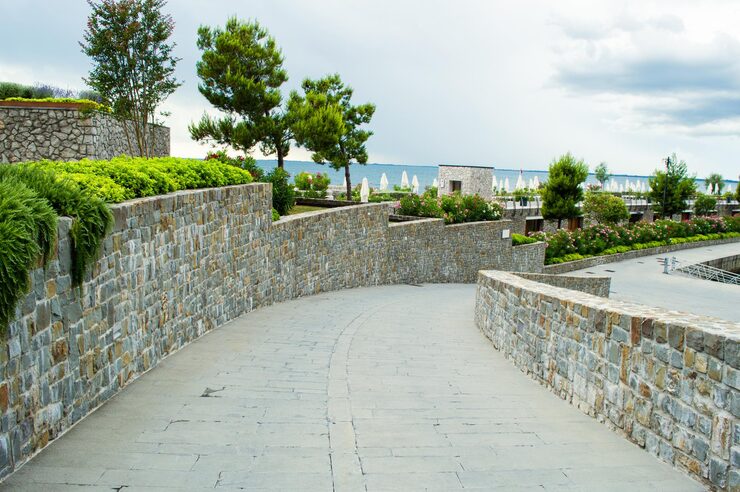
Where this suits Millis properties
Long wooded frontage
A drive running well back from the road through trees means the apron is judged on its own, with the house out of sight. It needs to hold up as a standalone entry statement.
Mature trees near the road
Root systems from established oaks and maples limit where excavation can happen, and shaded ground stays damp longer, making base and drainage work more important.
Older homes set well back
Farmhouses and older properties with existing stone or masonry benefit from edging that matches what is already there rather than newer, uniform-looking material.
So tar and chip suits a longer, gentler Millis drive with some room around it. It is a poor match for a short, steep or shared one, or one that opens straight onto the walk.
Questions we hear
How is a cobblestone apron different from repaving a driveway entrance?
Repaving replaces a failed surface with new asphalt in roughly the same footprint. A cobblestone apron changes the material and the edge detail entirely, usually as an upgrade rather than a repair, and involves excavation, base work, and edge restraint specific to stone rather than asphalt.
Will cobblestone edging survive snow plowing on a long Millis driveway?
A properly set edge restraint, tied into a compacted base, holds up to plow contact far better than an unedged gravel or lawn border. The edge detail is what takes the impact, not the stone surface itself.
Can new cobblestone match the look of an older stone wall or walkway already on the property?
Yes, within reason. Matching tone, texture, and scale to existing masonry is part of planning the work, and reclaimed or weathered stone often blends better with an older Millis property than brand-new material.
Does tree cover near the road affect how the apron is built?
It can. Root systems limit how close excavation can safely get to a mature tree, and shaded, damp ground needs a base built with that moisture in mind, since it will not dry out as quickly as an open, sunny area.
Next step
Call us at (413) 337-3772. Tell us about the lot, the slope and what you want the frontage to look like. We have been working in this area since 1988, and we will tell you plainly what suits your property.